Unisciti a noi in un viaggio nel mondo dei libri!
Aggiungi questo libro allo scaffale
Grey
Scrivi un nuovo commento Default profile 50px
Grey
Iscriviti per leggere l'intero libro o leggi le prime pagine gratuitamente!
All characters reduced
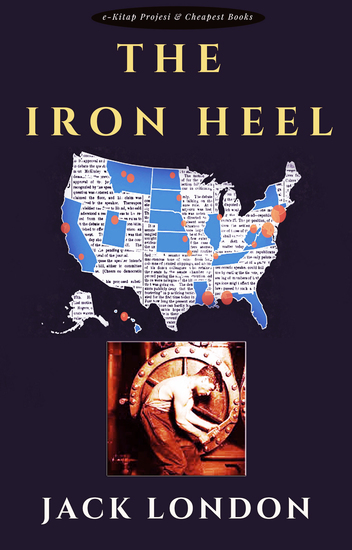
The Iron Heel - cover

The Iron Heel

Jack London

Casa editrice: E-Kitap Projesi & Cheapest Books

  • 0
  • 0
  • 0

Sinossi

The Iron Heel is a dystopian novel by American writer Jack London, first published in 1908. Generally considered to be "the earliest of the modern Dystopian," it chronicles the rise of an oligarchic tyranny in the United States. It is arguably the novel in which Jack London's socialist views are most explicitly on display.

To understand the full impact of the dystopia it is essential to contextualise the work within a historical framework. Jack London's novel, The Iron Heel was written during America's Technological Revolution, or Second Industrial Revolution, a second technological innovation in industries such as steel production, petroleum and electricity. These technological innovations, however, came at human expense and detriment. In the early twentieth century, the workplace was a dangerous place for the working classes. At the turn of century, life expectancy for the average male was only forty-nine years old. From 1906 to 1907, 526 workers died in "work accidents"; 195 of whom were steelworkers in a single county, Allegheny, Pennsylvania. As a result, a proliferation of socialism occurred across Europe and the United States, an ideology which is unmistakable throughout his text.

Real-life historical ideas, events and movements are represented in London's text through his use of faction, the blending of fact and fiction in literature. Many of the events mentioned dated before 1908, the time of The Iron Heel's writing and publication are factual (though London's interpretation places upon them subjective and political bias), providing the modern reader with a factual framework in which to contextualise the novel. For example, London cites Census figures from 1900 and references Robert Hunter's book Poverty to evidence the poverty of 10 million people in America. London seeks to prove to the masses that the existing society already bears the dystopian tropes of mass poverty and life-threatening factory conditions.
Disponibile da: 05/12/2023.
Lunghezza di stampa: 300 pagine.
Altri libri che potrebbero interessarti

  • Intelligence Isn't Enough - A Black Professional’s Guide to Thriving in the Workplace - cover

    Intelligence Isn't Enough - A...

    Carice Anderson, Joyce Roché

    • 0
    • 0
    • 0
    Master the balance between working on your career and working in it. Intelligence Isn't Enough helps Black professionals make strategic decisions and learn the unspoken rules for success. 
     
     
    Recounting the despair she felt as a frustrated young Black professional, Carice Anderson knows that many Black professionals are relying on their education alone to break into the workplace. In this book, she empowers young Black professionals everywhere with the right knowledge by exposing them to advice and little-known principles of career success from her interviews with thirty successful Black leaders. 
     
    Intelligence Isn't Enough is divided into six chapters that guide readers through what Anderson calls the six "major corporate muscles": 
     
    -	IQ 
    -	Mental attitude 
    -	People matters 
    -	Cultural intelligence 
    -	Personal branding 
    -	Communication 
     
    This book includes personal stories, quotes, lessons learned, and advice from both the author and Black leaders who have worked in some of the finest institutions across North America, Africa, and Europe. Readers will learn tips and tools to strategically chart their career paths and advance in the workplace for lifelong success.
    Mostra libro
  • Routes - cover

    Routes

    Rhiya Pau

    • 0
    • 0
    • 0
    At the core of this debut collection is a question – what is worth holding onto?
    Through poetic experiments that blend the academic and the artistic, Rhiya Pau queries complex characters and tender landscapes. Routes journeys from Ba's kitchen in Sonia Gardens to Independence hour in Delhi, across the pink shores of Nakuru, to meet a painter on Lee High Road.
    Celebrating fifty years since her community arrived in the UK, Pau chronicles the migratory histories of her ancestors and simultaneously lays bare the conflicts of identity that arise from being a member of the East African-Indian diaspora. In this multilingual discourse exhibiting vast formal range, Pau wrestles with language, narrative and memory, daring to navigate their collective fallibilities to architect her own identity.
    '[Routes]...holds up to the light the wisdom of the past, and asks what else is passed down along with it...a work of humane intelligence, formal experiment and linguistic verve' - Sarah Howe, Judge of Eric Gregory Awards 2022
    Mostra libro
  • The Prince - Strategy of Niccolo Machiavelli - cover

    The Prince - Strategy of Niccolo...

    Niccolo Machiavelli

    • 0
    • 0
    • 0
    🎧 Dive into the timeless wisdom of political strategy with "The Prince" by Niccolò Machiavelli, now available as an engaging audiobook!  
    Explore Machiavelli's profound insights on leadership, power, and governance, delivered straight to your ears in a captivating narration. Whether you're a student of history, a business professional, or simply intrigued by Machiavelli's philosophy, this audiobook offers invaluable lessons applicable to various aspects of life. 
    Discover strategies for achieving and maintaining authority, navigating through political landscapes, and understanding the intricate dynamics of power. Let Machiavelli's shrewd advice and cunning tactics inspire you to master the art of influence and succeed in your endeavors. Immerse yourself in this classic masterpiece, expertly brought to life in audio format, and elevate your understanding of leadership and governance. 
    Start listening to "The Prince" audiobook today and embark on a journey of strategic enlightenment!
    Mostra libro
  • Revolution - History of the French Revolution and Industrial Revolution - cover

    Revolution - History of the...

    Kelly Mass

    • 0
    • 0
    • 0
    These two titles are included in this audiobook: 
    1 - French Revolution: The Reign of terror was a period of considerable political and social change in France that started in 1789 with the starting of the Estates General and ended in the month of November 1799 with the development of the French Consulate. Tons of its ideas are now regarded important structures of liberal democracy, while terms like Liberté, égalité, and fraternité resurfaced in following revolts, which includes as the 1917 Russian Revolution, and stimulated efforts to eliminate oppression and attain universal suffrage. The causes are commonly accepted to be a mix of social, political, and financial concerns that the existing routine was not able to resolve. The Estates-General were assembled in May 1789 in reaction to considerable social discontent, and in the month of June they were become a National Assembly. The Assembly passed some remarkable reforms, and that includes the removal of feudalism, governmental control of the Catholic Church. 
    2 - Industrial Revolution: The Industrial Revolution was a period of shift in Britain, continental Europe, and the USA from around 1760 till at some point between 1820 and 1840, when new production innovations were introduced. The shift from hand to device production, new chemical and iron production strategies, increased use of steam and waterpower, the development of device tools, and the rise of the mechanized factory system were all part of this change. The Industrial Revolution also introduced a period of remarkable population growth. In regard to work, output value, and capital invested, fabrics were the most essential market throughout the Industrial Revolution. Textiles were also amongst the first markets to adopt modern production methods.
    Mostra libro
  • Cleopatra’s Needles - The Lost Obelisks of Egypt - cover

    Cleopatra’s Needles - The Lost...

    PhD Bob Brier

    • 0
    • 0
    • 0
    In the half-century between 1831 and 1881 three massive obelisks left Egypt for new lands. Prior to these journeys, the last large obelisk moved was the Vatican obelisk in 1586—one of the great engineering achievements of the Renaissance. Roman emperors moved more than a dozen, but left no records of how they did it. The nineteenth-century engineers entrusted with transporting the obelisks across oceans had to invent new methods, far from certain that they would work. As the three obelisks, bound for Paris, London, and New York, sailed towards their new homes, the world held its breath. Newspapers reported the obelisks' daily progress, complete with illustrations of the heroic deeds of the engineers and crews struggling under nearly impossible conditions. When the obelisks arrived safely in their new homes, bands played Cleopatra's Needle Waltz and silver obelisk pencils dangled from fashionable ladies' necks. 


    This turbulent era, caught up in obelisk mania, is recreated by Bob Brier in all its glory. Amid tales of engineering dexterity and naval endurance, the individuals involved in transporting the obelisks and receiving them in their future homes are brought to life through their letters, diaries, and newspaper articles. This book will fascinate all those interested in Egypt, its iconic monuments, and the history of great endeavor.
    Mostra libro
  • How Could I Believe in Santa Claus? - Philosophy in Everyday Life - cover

    How Could I Believe in Santa...

    Gilles Vervisch

    • 0
    • 0
    • 0
    How to be yourself at a party where you don’t know anyone?
    (Does the self exist?)
    Why does Grandma put a cap and a plaid sweater on her Yorkie?
    (Do animals have a reason?)
    How could I have stayed with such a stupid guy for so long?
    (Do we only desire things that we consider good?)
     
    When we hear “philosophy,” we sometimes think of incomprehensible or boring books. The very names of the authors are unpronounceable: Kierkegaard, Nietzsche, Heidegger. Living or dead, they often look like zombies. They are in their own world and use words that we do not always understand, like “idiosyncrasy,” “ontological,” or “transcendental.” In this book, we hope to remove these prejudices. Philosophy is not boring; it allows us to understand complex things in a simple way, and therefore it is never far from everyday life. It speaks to everyone. It is for everyone.
    Mostra libro