Unisciti a noi in un viaggio nel mondo dei libri!
Aggiungi questo libro allo scaffale
Grey
Scrivi un nuovo commento Default profile 50px
Grey
Iscriviti per leggere l'intero libro o leggi le prime pagine gratuitamente!
All characters reduced
California illustrated - Including a description of the Panama and Nicaragua routes - cover

California illustrated - Including a description of the Panama and Nicaragua routes

J. M. Letts

Casa editrice: Good Press

  • 0
  • 0
  • 0

Sinossi

In "California Illustrated," J. M. Letts presents a rich tapestry that captures the multifaceted essence of California through vivid illustrations and compelling prose. With a literary style that seamlessly blurs the lines between travel writing and visual storytelling, Letts invites readers on an immersive journey that celebrates the state's diverse landscapes, cultures, and histories. Utilizing a lyrical narrative interspersed with striking artwork, the book serves as both a geographical guide and an artistic homage to California, reflecting the complex interplay between nature and urbanism in this iconic region. J. M. Letts is renowned for his interdisciplinary approach, drawing from his background in both art and literature. His lifelong fascination with California's cultural diversity and environmental beauty is evident in his works, as he endeavored to document the intricate relationship between the inherent landscapes and the human experiences they inspire. Letts' previous travels and studies across the Golden State provide the foundation for this work, allowing him to convey a nuanced perspective shaped by personal exploration and historical context. "California Illustrated" is a must-read for those seeking to deepen their appreciation of the Golden State. Whether you are an art enthusiast, a lover of nature, or a history buff, Letts' masterful blend of visual and literary elements will resonate deeply, offering a refreshing and enlightening perspective on one of America's most iconic locations.
Disponibile da: 24/04/2025.
Lunghezza di stampa: 200 pagine.
Altri libri che potrebbero interessarti

  • Stonewall Brigade and Hood’s Brigade The: The History of the Most Famous Units in Robert E Lee’s Army of Northern Virginia during the Civil War - cover

    Stonewall Brigade and Hood’s...

    Editors Charles River

    • 0
    • 0
    • 0
    The Stonewall Brigade went on to fight in every major battle in the Eastern theater of the American Civil War, to the extent that of the 6,000 men who fought with the brigade over the course of four years, less than 200 remained by the time General Robert E. Lee surrendered at Appomattox Courthouse on April 9, 1865. They were organized, trained, and mentored by one of the most revered military leaders in American history, and they made a decisive impact on battles like First Manassas, the 1862 Valley Campaign, and Chancellorsville. The brigade was virtually a spent force by the end of the Battle of Spotsylvania Courthouse in May 1864, which took place nearly a year after Stonewall Jackson himself had been mortally wounded at Chancellorsville. 
    Organized in Richmond, Virginia on October 22, 1861, Hood’s Texas Brigade was one of the most formidable fighting forces of the Confederate States during the American Civil War. At times undisciplined, the men who comprised this brigade were a group of fearless and determined volunteers-turned-soldiers. Over the course of the Civil War, the Texas Brigade engaged over 4,000 men and was comprised of the only Texans to fight with General Robert E. Lee’s Army of Northern Virginia in the Eastern Theater. With the exception of Chancellorsville, these men fought in every major battle in the East, and they also participated in significant battles in the Western Theater. Of the more than 4,000 men who fought with the brigade over the course of the war, approximately 600 remained to surrender at Appomattox. The brigade suffered a horrific casualty rate of sixty-one percent and were lauded for their courage by men such as generals Thomas “Stonewall” Jackson, James Longstreet, and Lee.
    Mostra libro
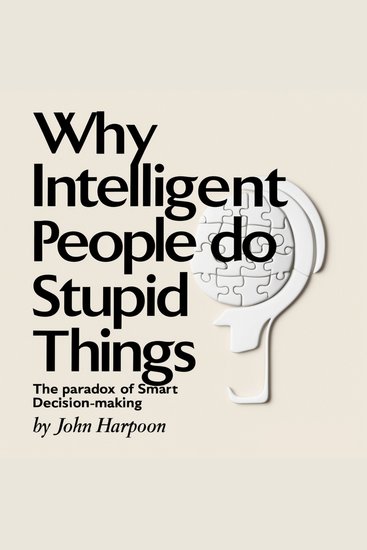
  • Why Intelligent People Do Stupid Things - The Paradox of Smart Decision-Making - cover

    Why Intelligent People Do Stupid...

    John Harpoon

    • 0
    • 0
    • 0
    Intelligence is often seen as the key to making sound decisions, yet many highly intelligent individuals find themselves making choices that defy logic and reason. This paradox is at the heart of why even the smartest people can sometimes act in ways that are seemingly irrational. Despite possessing vast knowledge, sharp problem-solving skills, and an ability to think critically, intelligent people often fall victim to cognitive biases, emotional triggers, and societal pressures that lead them to make poor decisions. Understanding why this happens requires an exploration into the intricate relationship between intelligence and decision-making. 
      
    At the core of this paradox lies the idea that rationality and intelligence do not always go hand in hand. While intelligence may increase the ability to process information and analyze complex scenarios, it does not always shield individuals from the cognitive biases that distort perception and judgement. In fact, many intelligent individuals are even more susceptible to these biases because they rely heavily on their analytical skills, assuming that their logic will always lead them to the right conclusion. However, this overreliance can blind them to the emotional and social factors that influence decision-making, causing them to overlook key details or make choices based on faulty assumptions. 
      
    Furthermore, decision-making is not solely a rational process; emotions play a crucial role in guiding our actions, and they can often override logic. Intelligent individuals are not immune to emotional influences such as stress, fear, or the desire for instant gratification. These emotions can cloud judgement, leading to impulsive decisions or the failure to consider long-term consequences. This is particularly true in high-pressure situations where the stakes are high, and the need to make quick decisions can push even the most intelligent person into making mistakes.
    Mostra libro
  • Displaced - A Holocaust Memoir and the Road to a New Beginning - cover

    Displaced - A Holocaust Memoir...

    Linda Schwab, Todd M. Mealy

    • 0
    • 0
    • 0
    Displaced is Linda Schwab’s Holocaust memoir, a retelling of her experience surviving 18 months in a man-made cave, another year as an exile in Poland and Germany, and three years as a refugee in a displaced persons camp. Just six years old when a band of Nazi soldiers arrived in her tiny shtetl in Myadel, Poland, Linda observed atrocities no child ever needs to witness.With her parents and two brothers, during the summer of 1942, Linda was forcibly relocated into a ghetto where most of the Jewish men were led to the nearby forest and killed in a pogrom. After the massacre, Linda escaped with her family into the Ponar Forest, but only after evading Polish nationals and Nazis that patrolled Poland's countryside. Deep in the woods, Linda’s family lived in a cave. They survived brutal winters, eluded partisan fighters that might force Linda’s father to leave the family, and remained out of sight from Nazis and Polish police, who at one point, came only feet from their dugout.Written with historian Todd M. Mealy during a time when Holocaust deniers aim to rehabilitate the Nazi ideology and as roughly 400,000 survivors remain with us, Displaced presents Schwab’s singular voice. Her narrative will help maintain—if not bolster—Holocaust knowledge, as her story of surviving the Polish wilderness during WWII and in a Displaced Persons Camp after the war is unique from most accounts. Displaced will inspire the rest of us to confront hatred in its many forms.
    Mostra libro
  • Edge of Knowledge The: How Philosophy Shapes Science - cover

    Edge of Knowledge The: How...

    Henry J. Howes

    • 0
    • 0
    • 0
    The topic "The Edge of Knowledge: How Philosophy Shapes Science" explores the profound relationship between two fields that, while distinct, have deeply influenced each other throughout history. Philosophy lays the foundational questions about existence, reality, and knowledge, while science provides empirical methods and evidence to explore those questions. Together, they push the boundaries of human understanding, with philosophy offering the framework for inquiry and ethics, and science delivering the tools for discovery and innovation. This interplay drives the evolution of ideas, fostering groundbreaking insights into the mysteries of the universe and the principles guiding human progress.
    Mostra libro
  • Meditations: Main Ideas & Key Takeaways - cover

    Meditations: Main Ideas & Key...

    Parth Sawhney

    • 0
    • 0
    • 0
    Ancient wisdom for modern challenges. 
    Meditations is a collection of private thoughts of the great Roman emperor Marcus Aurelius who reflected daily on the essential tenets of philosophy by writing personal notes to himself. In this way, he persuaded himself every night to stay on the right path by repeating to himself his observations and the lessons he learned touching on the core principles and beliefs of Stoic philosophy.  
    This book is, without doubt, one of the finest works of spiritual and ethical thought ever written, consisting of a series of spiritual exercises enriched with wisdom, practical instruction, and a profound grasp of human behavior. 
    In this Snapshort, you’ll learn how to:Apply the basic precepts of Stoicism to the contemporary world.Let go of anxiety and concentrate your efforts on your inner life.Fulfill leadership demands while keeping personal integrity and spiritual well-being in mind.
    Mostra libro
  • The Era of Revolution - 1775-1796 - cover

    The Era of Revolution - 1775-1796

    George Washington, Maximilien de...

    • 0
    • 0
    • 0
    Six speeches about freedom and revolution from the American, French and Irish revolutions.The first two speeches are from the American Revolutionary war (1775-1783). Patrick Henry’s “Give me Liberty or give me death” is recognized even today, two centuries since Henry spoke at the Second Virginia Convention to an audience including Thomas Jefferson and George Washington. The speech is credited with providing troops from Virginia for the revolutionary war.In the Newburgh Address, Washington and implores his army to put their faith in him. A mutiny was proposed because Congress has not paid them as promised. Washington needed to make clear to his generals that there was no option to surrender or turn away to unsettled lands, and that he was with them and on their side in the thick of both war and politics.Next is William Wilberforce’s Abolition Speech to the British parliament in 1789, the apex of a campaign that led to slavery being outlawed across the British Empire.Speeches from the French revolution then follow. First, there is the reaction from the aristocracy in England; a valediction from Edmund Burke, an MP in the British Parliament, on the beauty of Marie Antoinette and his sadness at her passing.Four speeches follow by Maximilien de Robespierre, a foundational member of the French Revolution, who laid down the political philosophy of liberty and the moral law over divinity and customary law. The speeches are filled with a passion for direct democracy and the rule of the people, not the elites.The volume ends with a more measured, but no less impassioned, address by the Irish lawyer and statesman John Curran. It was given in Curran’s defence of Archibald Rowan, who was sentenced to transportation to Australia for his treasonous activities fighting for Irish independence. While unsuccessful, this rallying cry for genuine self-determination and free speech captures the heart of the conflicts that defined the era.
    Mostra libro