Join us on a literary world trip!
Add this book to bookshelf
Grey
Write a new comment Default profile 50px
Grey
Subscribe to read the full book or read the first pages for free!
All characters reduced
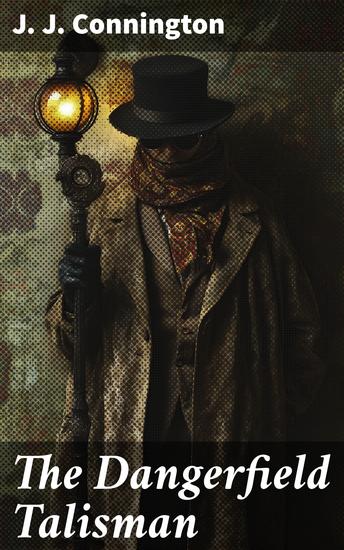
The Dangerfield Talisman - cover

The Dangerfield Talisman

J. J. Connington

Publisher: Good Press

  • 0
  • 0
  • 0

Summary

In 'The Dangerfield Talisman,' J. J. Connington crafts a masterful blend of mystery and adventure set against the backdrop of early 20th-century England. The novel intricately weaves elements of detective fiction, echoing the style of contemporaries like Agatha Christie but marked by Connington's unique narrative flair. With a plot that centers around a cursed talisman and its intertwining with the lives of its possessors, the text explores themes of greed, fate, and the supernatural, all while maintaining a sharp wit and complex character development that engages readers at every turn. J. J. Connington, born Alfred Walter Stewart, was a noted figure in early detective literature, often drawing from his background in mathematics and expertise in problem-solving to construct intricate plots. His personal fascination with archaeology and the occult undoubtedly influenced 'The Dangerfield Talisman,' infusing the narrative with a sense of authenticity and intrigue. Connington's rich understanding of human psychology and his meticulous attention to detail make this novel both a compelling read and a psychological study. This novel is highly recommended for fans of classic detective fiction and those who appreciate an intelligent blend of suspense and the supernatural. Connington's deft storytelling ensures that readers will be captivated from the first page to the last, making 'The Dangerfield Talisman' a significant contribution to the genre.
Available since: 03/02/2025.
Print length: 110 pages.

Other books that might interest you

  • Twenty-Six Men and a Girl - From their pens to your ears genius in every story - cover

    Twenty-Six Men and a Girl - From...

    Maxim Gorky

    • 0
    • 0
    • 0
    Alexei Maximovich Peshkov was born on 28th March 1868, in Nizhny Novgorod, Russia. 
    Better known as Maxim Gorky he was orphaned at 11 and ran away from home at 12.  At 19 he had already attempted suicide and thereafter travelled, by foot, across the Russian Empire for 5 years. 
    His first book ‘Essays & Stories’ in 1898 was a sensation and so began a long career as an author of short stories, novels and plays.  Gorky saw writing as a moral and political act that would help to change the unjust world around him.  He was an ardent early advocate of the emerging Marxist movement and publicly opposed the Tsarist regime leading several times to his arrest.  
    In 1904 he began his own theatre but the censor banned every play and Gorky was forced to abandon the project. 
    But Gorky was a financially successful author, editor, and playwright and gave monies to political parties as well as for civil rights and social reform.  The brutal shooting of workers, which set in motion the Revolution of 1905, pushed Gorky more decisively toward radical solutions.  
    In 1906 he went to the United States to raise funds for the Bolsheviks. Those experiences including a scandal over travelling with his lover and not his wife deepened his contempt for the ‘bourgeois soul.’ 
    Gorky now moved to Capri in Italy, both for health reasons and to escape the increasingly repressive times in Russia.  
    An amnesty for the 300th anniversary of the Romanov dynasty saw him return to Russia in 1914. His politics remained close to the Bolshevik cause.  But soon, after the 1918 revolution, his essays referred to Lenin as a tyrant for his senseless arrests and repression.  He was soon appealing to the outside world for food aid after the catastrophic crop failure. 
    In October 1921 Gorky returned to Italy, now in Fascist hands, and settled in Sorrento until 1932.  His health worsened with the onset of tuberculosis. 
    He wrote several successful books there but now decided to find an understanding with the communist regime. Stalin invited him home and his return was hailed as a major propaganda victory.  He was decorated with the Order of Lenin, and a province, a park, and various streets re-named in his honour. 
    But he had his faults too.  In 1933, Gorky co-edited a book on the White Sea-Baltic Canal and denied even a single prisoner died during its construction, but thousands had. As well, knowing that some Nazis were homosexual, a phrase was attributed to him that said ‘exterminate all homosexuals and fascism will vanish’.  Although he was himself was quoting another he was decidedly homophobic. 
    With the increase of Stalinist repression in 1935 Gorky was placed under unannounced house arrest. 
    Maxim Gorky died on the 18th June 1936 from pneumonia.  He was 68. 
    Stalin and Molotov were among those who carried Gorky's urn of ashes at his funeral.
    Show book
  • Heart of Darkness - cover

    Heart of Darkness

    Joseph Conrad

    • 0
    • 0
    • 0
    Are you ready to embark on a journey into the depths of human nature? Look no further than Joseph Conrad's classic novel, Heart of Darkness, brought to life in an unforgettable audiobook experience. 
     
    Set against the backdrop of the Belgian Congo in the late 19th century, Heart of Darkness tells the story of Charles Marlow, a steamboat captain tasked with venturing up the Congo River to find the enigmatic and notorious ivory trader, Kurtz. As Marlow makes his way deeper into the heart of the African continent, he confronts the brutal realities of imperialism and the dark, primal forces that lie within us all. 
     
    Narrated by a talented voice actor, this audiobook will transport you to the heart of Africa, immersing you in Conrad's haunting prose and vivid descriptions of the jungle landscape. You'll feel the humidity of the air and the murkiness of the river as Marlow navigates the dangerous terrain, and you'll experience the tension and suspense as he unravels the mystery of Kurtz. 
     
    But Heart of Darkness is more than just an adventure story. It's a powerful exploration of the human psyche and the darkness that lurks within us all. Conrad's vivid portrayal of the destructive forces of greed, imperialism, and the human capacity for evil will leave you contemplating the nature of humanity long after the audiobook has ended. 
     
    Perfect for fans of classic literature, adventure stories, and psychological thrillers, Heart of Darkness is a timeless masterpiece that will captivate and challenge listeners of all ages. Don't miss your chance to experience this literary classic in a whole new way with the Heart of Darkness audiobook.
    Show book
  • At Christmas Time - From their pens to your ears genius in every story - cover

    At Christmas Time - From their...

    Anton Chekhov

    • 0
    • 0
    • 0
    Anton Pavlovich Chekhov was born on 29th January 1860 in Taganrog, on the south coast of Russia.  
    His family life was difficult; his father was strict and over-bearing but his mother was a passionate story-teller, a subject Chekhov warmed to. As he later said; ‘our talents we got from our father, but our soul from our mother’.  
    At school Chekhov was distinctly average. At 16 his father mis-managed his finances and was declared bankrupt. His family fled to Moscow. Chekhov remained and eked out a living by various means, including writing and selling short sketches to newspapers, to finish his schooling. That completed and with a scholarship to Moscow University obtained he rejoined his family. 
    He was able to help support them by selling satirical sketches and vignettes of Russian lifestyles and gradually obtained further commissions. In 1884, he qualified as a physician and, although it earned him little, he often treated the poor for free, he was fond of saying ‘Medicine is my lawful wife, and literature is my mistress.’ 
    His own health was now an issue as he began to cough up blood, a symptom of tuberculosis.  Despite this his writing success enabled him to move the family into more comfortable accommodation.  
    Chekhov wrote over 500 short stories which included many, many classics including ‘The Kiss’ and ‘The Lady with a Dog’.  His collection ‘At Dusk’ won him the coveted Pushkin Prize when was only 26.  
    He was also a major playwright beginning with the huge success of ‘Ivanov’ in 1887.   
    In 1892 Chekhov bought a country estate north of Moscow. Here his medical skills and money helped the peasants tackle outbreaks of cholera and bouts of famine. He also built three schools, a fire station and a clinic.  It left him with less time for writing but the interactions with real people gained him detailed knowledge about the peasantry and their living conditions for his stories.  
    His most famous work, ‘The Seagull’ was received disastrously at its premiere in St Petersburg. It was later restaged in Moscow to highlight its psychological aspects and was a huge success. It led to ‘Uncle Vanya’, ‘The Three Sisters’ and ‘The Cherry Orchard’.  
    Chekhov suffered a major lung hemorrhage in 1897 while visiting Moscow. A formal diagnosis confirmed tuberculosis and the doctors ordered changes to his lifestyle.  
    Despite a dread of weddings the elusive literary bachelor quietly married the actress Olga Knipper, whom he had met at rehearsals for ‘The Seagull’, on 25th May 1901. 
    By May 1904 with his tuberculosis worsening and death imminent he set off for the German town of Badenweiler writing cheerful, witty letters to his family and assuring them his health was improving.  
    On 15th July 1904 Anton Chekhov died at Badenweiler.  He was 44.
    Show book
  • The Overtone - cover

    The Overtone

    D H Lawrence

    • 0
    • 0
    • 0
    'The Overtone' looks at a sterile marriage with no children and no spontaneous sexual feeling between the couple. Lawrence seems to lose interest in the story, although he introduces a younger woman, who walks away baffled at the end. His purpose seems to be to analyse the relationship between men and women in religious terms - Christianity for the women and the old Pan religion for the men. Lawrence produces some fine writing but the argument at the end of the story seems contrived.
    Show book
  • The House of the Dead - Or Prison Life in Siberia - cover

    The House of the Dead - Or...

    Fyodor Dostoyevsky

    • 0
    • 0
    • 0
    The semiautobiographical prison account of convict Aleksandr Petrovich Goryanchikov, from the author of Crime and Punishment.   Originally published in 1862, The House of the Dead is based on Fyodor Dostoyevsky’s own four-year imprisonment in Siberia for his involvement in the Petrashevsky Circle. This masterpiece of Russian literature begins with a nameless narrator coming upon former convict Aleksandr Petrovich Goryanchikov in a remote Siberian town. Previously a nobleman and landowner, Goryanchikov had been given a ten-year sentence of hard labor for the murder of his wife, a crime of passion sparked by jealousy. After Goryanchikov’s death, the narrator finds a handwritten record of his decade of penal servitude. From his first days in the barracks, friendless and broken in spirit, to the removal of his shackles and freedom, Goryanchikov portrays the experiences of a “lost tribe of men,” and the horrors and degradation they experienced.  “Episodic, rambling, full of keen and deliberately stretched-out character sketches, the book is the drama of a person working out how to reproduce prison life in prose: its longueurs, its diversions, its pleasures, traumas, and inurements  . . . If Dostoyevsky’s captors had found the ribald, cacophonous commonplace book he assembled out of overheard insults and tossed-off sayings during his time in prison, they would have recognized that they were dealing with a spirit not easily suppressed.” —The Paris Review  “I know no better book in all modern literature.” —Leo Tolstoy
    Show book
  • The Complete Alice in Wonderland Collection - Alice's Adventures in Wonderland Through the Looking-Glass The Hunting of the Snark & Alice's Adventures Under Ground - cover

    The Complete Alice in Wonderland...

    Lewis Carroll

    • 0
    • 0
    • 0
    The Complete Alice in Wonderland Collection includes the four original stories about Alice in Wonderland by Lewis Carroll.
    Alice's Adventures in Wonderland (commonly shortened to Alice in Wonderland) is an 1865 novel written by English author Charles Lutwidge Dodgson under the pseudonym Lewis Carroll. It tells of a young girl named Alice falling through a rabbit hole into a fantasy world populated by peculiar, anthropomorphic creatures. The tale plays with logic, giving the story lasting popularity with adults as well as with children. It is considered to be one of the best examples of the literary nonsense genre. Its narrative course, structure, characters, and imagery have been enormously influential in both popular culture and literature, especially in the fantasy genre.
    Included in this collection:
    1. Alice's Adventures in Wonderland (1865)
    2. Through the Looking-Glass (1871)
    3. The Hunting of the Snark (1876)
    4. Alice's Adventures Under Ground (1886)
    Show book