Unisciti a noi in un viaggio nel mondo dei libri!
Aggiungi questo libro allo scaffale
Grey
Scrivi un nuovo commento Default profile 50px
Grey
Iscriviti per leggere l'intero libro o leggi le prime pagine gratuitamente!
All characters reduced
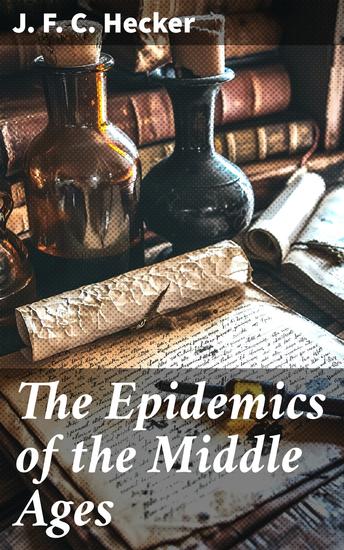
The Epidemics of the Middle Ages - The Black Death The Dancing Mania & The Sweating Sickness - cover

The Epidemics of the Middle Ages - The Black Death The Dancing Mania & The Sweating Sickness

J. F. C. Hecker

Traduttore B. G. Babington

Casa editrice: Good Press

  • 0
  • 0
  • 0

Sinossi

In "The Epidemics of the Middle Ages," J. F. C. Hecker presents a meticulous survey of the plagues and pestilences that ravaged Europe during the medieval period. Hecker's literary style is both scholarly and accessible, weaving together vivid historical narratives with epidemiological insights. Drawing upon an array of primary sources, Hecker contextualizes the social, economic, and cultural impacts of these epidemics, particularly the Black Death. His work is situated within a burgeoning historical discourse that seeks to understand the relationship between disease and societal transformation, effectively bridging the gap between medical history and the broader human experience. J. F. C. Hecker, a prominent physician and historian of the 19th century, was deeply influenced by the intellectual climate of his time, which favored empirical research and critical examination of past events. His background in medicine illuminated his exploration of medieval diseases, allowing him to address contemporaneous health crises with a historical lens. Hecker's passion for uncovering the realities behind epidemics reflects not just an academic pursuit, but a broader concern for public health. This book is essential reading for historians, medical professionals, and general readers alike, offering a profound understanding of how epidemics shaped medieval society and continue to resonate in contemporary debates about public health. Hecker's erudition and clarity reveal the enduring relevance of historical epidemics in our ongoing struggle against disease.
Disponibile da: 15/12/2023.
Lunghezza di stampa: 441 pagine.

Altri libri che potrebbero interessarti

  • For The Love of Autism - Stories of Love Awareness and Acceptance on the Spectrum - cover

    For The Love of Autism - Stories...

    Tamilka Lecheé Morales

    • 0
    • 0
    • 0
    In this first-of-its-kind compilation, autistics, influencers, parents, and siblings dare to unite and amplify their voices as one community.  Their goal: to change the narrative around autism.  Each author contributes an honest, raw account of a life changed by autism. Their struggles are not in vain. Their adversity is their advantage. They find healing through resilience and acceptance. They combat stigmas and face broken systems. With vulnerability, they share how love powers transformation. 
    Regardless of where you are on your journey,  these stories show why you should never give in and never give up. They share how we all have something to teach and something to learn. Love changes the equation. Love is at the center of recognizing that we are all uniquely human. This anthology reflects the beauty of autism and the power of acceptance. 
    The mastermind behind The Autism Hero Project, Tamika Lecheé Morales, reveals that love can transform hearts and minds in this love letter to the world. Find out what these authors do...for the love of autism.
    Mostra libro
  • Crimean War - cover

    Crimean War

    Kelly Mass

    • 0
    • 0
    • 0
    The Crimean War was an army war between Russia and an alliance of France, the Ottoman Empire, the UK, and Sardinia that lasted from October 1853 to February 1856. The rights of Christian minority in Palestine, which became part of the Ottoman Empire, were the instant reason for the war. The rights of Roman Catholics were promoted by the French, while those of the Eastern Orthodox Church were promoted by Russia.Longer-term elements included the Ottoman Empire's fall, the Russian Empire's development at the time of the preceding Russo-Turkish Wars, and the British and French desire to safeguard the Ottoman Empire to maintain the Show of Europe's power balance. It has been commonly observed that the causes, that included a difference over a type in one case, never ever suggested a "bigger confusion of purpose" but instead caused a dispute well-known for its "infamously inexperienced worldwide butchery."Let’s learn more about this often-forgotten war.
    Mostra libro
  • The Truth About Conspiracy Theories: How Conspiracy Myths Emerge Spread and Gain Followers – including the Debunking of Many Myths like Moon Landing Rothschilds or Chemtrails - cover

    The Truth About Conspiracy...

    Sebastian Brunow

    • 0
    • 0
    • 0
    THE TRUTH About CONSPIRACY THEORIES
    
    From the power, danger, and fascination of conspiracy theories: Why people believe what they shouldn't believe. What makes a conspiracy theory? Where do the myths come from, who spreads them, and why? Why are some people susceptible to obviously absurd things, and what mechanisms keep conspiracy believers so firmly in their grip? Dive into the world of outrageous stories, discover the most popular theories, and find out what really matters when confronting invented and unprovable things!
    Mostra libro
  • Battle of Kapetron The: The History and Legacy of the First Major Battle Between the Byzantine Empire and Seljuk Turks - cover

    Battle of Kapetron The: The...

    Editors Charles River

    • 0
    • 0
    • 0
    The Byzantine Empire existed for over a thousand years, with a history spanning from the division of the Roman Empire in 395 until the Ottoman conquest of Constantinople in 1453. It was formed from the previous Eastern Roman Empire, and during its long existence, the Byzantine inhabitants were very proud to call themselves Romans.  
    	However, many things changed during the long lifespan of the Byzantine Empire, starting with a Hellenization in the 6th century. The use of the Latin language diminished and Greek took its place, while the typical Roman culture gave way to a more Hellenistic one. The Hellenization of Byzantium was detrimental to the relationship with the Holy Roman Empire, and the Christian world from that point would be split in two. The subsequent strengthening of the Orthodox Church caused many civil wars and conflicts to arise during the centuries, which shattered and reshaped the territory time after time. By the end of the Byzantine Empire’s existence, the old age had weakened both the state and church, making it an easy target for invading forces.  
    	The most notable invaders were the Turkish-speaking Seljuks, led through a series of battles by Kutalmishouglu Suleiman, who supported different usurpers against the Byzantine emperor. The expansion of the Seljuks was so successful that when Suleiman died, he had put all of Bithynia under his control as well as several important harbor towns along the shores on the Asian side of Bosphorus. With that accomplishment, he had managed to separate the Byzantines living in Anatolia from their emperor in Constantinople. This immediately weakened the unity of the Byzantine Empire.  
    	Of all the conflicts that brought this state of affairs into being, few were as instrumental as the Battle of Kapetron, the culmination of one of the first major Seljuk raids into Byzantine territory.
    Mostra libro
  • Hoodoo for Health and Success - Powerful Spells to Attract Health Luck Job and Money you Deserves through the African Magic that Works - Beginner’s Guide - cover

    Hoodoo for Health and Success -...

    Amina Waynes

    • 0
    • 0
    • 0
    The magic that works for Health and Success, even if you are a beginner! 
    The essence of Hoodoo is the search for earthly advantage through magic. 
    Almost everyone aspires to be prosperous. You would probably like your financial goals to be achieved at the desired time, whether you have a regular day job or are a struggling entrepreneur attempting to make your business more competitive. But to have all this you also need to enjoy good health in your life. You know, this book will help you to bring both! 
    "Hoodoo for Health and Success" is an upgrade to the book "Hoodoo for Beginners". It will teach you to use Hoodoo to bring Health and Success with 30+ ready-to-use Spells and Rituals with instructions, that will help you materialize abundance, attract luxury, attract unanticipated financial gain, and bring good fortune. These spells can be cast by both beginners and experts. 
    This is a part of what you'll find in "Hoodoo for Health and Success":How to get started with HoodooTerminology of HoodooHow to get started with SpellsSpell Tools30+ Spells and Rituals: For Money For Health For Job For Luck 
    ...and much more! 
    Even if you've never practiced Hoodoo, thanks to Amina Waynes with this book you can attract Health and Success in your life and that of others!
    Mostra libro
  • Nok Civilization - The Mysterious Sculptor of Terracotta and West Africa's Early Culture - cover

    Nok Civilization - The...

    Rolf Hedger

    • 0
    • 0
    • 0
    The Nok civilization is one of the most fascinating and mysterious ancient cultures of West Africa. It flourished between approximately 1500 BCE and 500 CE, making it one of the earliest known complex societies in sub-Saharan Africa. The Nok people are best known for their remarkable terracotta sculptures, which provide valuable insights into their artistry, beliefs, and way of life. Despite their historical significance, much about the Nok civilization remains unknown, leaving archaeologists and historians to piece together their story from scattered artifacts and excavation sites. 
    The first discovery of Nok artifacts occurred in 1928, when British archaeologist Bernard Fagg came across a series of terracotta figurines in central Nigeria. These artifacts, found near the village of Nok, revealed an advanced artistic style that was distinct from any previously known African culture. The sculptures depicted human figures with intricate hairstyles, elaborate jewelry, and expressive facial features, suggesting a highly developed artistic tradition. This discovery marked the beginning of a deeper exploration into the Nok civilization, leading to further excavations that uncovered tools, pottery, and evidence of early ironworking. 
    One of the most significant aspects of Nok’s discovery was its role in the history of metallurgy in Africa. Archaeological findings suggest that the Nok people were among the earliest in West Africa to practice iron smelting, a technological advancement that contributed to agricultural development and societal growth. The presence of iron tools indicates that they engaged in farming, hunting, and trade, supporting the idea that Nok society was well-organized and economically active.
    Mostra libro