

Join us on a literary world trip!
Add this book to bookshelf
Grey
Write a new comment Default profile 50px
Grey
Subscribe to read the full book or read the first pages for free!
All characters reduced
Lost Art Treasures - cover

Lost Art Treasures

Isabella Hughes

Translator A Ai

Publisher: Publifye

  • 0
  • 0
  • 0

Summary

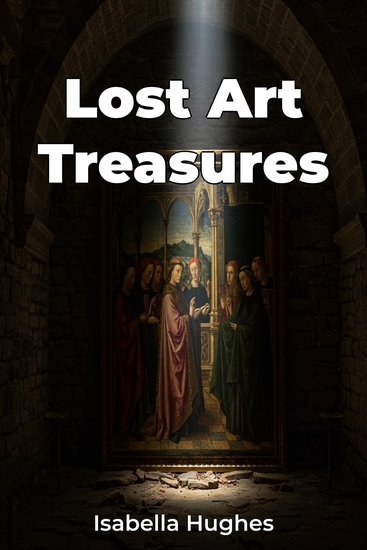
Lost Art Treasures explores the shadowy world of stolen, missing, and misplaced masterpieces, delving into the circumstances of their disappearances and the ongoing quests for their recovery. These treasures represent more than mere monetary value; they are vital pieces of our cultural heritage, and their absence leaves a significant void in our understanding of art history.

 
The book examines famous cases, such as the Just Judges panel of the Ghent Altarpiece and the Amber Room, highlighting the historical context, investigative processes, and the impact of these losses on the art world.

 
The book uniquely blends art history with elements of criminology and international law. It presents meticulously researched accounts, drawing from diverse sources like archival documents and forensic analysis, to reveal the sophisticated networks involved in art crime.

 
The narrative progresses from an introduction of the concept of art crime through detailed narratives of specific lost works, concluding with ethical implications of art recovery.
Available since: 02/21/2025.
Print length: 69 pages.

Other books that might interest you

  • The Rise of Socialism - 1884-1918 - cover

    The Rise of Socialism - 1884-1918

    William Morris, Annie Besant,...

    • 0
    • 0
    • 0
    The birth of liberation movements in the C19th saw a rise in fighting for the rights of workers.William Morris believed decries the belief “not that Commerce was made for man, but that man was made for Commerce”, with the profit motive that renders all work miserable when “It is right and necessary that all men should have work to do which shall be worth doing, and be of itself pleasant to do; and which should be done under such conditions as would make it neither over-wearisome nor over-anxious.”Edward Carpenter demands of those whose only question is “Does It Pay?” to know why any action is undertaken. On starting a farm, he found, “that if I was happy in the life..., and if we were cultivating genuine and useful products… that it might really pay me better to get 1%, than 10% with jangling and wrangling.”Annie Besant attacks a reactionary appeal to the ‘natural’ role of men and women by pointing out that it is equality of opportunity and representation that women want.Eduard Bernstein confronts a misunderstanding that people still have today. Marx and Engels realized in their lifetimes that society was further away than they initially thought from a genuine socialism – that many small revolutions would be necessary, and that a single grand rewriting of society could not work. The next writer also refers to it, in saying that “A few.. only know what Socialism is, and they are Socialists. The rest are opposed to it because the little they know about it is not true.”Eugene Debs rails against the approach government takes in promoting “equality” between capitalist and labourer.We end with Debs' response to being sentenced to ten years imprisonment, for the crime of “opposing a social order in which it is possible for one man who does absolutely nothing that is useful to amass a fortune, while millions work all the days of their lives secure barely enough for a wretched existence. .”
    Show book
  • Ancient Origins of Mesoamerica - Fresh Insights into the Civilizations of the Americas - cover

    Ancient Origins of Mesoamerica -...

    NORAH ROMNEY

    • 0
    • 0
    • 0
    Mexico, El Salvador, Honduras, Guatemala, and, to a smaller extent, Nicaragua, Costa Rica, Peru, and Bolivia in the Central Andes have deep-rooted roots in the subsoil of their pre-Columbian civilizations. The first chapters of the history of Latin America correspond to those who inhabited it before their first contact with Europeans. This is especially true in Mesoamerica. The objectives here are to show the development of the peoples and high civilizations of Mesoamerica before the establishment of the Mexica (Aztecs) in the Valley of Mexico (1325); second, to examine the key features of the political and socio-economic organization, and the artistic and intellectual achievements achieved during the period of rule of the Mexica (Aztecs) in the fourteenth and fifteenth centuries; and, finally, present a vision of the prevailing situation in Mesoamerica, on the eve of the European invasion (1519), between the solid continental masses of North and South America, Mesoamerica (that is, the area where it developed with High culture difficulties, which, at the time of contact with the Spaniards, reached an area of about 900,000 km2), has a varied isthmic character, with various geographical features, such as the gulfs of Tehuantepec and Fonseca, on the Pacific Ocean coast, the Yucatan Peninsula and the Gulf of Honduras.
    Show book
  • Pax Romana: A Captivating Guide to Ancient Rome during the Roman Peace Period - cover

    Pax Romana: A Captivating Guide...

    Captivating History

    • 0
    • 0
    • 0
    Did you know that the biggest territorial expansion in ancient Rome took place during the reign of its first emperor, who also ruled the longest out of all of the rulers prior to the fall of the Western Roman Empire? 
    The Roman Empire reached its zenith within the first two centuries of the fall of the Roman Republic, expanding its territory and spreading its influence well beyond the borders of Europe. During that time, a sort of global peace was achieved, which historians call the Pax Romana. But what exactly is the Pax Romana, and how does one delve into this huge, ever-expanding subject? 
    Like many other segments of Roman history, the Pax Romana is riddled with murky areas, contradictory information from contemporary sources, and fascinating archaeological finds. In this book, you’ll discover what made Rome tick during those roughly two hundred years of relative peace. 
    Throughout the pages of this tome, you’ll get brief glimpses of the reigns of many emperors who made the Pax Romana into what it was. Discover the Pax Romana’s long-term effects and how it managed to cement the Roman Empire as the go-to empire for many later civilizations to try and emulate. 
    Among other things, you’ll gain new knowledge on the following facts:How the empire evolved from the former republic and who the men were that brought about the changes What made the reign of each emperor uniqueWho the best emperors during the Pax Romana were, and which ones were considered the worstWhat role the provinces and territorial expansion played in the growth and development of the empireHow the imperial Romans were stratifiedWhat societal changes came about with the abolition of the republic and the return to a monarchic model 
    Scroll up, and give that “add to cart” button a click to learn more about the Pax Romana!
    Show book
  • From Stormy Seas to Plymouth's Shores - The Epic Tale of the First Thanksgiving - cover

    From Stormy Seas to Plymouth's...

    Dr. David K. Ewen

    • 0
    • 0
    • 0
    The topic of the first Thanksgiving is exciting to read about and learn because it offers a captivating and adventurous tale of courage, resilience, and cultural encounters. The daring journey of the Mayflower in 1620 sets the stage for an epic narrative as the Pilgrims face numerous challenges and overcome obstacles in their pursuit of religious freedom. The story of survival and cooperation between the Pilgrims and the Wampanoag tribe, led by Chief Massasoit, adds a heartwarming dimension to the historical account, capturing the spirit of unity and gratitude.The vivid descriptions of the Pilgrims' journey, the treacherous storm, and their eventual settlement in Plymouth, Massachusetts, paint a vivid picture of the hardships they endured. The first winter's unforgiving nature and the subsequent assistance from the Wampanoag create a sense of anticipation and emotional depth in the narrative. The eventual celebration of a triumphant three-day feast of thanksgiving not only marks the origin of Thanksgiving but also highlights the power of unity and mutual support in the face of adversity.Moreover, the historical context of Thanksgiving and its evolution into a beloved holiday in modern times add layers of complexity and relevance to the topic. Learning about the challenges and conflicts that followed the initial harmony between the Pilgrims and the Wampanoag encourages readers to engage in meaningful discussions about the impact of colonization and the importance of cultural understanding. The topic invites readers to reflect on the true essence of Thanksgiving, embracing themes of gratitude, empathy, and inclusivity.Overall, the captivating tale of the first Thanksgiving weaves together history, culture, and human experiences, making it a compelling and enriching subject to explore. By delving into this narrative, readers gain insights into the interconnectedness of the past and present, and the significance of fostering a more inclusive and equitable future.
    Show book
  • The Right People - The Social Establishment in America - cover

    The Right People - The Social...

    Stephen Birmingham

    • 0
    • 0
    • 0
    An enlightening and entertaining inside look at the lifestyles of America's extremely wealthy from the bestselling author of "Our Crowd"
    
    It's no secret that the rich are different from the rest of us. But the rich, as author Stephen Birmingham so insightfully points out, are also different from the very rich. There's Society, and then there's Real Society, and it takes multiple generations for families of the former to become entrenched in the latter. Real Society is not about the money—or rather, it's not only about the money—it is about history, breeding, tradition, and most of all, the name.


    The Right People is an engrossing and illuminating journey through the customs and habits of the phenomenally wealthy, from the San Francisco elite to the upper crust of New York's Westchester County. It is a marvelously anecdotal, intimately detailed overview of the lives of the American aristocracy: where they gather and dine; their games and sports, clubs and parties, friendships and feuds; their mating, marriage, and divorce rituals—a potpourri of priceless true stories featuring the Astors, Goulds, Vanderbilts, Vanderlips, Dukes, Biddles, and other lofty names from the pages of the Social Register.
    Show book
  • Summary of Barry Goldwater's The Conscience of a Conservative - cover

    Summary of Barry Goldwater's The...

    Falcon Press

    • 0
    • 0
    • 0
    Buy now to get the main key ideas from Barry Goldwater's The Conscience of a Conservative 
      
    The Conscience of a Conservative (1960) by Barry Goldwater defines the basis of the American conservative spirit. Goldwater’s manifesto, which reinvigorated the conservative movement in the 1960s, details its stance on vital issues such as education, farming, labor unions, states’ and civil rights, taxes, and most importantly freedom. It also offers conservative solutions to the political, economic, and social problems that plague America. Goldwater’s book is an essential read for anyone looking to understand the roots of the conservative movement in the USA.
    Show book
