Unisciti a noi in un viaggio nel mondo dei libri!
Aggiungi questo libro allo scaffale
Grey
Scrivi un nuovo commento Default profile 50px
Grey
Iscriviti per leggere l'intero libro o leggi le prime pagine gratuitamente!
All characters reduced
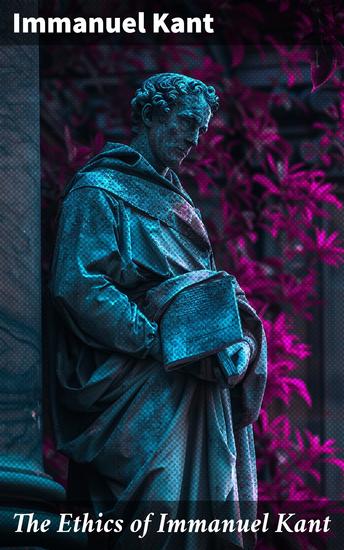
The Ethics of Immanuel Kant - Metaphysics of Morals - Philosophy of Law & The Doctrine of Virtue + Perpetual Peace + The Critique of Practical Reason: Theory of Moral Reasoning - cover

The Ethics of Immanuel Kant - Metaphysics of Morals - Philosophy of Law & The Doctrine of Virtue + Perpetual Peace + The Critique of Practical Reason: Theory of Moral Reasoning

Immanuel Kant

Traduttore Thomas Kingsmill Abbott, William Hastie

Casa editrice: Good Press

  • 0
  • 0
  • 0

Sinossi

In "The Ethics of Immanuel Kant," the reader is invited into the intricate moral philosophy that has profoundly influenced modern ethical discussions. Kant meticulously delineates his deontological ethics, emphasizing the significance of duty, autonomous will, and the categorical imperative. His literary style is marked by rigorous argumentation and a meticulous structure, reflecting his Enlightenment context where reason was revered as the foundation of human morality. Kant's work invites a critical examination of morality beyond mere consequentialism, asserting that moral laws must be universalizable and act as the guiding force in human actions. Immanuel Kant, a pivotal figure in Western philosophy, developed his ethical theory during a time of societal upheaval and intellectual ferment at the onset of the modern age. His educational background in mathematics and logic profoundly shaped his philosophical inquiries. Kant grappled with the implications of free will, rationality, and the nature of human existence, leading him to this seminal work that seeks to establish an ethical framework grounded in reason, rather than empirical consequences. Readers seeking to engage with fundamental questions of morality and human conduct will find "The Ethics of Immanuel Kant" essential. Its enduring relevance offers profound insights into ethical reasoning applicable not only in philosophical discourse but also in contemporary moral dilemmas. This text serves as a cornerstone for anyone wishing to explore the interplay between freedom, duty, and ethical imperatives, making it a vital addition to the library of any serious student of philosophy.
Disponibile da: 08/01/2024.
Lunghezza di stampa: 805 pagine.

Altri libri che potrebbero interessarti

  • Beyond Ethnic Loneliness - The Pain of Marginalization and the Path to Belonging - cover

    Beyond Ethnic Loneliness - The...

    Prasanta Verma

    • 0
    • 0
    • 0
    Foreword INDIES Book of the Year Award Finalist
    "So what are you? Go back where you belong!"
    Majority white American culture has historically marginalized people of color, who at times feel invisible and alienated and at other times are traumatized by oppression and public discrimination. This reality leads to a particular kind of aloneness: ethnic and racial loneliness.
    An Indian American immigrant who grew up in white Southern culture, Prasanta Verma names and sheds light on the realities of ethnic loneliness. She unpacks the exhausting effects of cultural isolation, the dynamics of marginalization, and the weight of being other. In the midst of disconnection and erasure, she points to the longing to belong, the need to share our stories, and the hope of finding safe friendships and community. Our places of exile can become places where we find belonging—to ourselves, to others, and to God.
    Mostra libro
  • Parmenides - The Philosopher on the Nature of Being - cover

    Parmenides - The Philosopher on...

    Hector Davidson

    • 0
    • 0
    • 0
    Parmenides of Elea stands as one of the most pivotal figures in the history of Western philosophy. His contributions, particularly in metaphysics and epistemology, challenged the prevailing philosophical ideas of his time and laid the groundwork for later philosophical inquiries. Born in the late sixth or early fifth century BCE, Parmenides is best known for his poem On Nature, in which he articulates a radical vision of reality that denies change, multiplicity, and the reliability of sensory perception. His assertion that “what is, is” and “what is not, is not” forms the core of his philosophical system, establishing the principle that true being must be eternal, unchanging, and indivisible. 
    Prior to Parmenides, early Greek thinkers, particularly the Presocratics like Heraclitus and the Milesian philosophers, sought to explain the nature of reality through empirical observation and the identification of a fundamental substance or element underlying all things. Heraclitus, for example, famously posited that change and flux were the fundamental aspects of existence, encapsulated in the notion that “everything flows.” Parmenides, however, forcefully rejected this view, arguing that change and plurality were mere illusions. He insisted that the senses deceive us, leading to a mistaken belief in a world of becoming rather than a singular, unchanging being. His philosophical method, based on reason rather than empirical observation, introduced a new way of thinking that would profoundly influence later philosophical traditions. 
    The significance of Parmenides lies not only in the content of his arguments but also in the impact he had on subsequent thinkers. Plato, for instance, engaged extensively with Parmenidean thought, particularly in dialogues such as the Parmenides and Sophist, where he sought to reconcile the Eleatic notion of an unchanging reality with the apparent diversity of the world.
    Mostra libro
  • AUSCHWITZ CHILDREN AND MENGELE EXPERIMENTS - The Immoral and Atrocious Research on Children in the Auschwitz Concentration Camp during World War II - cover

    AUSCHWITZ CHILDREN AND MENGELE...

    Jack Stew Barretta

    • 0
    • 0
    • 0
    In the name of humanity, that was the explanation of Dr. Claus Karl Schilling for the execution of malaria experiments on 1,200 inmates of the Dachau concentration camp during the Second World War. The reputable Schilling had come to Dachau with the personal permission of the Reichsführer-SS Heinrich Himmler in 1942 because he could use the prisoners as research subjects without the restriction of obtaining their consent. Schilling was not an exception.  
    Many Nazi doctors seized the unique opportunity to execute human experiments without legal and ethical restrictions during the war. The SS and the Wehrmacht either initiated or supported the research of the Nazi doctors. The central question that puzzled jurists and scientists is how these doctors, who were educated to heal people, could execute human experiments and deliberately harm and even kill people. To some scientists, their acts stand out as ‘exemplars of evil.’ This judgment is based on the fact that prisoners did not give their informed consent, the cruel and sometimes sadistic character of the experiments, and because never before in medical experiments was the death of the research subjects a central element of the research design. Many people think that ‘science went mad’ in the Third Reich and that Nazi doctors who committed these crimes were pseudo-scientists, sadists, and even monsters. However, thinking these perpetrators were madmen or monsters is a false explanation.  
    It is confronting to know that physicians belonging to the most advanced medical community in the world at the time, who had sworn to ‘do no harm, ' could commit these crimes. 
    On this trail, Dr. Josef Mengele’s pseudo-scientific research at the Auschwitz concentration camp during World War II led to immeasurable suffering among the camp’s children.
    Mostra libro
  • Aokigahara: The Truth Behind Japan's Suicide Forest - cover

    Aokigahara: The Truth Behind...

    Tara A. Devlin

    • 0
    • 0
    • 0
    What really lies in the forest’s depths? 
    Aokigahara is a mystery. Born out of an explosion, its roots twist and turn, the dense trees seeming to swallow anything that enters it whole. In recent years it has gained renown as a “suicide forest,” but it wasn’t always this way. 
    Aokigahara: The Truth Behind Japan’s Suicide Forest is fully researched from Japanese sources and looks at the history of the Sea of Trees, how it came to be, and why it became known worldwide as a popular suicide spot. It looks at why people choose the forest, the procedures the police follow when a body is discovered, and how the government is trying to turn its current image on its head. 
    Delve into the truth behind many of the forests terrifying legends, and discover why Aokigahara isn't just a “suicide forest,” but an important part of Japan’s spiritual and cultural history. 
    Get ready to enter the Sea of Trees and uncover the real truth hiding in its dark depths.
    Mostra libro
  • Vijayanagara Empire - Hampi's Glorious Past and the Last Hindu Kingdom - cover

    Vijayanagara Empire - Hampi's...

    Rolf Hedger

    • 0
    • 0
    • 0
    The Vijayanagara Empire emerged as one of the most significant and powerful dynasties in Indian history, rising at a time when the Indian subcontinent was fragmented and facing threats from expanding Islamic sultanates. Its foundation in the 14th century was a turning point that not only established a strong Hindu kingdom in southern India but also laid the groundwork for a cultural and economic renaissance. 
    The origins of Vijayanagara trace back to the political instability of the Deccan region. The Delhi Sultanate had extended its influence into the south, leading to the weakening of older Hindu kingdoms such as the Kakatiyas, Hoysalas, and Pandyas. Amid this turmoil, two brothers, Harihara and Bukka, originally serving under the Kakatiya rulers, rose to prominence. After being captured and later released by the Delhi Sultanate, they sought guidance from the sage Vidyaranya, who inspired them to establish a strong Hindu kingdom to resist further invasions. In 1336, they founded the city of Vijayanagara on the banks of the Tungabhadra River, marking the birth of the empire. 
    From its inception, the Vijayanagara Empire was strategically positioned to thrive. The Tungabhadra River provided a natural defensive barrier, while the rocky terrain of Hampi served as a formidable protection against enemy invasions. The early rulers focused on consolidating power, expanding their territories, and strengthening their military capabilities. Under Harihara I, the empire extended its control over parts of Karnataka and Andhra Pradesh, securing key trade routes and fortifying its defenses.
    Mostra libro
  • Kleptocrats and the Hidden Game: Unmasking America's Untold Money Secrets - "Unveil America's financial mysteries! Our engaging audiobook reveals untold money strategies for optimal wealth success" - cover

    Kleptocrats and the Hidden Game:...

    Micah Wellwood

    • 0
    • 0
    • 0
    Kleptocrats and the Hidden Game: Unmasking America's Untold Money Secrets 
    ⭐⭐ Simplified Guide & Explanations Included ⭐⭐ 
    Are you eager to enhance your career and deepen your understanding by uncovering powerful truths about wealth and accountability today? 
    Do you seek a thorough guide that encompasses everything necessary to grasp the intricate world of financial secrets?  
    Look no further! 
    This guide is your ultimate resource, crafted to enrich your comprehension, hone your skills, and provide practical exercises. With this, you are set up for success. 
    Updated to reflect the latest insights and structures in the realm of wealth and accountability. 
    Key highlights of this enhanced guide: 
    - In-depth insights into the hidden dynamics of wealth and accountability   
    - Comprehensive explanations of financial principles and practices   
    - Effective strategies for preparing and navigating through the complexities of wealth management   
    Our guide stands out due to its extensive coverage, ensuring you are well-equipped for success. Concepts are explored with clarity rather than glossed over. 
    Please note that this guide is an independent resource and is not connected to any official financial authority. 
    Crafted with a clear layout and easy-to-understand language, our guide ensures seamless transitions between subjects. Bid farewell to convoluted jargon and welcome straightforward, precise, and technically accurate content. 
    So, why wait? Click the BUY NOW button, secure your guide, and start your journey towards unlocking the secrets of wealth and accountability today!
    Mostra libro