Unisciti a noi in un viaggio nel mondo dei libri!
Aggiungi questo libro allo scaffale
Grey
Scrivi un nuovo commento Default profile 50px
Grey
Iscriviti per leggere l'intero libro o leggi le prime pagine gratuitamente!
All characters reduced
Lost Illusions (Complete Edition) - Enriched edition The Two Poets A Distinguished Provincial at Paris & Eve and David - cover

Lost Illusions (Complete Edition) - Enriched edition The Two Poets A Distinguished Provincial at Paris & Eve and David

Honore de Balzac

Traduttore Ellen Marriage

Casa editrice: Musaicum Books

  • 0
  • 0
  • 0

Sinossi

In Honoré de Balzac's landmark work, 'Lost Illusions (Complete Edition),' readers are immersed in the world of Lucien de Rubempré, a young poet from the provinces who dreams of literary success in the vibrant Parisian literary scene. Balzac's prose is characterized by its realism and attention to detail, providing a vivid depiction of 19th-century French society. The novel delves into themes of ambition, betrayal, and the consequences of sacrificing one's integrity in pursuit of success. Balzac's complex characters and intricate plotlines elevate 'Lost Illusions' to a masterpiece of French literature. The book's intricate narrative structure and astute commentary on human nature make it a must-read for fans of classic literature. Honoré de Balzac's own experiences as a struggling writer in Paris likely influenced the themes and characters in 'Lost Illusions.' His profound understanding of the literary world and the pressures faced by aspiring writers adds depth to the novel's exploration of artistic ambition and disillusionment. Balzac's dedication to capturing the essence of French society through his writing solidifies his reputation as one of the most influential novelists in literary history. For readers seeking a rich and immersive literary experience, 'Lost Illusions (Complete Edition)' is a poignant and thought-provoking masterpiece that continues to resonate with audiences today. Balzac's keen observations of human nature and society make this novel a timeless classic worthy of exploration.

In this enriched edition, we have carefully created added value for your reading experience:
- A comprehensive Introduction outlines these selected works' unifying features, themes, or stylistic evolutions.
- The Author Biography highlights personal milestones and literary influences that shape the entire body of writing.
- A Historical Context section situates the works in their broader era—social currents, cultural trends, and key events that underpin their creation.
- A concise Synopsis (Selection) offers an accessible overview of the included texts, helping readers navigate plotlines and main ideas without revealing critical twists.
- A unified Analysis examines recurring motifs and stylistic hallmarks across the collection, tying the stories together while spotlighting the different work's strengths.
- Reflection questions inspire deeper contemplation of the author's overarching message, inviting readers to draw connections among different texts and relate them to modern contexts.
- Lastly, our hand‐picked Memorable Quotes distill pivotal lines and turning points, serving as touchstones for the collection's central themes.
Disponibile da: 18/12/2019.
Lunghezza di stampa: 564 pagine.
Altri libri che potrebbero interessarti

  • How to Focus - A Monastic Guide for an Age of Distraction - cover

    How to Focus - A Monastic Guide...

    John Cassian, Jamie Kreiner

    • 0
    • 0
    • 0
    Distraction isn't a new problem. We're also not the first to complain about how hard it is to concentrate. Early Christian monks beat us to it. They had given up everything to focus on God, yet they still struggled to keep the demons of distraction at bay. But rather than surrender to the meandering of their minds, they developed powerful strategies to improve their attention and engagement. How to Focus is an inviting collection of their strikingly relatable insights and advice—frank, funny, sympathetic, and psychologically sophisticated. 


    This wisdom is drawn from John Cassian's Collationes, one of the most influential manuals for monks from late antiquity. The Collationes follow Cassian and his friend Germanus as they travel around Egypt, asking a series of sage monks how they can make their minds stronger. In response, these monks offer a range of techniques for increasing focus, including setting goals, training the body, managing the memory, using mantras, taking breaks, consulting others—and, most of all, being honest about yourself. As Cassian and Germanus eventually realize, we can't escape distraction—but we can learn how to confront it and, eventually, to concentrate. 


    Featuring an engaging new translation by Jamie Kreiner, How to Focus can help even the least monkish of us to train our attention on what matters most.
    Mostra libro
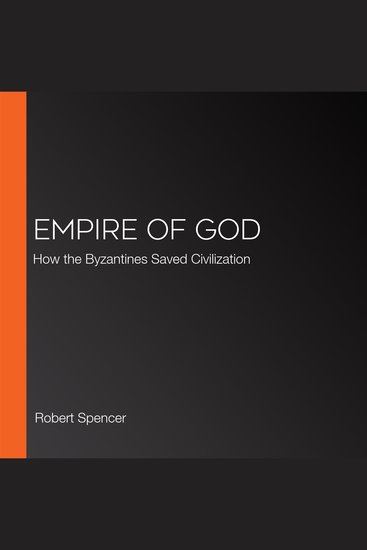
  • Empire of God - How the Byzantines Saved Civilization - cover

    Empire of God - How the...

    Robert Spencer

    • 0
    • 0
    • 0
    Western civilization is generally regarded as the child of Athens, Jerusalem, and Rome. That is, in the West, our philosophical and political thought is derived from that of the ancient Greeks; our Christian religion comes from the Jewish religion, and both of these came to us via the Roman Empire. 


    Western society has other forefathers as well: we would be unwise to give the Byzantine Empire short shrift. The ways in which it has influenced our world for the good, and indeed, created the parameters of our society at its healthiest and strongest, are insufficiently appreciated today. 


    If the United States were to last as long as the Roman Empire, including its Byzantine period, it would have to continue as an independent country until the year 2899. To maintain a unified nation state for over eleven hundred years is a remarkable achievement by any standard, and the Romans accomplished it while facing existential threats and efforts to extinguish their polity during virtually every period of their existence. Now, nearly six hundred years after the demise of the empire, its influence still resonates in a number of fields. 


    There is no arguing with success. It's time we took notice.
    Mostra libro
  • The Lifted Veil - cover

    The Lifted Veil

    George Eliot

    • 0
    • 0
    • 0
    George Eliot's 1859 novella, The Lifted Veil, departs radically from the grounded realism of her longer and better known works, such as Middlemarch and Daniel Deronda. Its tone calls to mind the works of middlebrow Sensationists, like Wilkie Collins (The Moonstone), and of some of the better known authors of Victorian era horror writings, such as Bram Stoker (Dracula) and Mary Shelley (Frankenstein).Eliot here explores mystical themes, considering the world of phenomena which are felt but not seen. Yet in doing so she suggests that the apparent clairvoyance of her main character, Latimer, may in fact be, at least in part, psychological expressions of his early life experiences. This view is supported by the fact that most of Latimer's vision-based predictions of how people will behave and events unfold do not, in the end, turn out as he had foretold.Much of this work's power and complexity lie in Latimer's relationship with Bertha, whom he ultimately, unhappily, marries. Bertha is the one person whose thoughts and feelings he is not able to read, raising the question: What is it about Bertha that renders her inaccessible to his psychic penetration – and what does this tell us about her, and about him.
    Mostra libro
  • Nazis after Hitler - How Perpetrators of the Holocaust Cheated Justice and Truth - cover

    Nazis after Hitler - How...

    Donald M McKale

    • 0
    • 0
    • 0
    The stories of thirty war criminals who escaped accountability, from a historian praised for his “well written, scrupulously researched” work (The New York Times).   This deeply researched book traces the biographies of thirty “typical” perpetrators of the Holocaust—some well-known, some obscure—who survived World War II. Donald M. McKale reveals the shocking reality that the perpetrators were rarely, if ever, tried or punished for their crimes, and nearly all alleged their innocence in Germany’s extermination of nearly six million European Jews. He highlights the bitter contrasts between the comfortable postwar lives of many war criminals and the enduring suffering of their victims, and how, in the face of exhaustive evidence showing their culpability, nearly all claimed ignorance of what was going on—and insisted they had done nothing wrong.   “McKale ends the book with a haunting question: whether life would be different today if the Allies had pursued Holocaust criminals more aggressively after WWII. History buffs and students of the Holocaust will be fascinated.” ―Publishers Weekly   “Gripping and important reading.” —Eric A. Johnson, author of What We Knew 
    Mostra libro
  • The Self - A Very Short Introduction - cover

    The Self - A Very Short...

    Marya Schechtman

    • 0
    • 0
    • 0
    'Know thyself' is said to have been one of the maxims carved into the Temple of Apollo at Delphi. On the face of it, this does not seem like a very difficult task. My self is with me at every moment of every day, I have access to its inner thoughts and feelings, and I am hardly liable to mistake someone else for me. At the same time, however, the self is surprisingly elusive and opaque. Our understanding of the self is replete with puzzles and paradoxes: I cannot be anyone but who I am, and yet everyone will acknowledge that there are circumstances in which being oneself is a difficult task. If I change enough, I can be said to have become a different person. I cannot get away from myself, and yet I can find and lose myself. 


    In this Very Short Introduction, Marya Schechtman uses insights from philosophy, psychology, psychiatry, sociology, and popular thought to consider some of the most compelling and puzzling questions about the self, including questions about what kind of object a self is if it is an object at all, what it means to be oneself and why it is important, what kinds of changes the self can and cannot survive, whether a self can be separated from its body, whether more than one self can exist in a single body, and what role engagement with the environment and with other selves plays in constituting and maintaining the self.
    Mostra libro
  • Instructions to His Generals - The Military Philosophy of Frederick the Great - cover

    Instructions to His Generals -...

    Frederick the Great, Tim Zengerink

    • 0
    • 0
    • 0
    What if you could master the art of leadership, inspire loyalty, and achieve victory through strategy and discipline? 
    Instructions to His Generals: The Military Philosophy of Frederick the Great presents the timeless wisdom of one of history’s greatest military leaders, thoughtfully adapted for today’s listeners. 
    Frederick the Great, King of Prussia, distilled his strategies and leadership principles into concise instructions for his generals. His insights provide a practical roadmap for military success, effective leadership, and strategic thinking. Beyond the battlefield, these principles offer profound lessons for modern leaders, strategists, and anyone seeking success through preparation and discipline. 
    This isn’t just a military text—it’s a guide to mastering leadership, building confidence, and achieving success in the face of challenges. 
    What You’ll Discover: 
    - Strategic Leadership: Inspire loyalty, build disciplined teams, and lead decisively with preparation and adaptability. 
    - The Art of Strategy: Gain insights into planning, executing campaigns, and succeeding through calculated decisions. 
    - Discipline and Adaptability: Embrace preparation, resilience, and flexibility to overcome obstacles. 
    - Clear, Accessible Language: Frederick’s timeless instructions are presented in a modernized format for today’s leaders. 
    Frederick the Great’s Instructions offers a masterclass in leadership, strategy, and discipline. His principles continue to inspire leaders and professionals striving to succeed in a competitive world. 
    Imagine having the tools to lead decisively, adapt to challenges, and inspire confidence in those you lead. 
    Download your copy today and transform your approach to leadership with Frederick the Great’s timeless wisdom.
    Mostra libro