Unisciti a noi in un viaggio nel mondo dei libri!
Aggiungi questo libro allo scaffale
Grey
Scrivi un nuovo commento Default profile 50px
Grey
Iscriviti per leggere l'intero libro o leggi le prime pagine gratuitamente!
All characters reduced
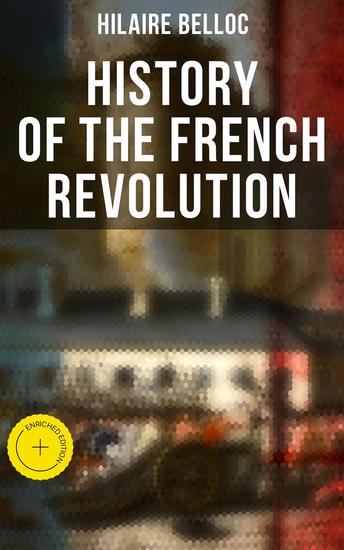
History of the French Revolution - Enriched edition - cover

History of the French Revolution - Enriched edition

Hilaire Belloc

Casa editrice: Musaicum Books

  • 0
  • 0
  • 0

Sinossi

In "History of the French Revolution" by Hilaire Belloc, the author provides a detailed account of one of the most crucial events in European history. Belloc's literary style is scholarly yet engaging, offering readers a thorough exploration of the causes, events, and consequences of the French Revolution. Written in the early 20th century, Belloc's work reflects the historical context of his time and provides a unique perspective on this pivotal period. The book is a valuable resource for students and scholars interested in understanding the complex dynamics of the French Revolution. Hilaire Belloc, a renowned historian and writer, drew on his deep knowledge of European history to pen this comprehensive study of the French Revolution. His expertise and passion for the subject shine through in the thorough research and insightful analysis presented in the book. Belloc's background as a prolific author and political thinker adds depth and credibility to his examination of this transformative period. I highly recommend "History of the French Revolution" to anyone seeking a nuanced understanding of this pivotal moment in history. Belloc's meticulous research and eloquent writing make this book a must-read for those interested in political revolutions and their lasting impact on society.

In this enriched edition, we have carefully created added value for your reading experience:
- A succinct Introduction situates the work's timeless appeal and themes.
- The Synopsis outlines the central plot, highlighting key developments without spoiling critical twists.
- A detailed Historical Context immerses you in the era's events and influences that shaped the writing.
- A thorough Analysis dissects symbols, motifs, and character arcs to unearth underlying meanings.
- Reflection questions prompt you to engage personally with the work's messages, connecting them to modern life.
- Hand‐picked Memorable Quotes shine a spotlight on moments of literary brilliance.
- Interactive footnotes clarify unusual references, historical allusions, and archaic phrases for an effortless, more informed read.
Disponibile da: 04/01/2022.
Lunghezza di stampa: 136 pagine.

Altri libri che potrebbero interessarti

  • Meaning - A Very Short Introduction - cover

    Meaning - A Very Short Introduction

    Emma Borg, Sarah A. Fisher

    • 0
    • 0
    • 0
    Our ability to find meaning in things is one of the most important aspects of human life. But it is also one of the most mysterious. Where does meaning come from? What sorts of things have meaning? And how do we grasp the meaning others want to convey? Meaning: A Very Short Introduction is shaped by exploring possible answers to these questions. 


    Human societies have one particularly important device for expressing and sharing meaning: language. Since our words are paradigm examples of things which have meaning, in this book, Emma Borg and Sarah Fisher use meaning in language as a case study for exploring meaning more generally. They focus on three possible sources for word meaning: things in the world, things in the mind, and social practices, exploring the key approaches thinkers have put forward in each of these arenas. Finally, they end by looking at some concrete applications of the ideas and approaches introduced in the book.
    Mostra libro
  • Mastering Emotional Intelligence - Unraveling the Art of Understanding Navigating and Influencing Emotions in Yourself and Others - cover

    Mastering Emotional Intelligence...

    Vines Graener

    • 0
    • 0
    • 0
    Since the latter part of the twentieth century, breakthroughs in science, like advancements in brain imaging, have sparked a growing fascination with the intersection of emotions and neurobiology. Researchers have come to acknowledge the close connection between the brain and the immune system, the detrimental impact of chronic stress on the human body, and the significant correlation between emotions and health issues such as heart disease. 
    Before this scientific awakening, there was an undue emphasis on academic intelligence by researchers. This bias ignored the reality that intelligence is not a reliable predictor of success and happiness. Instead, emotional intelligence emerges as a more accurate indicator of life trajectory. It encompasses psychological resilience, the ability to persevere in the face of challenges, impulse control, and social skills like empathy. 
    Contrary to earlier beliefs that emotional intelligence was an inherent trait, recent research has revealed it to be a capacity rather than an absolute characteristic. Nevertheless, the formative stage for emotional intelligence is primarily in early childhood. A baby receiving nurturing care is more likely to develop a positive outlook, while a neglected baby may struggle with challenges later in life. Although tendencies toward optimism or pessimism take root early, they can still evolve later on, influenced by one's social network, as emotions tend to be contagious. 
    It's crucial to recognize that complete control over emotions is not feasible. Emotions are a result of the brain processing external feedback and are not consciously regulated. However, individuals can control how they respond to their emotions. The initial step in effective emotional management is being aware of one's emotions, forming the foundation for emotional intelligence.
    Mostra libro
  • Colombia's Economic Transformation - Historical Insights - cover

    Colombia's Economic...

    Anya Solace

    • 0
    • 0
    • 0
    Colombia's economic transformation has been a complex and dynamic process shaped by historical events, political decisions, and global economic trends. From its early indigenous trade systems to its current standing as one of Latin America's largest economies, Colombia's journey has been marked by periods of growth, crisis, and resilience. Understanding this transformation requires a deep dive into the key factors that have influenced its economy over the centuries. 
    The foundation of Colombia's economy was laid long before Spanish colonization. Indigenous communities engaged in agriculture, trade, and resource management, establishing early economic structures. However, the arrival of the Spanish in the early 16th century drastically altered the economic landscape. The Spanish introduced a mercantilist system that prioritized resource extraction, particularly gold, and forced indigenous labor into exploitative economic activities. This period also saw the beginnings of agricultural exports, as crops like sugar and tobacco became integral to the colonial economy. 
    Following independence in 1810, Colombia faced significant economic instability. The transition from colonial rule to a sovereign state disrupted established trade networks and led to political fragmentation. Wars of independence had devastated infrastructure and financial systems, leaving the new republic struggling to establish a stable economy. The 19th century saw slow economic progress, with regional economies developing independently and a reliance on agriculture persisting. Coffee emerged as Colombia's most valuable export by the late 19th century, setting the stage for greater economic integration and growth.
    Mostra libro
  • Decolonizing Language and Other Revolutionary Ideas - cover

    Decolonizing Language and Other...

    Ngũgĩ wa Thiong’o

    • 0
    • 0
    • 0
    Ngũgĩ wa Thiong'o was a towering figure in African literature, and his novels A Grain of Wheat; Weep Not, Child; and Petals of Blood are modern classics. Emerging from a literary scene that flourished in the 1950s and '60s during the last years of colonialism in Africa, he became known not just as a novelist—one who, in the late '70s, famously stopped writing novels in English and turned to the language he grew up speaking, Gĩkũyũ—but as a major postcolonial theorist. 


    In Decolonizing Language and Other Revolutionary Ideas, Ngũgĩ gives us a series of essays that build on the revolutionary ideas about language and its constructive role in national culture, history, and identity that he set out in his earlier work. 


    Intricate and deeply nuanced, this collection examines the enduring power of African languages in resisting both the psychic and material impacts of colonialism, past and present. 


    A brave call for discourse and immensely relevant to our present moment, Decolonizing Language and Other Revolutionary Ideas works both as a wonderful introduction to the enduring themes of Ngũgĩ's work as well as a vital addition to the library of the world's greatest and most provocative writers.
    Mostra libro
  • Mending Sunday - Embracing Differences in a Church Torn by Division - cover

    Mending Sunday - Embracing...

    Skot Welch

    • 0
    • 0
    • 0
    Diversity is God’s idea—and unity is how we honor God.Our heavenly Father calls us to unite, but Christians remain some of the most divided people on the planet. It seems we mistake God’s call for unity as a command for uniformity: We split along political and denominational lines and prefer our churches, neighborhoods, and other spaces to be filled with those most “like” ourselves.Our segregated habits may satisfy our need for comfort, but division breaks God’s heart. We are called to embrace the miracle of unity, when what was once separated due to difference comes together—when people from every group, nation, and tongue praise the name of Jesus.In Mending Sunday, Skot Welch offers a pathway for putting on the mind of Christ when it comes to diversity and division. God’s unity doesn’t mean giving up our unique identities and the gifts of ethnicity, family, language, or tradition. Rather, when we put Jesus at the center of our lives and communities, we experience a grace and power we’ve never before known. In a culture bent on division, a church that embraces differences becomes the biggest witness for Christ the world has ever seen.
    Mostra libro
  • Today Hong Kong Tomorrow the World - What China's Crackdown Reveals About Its Plans to End Freedom Everywhere - cover

    Today Hong Kong Tomorrow the...

    Mark L. Clifford

    • 0
    • 0
    • 0
    For 150 years as a British colony, Hong Kong was a beacon of prosperity where people, money, and technology flowed freely, and residents enjoyed many civil liberties. In preparation for handing the territory over to China in 1997, Deng Xiaoping promised that it would remain highly autonomous for fifty years. An international treaty established a Special Administrative Region (SAR) with a far freer political system than that of Communist China. 


    But as the halfway mark of the SAR's lifespan approaches in 2022, it is clear that China has not kept its word. Universal suffrage and free elections have not been instituted, harassment and brutality have become normalized, and activists are being jailed en masse. This tragic backslide has dire worldwide implications. 


    Today Hong Kong, Tomorrow the World tells the complete story of how a city once famed for protests so peaceful that toddlers joined grandparents became a place where police have fired tear gas, rubber bullets and even live ammunition at their neighbors, while pro-government hooligans attack demonstrators. A Hong Kong resident from 1992 to 2021, author Mark L. Clifford has witnessed this transformation firsthand. A powerful and dramatic mix of history and on-the-ground reporting, this book is the definitive account of one of the most important geopolitical standoffs of our time.
    Mostra libro