Unisciti a noi in un viaggio nel mondo dei libri!
Aggiungi questo libro allo scaffale
Grey
Scrivi un nuovo commento Default profile 50px
Grey
Iscriviti per leggere l'intero libro o leggi le prime pagine gratuitamente!
All characters reduced
Memoirs of the Confederate War for Independence - Civil War Memories Series - cover

Memoirs of the Confederate War for Independence - Civil War Memories Series

Heros von Borcke

Casa editrice: DigiCat

  • 0
  • 0
  • 0

Sinossi

Heros von Borcke's "Memoirs of the Confederate War for Independence" offers a unique perspective on the American Civil War through the eyes of a Prussian military officer who served as a cavalry lieutenant under General J.E.B. Stuart. Written with vivid detail and a compelling narrative style, the memoir combines personal anecdotes with military strategy and observations, providing readers with a window into the complexities of the conflict. The work is situated in the context of 19th-century military literature, blending memoir and history, and serves to illuminate not only the battles and tactics of the Confederacy but also the culture and ethos of the Southern states during a time of strife. Born in 1835, von Borcke's experience in the Prussian Army combined with his deep admiration for the Confederate cause shaped his narrative both as an observer and participant. His account reflects the complexities of loyalty, foreign perspectives on American society, and the broader implications of war. His insights echo the struggles of a burgeoning nation while simultaneously providing a European vantage point on American ideals and conflict. "Memoirs of the Confederate War for Independence" is highly recommended for historians, civil war enthusiasts, and anyone intrigued by the personal stories that constitute the fabric of history. Von Borcke's engaging prose and keen observations not only enhance our understanding of the Civil War but also serve as a poignant reminder of the personal sacrifices made during that tumultuous era.
Disponibile da: 08/11/2023.
Lunghezza di stampa: 351 pagine.

Altri libri che potrebbero interessarti

  • How to Recognize Toxic Anxiety - cover

    How to Recognize Toxic Anxiety

    Olivia Werner

    • 0
    • 0
    • 0
    [How to Recognize Toxic Anxiety] delves into the intricate landscapes of modern anxiety with unflinching precision and intimate understanding. Through lyrical prose that echoes the quiet moments of psychological struggle, this groundbreaking exploration maps the subtle territories where anxiety infiltrates daily life. With remarkable attention to detail, the book illuminates how anxiety transforms ordinary experiences—from morning coffee rituals to midnight thoughts—into complex negotiations with fear. Drawing on rich metaphorical frameworks of weather patterns, architecture, and internal chemistry, it offers readers a revolutionary lens for understanding their own experiences of anxiety. What sets this work apart is its masterful balance of scientific insight and emotional resonance, weaving together the biological underpinnings of anxiety with the deeply personal experience of navigating its presence in contemporary life. The narrative doesn't just describe anxiety; it captures its essence in the spaces between heartbeats, in the pauses between breaths, in the moments between thoughts—making visible what has long remained unseen.
    Mostra libro
  • Albert Camus - Existentialism the Absurd and rebellion - cover

    Albert Camus - Existentialism...

    50 50minutes

    • 0
    • 0
    • 0
    Keen to learn but short on time? Find out everything you need to know about the life and work of Albert Camus in just 50 minutes with this straightforward and engaging guide!Albert Camus is one of the most celebrated and influential writers of the 20th century. From humble beginnings in Algeria under French rule, he garnered international recognition for his novels, short stories, plays and essays, and was awarded the Nobel Prize in Literature in 1957. Camus was also a profoundly politically engaged writer: he took part in the French Resistance during the Second World War, denounced totalitarianism and injustice in all its forms, and campaigned in favour of the abolition of the death penalty. His writing grapples with universal philosophical themes such as the ultimate meaninglessness of life, and as such still resonates with many people today.In this book, you will learn about:• Camus's childhood and the historical context in which his books were written• The main themes and ideas explored in Camus's work, including the Absurd and the necessity of rebellion• Camus's influence on later writers and thinkers, both in France and abroadABOUT 50MINUTES.COM|Art & LiteratureThe Art & Literature series from the 50Minutes collection aims to introduce readers to the figures and movements that have shaped our culture over the centuries. Our guides are written by experts in their field and each feature a full biography, an introduction to the relevant social, political and historical context, and a thorough discussion and analysis of the key works of each artist, writer or movement, making them the ideal starting point for busy readers looking for a quick way to broaden their cultural horizons.
    Mostra libro
  • Yearning - Race Gender and Cultural Politics 2nd Edition - cover

    Yearning - Race Gender and...

    Bell Hooks

    • 0
    • 0
    • 0
    For bell hooks, the best cultural criticism sees no need to separate politics from the pleasure of reading. Yearning collects together some of hooks's classic and early pieces of cultural criticism from the '80s. Addressing topics like pedagogy, postmodernism, and politics, hooks examines a variety of cultural artifacts, from Spike Lee's film Do the Right Thing and Wim Wenders's film Wings of Desire to the writings of Zora Neale Hurston and Toni Morrison. The result is a poignant collection of essays which, like all of hooks's work, is above all else concerned with transforming oppressive structures of domination.
    Mostra libro
  • The Child and the Curriculum - cover

    The Child and the Curriculum

    John Dewey

    • 0
    • 0
    • 0
    "The Child and the Curriculum" is a book written by John Dewey, an American philosopher, psychologist, and educational reformer, and published in 1902. The book is a collection of essays and lectures that explore Dewey's ideas about the relationship between the child and the curriculum in education. 
    Dewey argues that education should focus on the child's experiences and interests, rather than on a predetermined curriculum that is disconnected from the child's life. He advocates for a child-centered approach to education that emphasizes active learning, critical thinking, and problem-solving. 
    According to Dewey, the curriculum should be flexible and adaptable to the needs and interests of each child, rather than a fixed set of subjects that all students must learn. He also emphasizes the importance of hands-on, experiential learning, and the integration of subjects across disciplines. 
    Overall, "The Child and the Curriculum" is a seminal work in the field of education that continues to influence educational theory and practice today. Dewey's ideas about child-centered education, active learning, and the integration of subjects continue to shape the way educators think about teaching and learning
    Mostra libro
  • In These Streets - Reporting from the Front Lines of Inner-City Gun Violence - cover

    In These Streets - Reporting...

    Josiah Bates

    • 0
    • 0
    • 0
    Journalist Josiah Bates pulls back the curtain on a crisis that continues to plague the United States in this gripping narrative. Fueled by the convergence of the COVID-19 pandemic and social unrest, gun violence has surged to unprecedented levels, devastating marginalized communities and urban areas across the nation.  
     
    Bates embarks on a heart-wrenching journey, crisscrossing the country to meet victims, perpetrators, community activists, and renowned scholars. Through their powerful stories, he unearths the hidden causes behind the escalating gun violence epidemic. From the corrosive effects of poverty to the contentious debates surrounding policing and calls to defund law enforcement, Bates fearlessly navigates the intricate web of factors influencing gun violence. Through firsthand accounts and expert analysis, he exposes the systemic failures that perpetuate this cycle of destruction and delivers a powerful clarion call for change.  
     
    Bates amplifies rarely heard voices in this debate, including both victims and perpetrators of shootings, some of whom now work tirelessly to dismantle the violence in their communities. Their stories, alongside Bates’s unflinching reporting, illuminate a path toward long-term solutions. As the nation grapples with this relentless epidemic, Bates presents a compelling case for unity and action. In These Streets is a groundbreaking investigation that uncovers the deep-rooted causes of gun violence, empowering readers with the knowledge, empathy, and inspiration needed to drive meaningful transformation. 
     
    “If you want to understand gun violence but don’t know where to start, start here. Josiah Bates brings together gripping stories, solid research, and astute analysis—all in clear, readable language. By approaching violence as a problem to be solved and not an argument to be won, Bates leaves us with something in short supply these days: hope.”—Thomas Abt, author of Bleeding Out: The Devastating Consequences of Urban Violence—and a Bold New Plan for Peace in the Streets
    Mostra libro
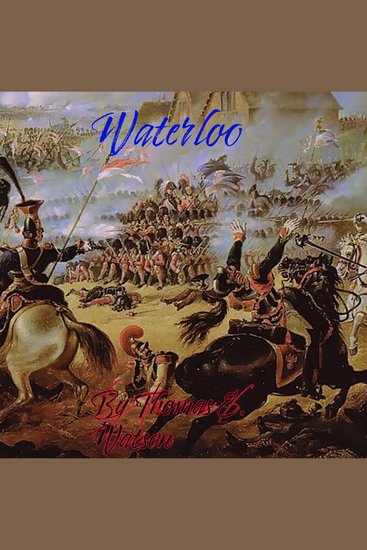
  • Waterloo - cover

    Waterloo

    Thomas E. Watson

    • 0
    • 0
    • 0
    Excerpt from Chapter One 
    In 1815 the Emperor was no longer a lean, sinewy, tireless, eternally vigilant human tiger—the Napoleon of Rivoli and Marengo. He was no longer the consummate General-in-Chief of Austerlitz and Wagram. The mysterious lethargy which had overwhelmed him at the critical hour of Borodino, when he withheld the order for the Old Guard to charge and convert the Russian defeat into a decisive disaster, had been the first visit of the Evil Genius which was to come again. The strange loss of the power to decide between two totally different lines of action, which, at the Château Düben had kept him idle two days, lolling on a sofa, or sitting at his writing-table tracing on the paper big school-boy letters, was to become a recurrent calamity, puzzling all who knew him, and paralyzing the action of his lieutenants in the most critical emergencies'. 
    At Leipsic the reins had fallen from his hands; only one permanent bridge over the deep river in his rear had been provided to let him out of the death trap; and when the strong currents of the rout tore through the frantic city, the great Napoleon drifted with the furious tide, whistling vacantly. 
    The same unexplainable eclipse of genius, which General E. P. Alexander described as occurring to Stonewall Jackson, in the Malvern Hill movements of our Civil War, happened to the French Emperor, time and again, after that first collapse at Borodino. 
    In Spain he ordered a madly reckless charge of his Polish Light Cavalry against the heights of Sommo Sierra, where the Spanish army was entrenched and where the position easily admitted of successful flanking, got his best troops wastefully butchered—and could not afterward remember who gave the order to charge! 
    In Dresden, in 1813, he had won a brilliant victory which needed only to be ruthlessly pushed; and he was pushing it with all his tremendous driving power when, in the twinkle of an eye, his Evil Genius descended upon him, took his strength away...
    Mostra libro