Join us on a literary world trip!
Add this book to bookshelf
Grey
Write a new comment Default profile 50px
Grey
Subscribe to read the full book or read the first pages for free!
All characters reduced
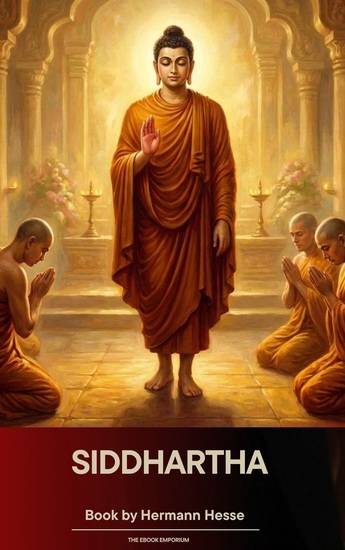
Siddhartha - cover

Siddhartha

Hermann Hesse

Publisher: The Ebook Emporium

  • 0
  • 0
  • 0

Summary

"Wisdom is not communicable. The wisdom which a wise man tries to communicate always sounds foolish."

Set in Ancient India during the time of the Buddha, Siddhartha tells the story of a young Brahmin who leaves his home, his family, and his privileged life to find the meaning of existence. His journey is not a straight line; it takes him from the asceticism of the forest-dwelling Samanas to the sensual temptations of the city, and from the heights of worldly wealth to the quiet humility of a ferryman's hut. Siddhartha learns that truth cannot be taught by a master—not even by the enlightened Gotama himself—but must be experienced through the "river" of life. Hesse's novel is a beautiful, meditative exploration of the unity of all things and the courage it takes to listen to one's own soul.

The Symbolism of the River: The most enduring image of the novel is the river, which Siddhartha eventually learns to "listen" to. It represents the eternal cycle of life—the idea that time is an illusion and that every moment contains the past, present, and future simultaneously. The river is both the path and the destination.

A Personal Path to Truth: The novel's power lies in its celebration of the individual. Siddhartha's ultimate realization is that "knowledge" can be passed on, but "wisdom" must be lived. This message has made the book a foundational text for seekers, students, and dreamers for over a hundred years.

Why It Is a Global Classic: Siddhartha is a short book with a massive heart. It addresses the universal human hunger for purpose and peace without being preachy or dogmatic. Whether you are at a crossroads in your life or simply love beautiful storytelling, Siddhartha offers a sanctuary of calm and a map for the soul.

Find your own river. Purchase "Siddhartha" today.
Available since: 01/19/2026.
Print length: 102 pages.

Other books that might interest you

  • Mr Barlings Income - From their pens to your ears genius in every story - cover

    Mr Barlings Income - From their...

    William Pett Ridge

    • 0
    • 0
    • 0
    William Pett Ridge was born at Chartham, near Canterbury, Kent, on 22nd April 1859. 
    His family’s resources were certainly limited. His father was a railway porter, and the young Pett Ridge, after schooling in Marden, Kent became a clerk in a railway clearing-house. The hours were long and arduous, but self-improvement was Pett Ridge’s goal.  After working from nine until seven o’clock he would attend evening classes at Birkbeck Literary and Scientific Institute and then to follow his passion; the ambition to write.  He was heavily influenced by Dickens and several critics thought he had the capability to be his successor. 
    From 1891 many of his humourous sketches were published in the St James's Gazette, the Idler, Windsor Magazine and other literary periodicals of the day. 
    Pett Ridge published his first novel in 1895, A Clever Wife. By the advent of his fifth novel, Mord Em'ly, a mere three years later in 1898, his success was obvious.  His writing was written from the perspective of those born with no privilege and relied on his great talent to find humour and sympathy in his portrayal of working class life. 
    Today Pett Ridge and other East End novelists including Arthur Nevinson, Arthur Morrison and Edwin Pugh are being grouped together as the Cockney Novelists.   
    In 1924, Pugh set out his recollections of Pett Ridge from the 1890s: “I see him most clearly, as he was in those days, through a blue haze of tobacco smoke. We used sometimes to travel together from Waterloo to Worcester Park on our way to spend a Saturday afternoon and evening with H. G. Wells. Pett Ridge does not know it, but it was through watching him fill his pipe, as he sat opposite me in a stuffy little railway compartment, that I completed my own education as a smoker... Pett Ridge had a small, dark, rather spiky moustache in those days, and thick, dark, sleek hair which is perhaps not quite so thick or dark, though hardly less sleek nowadays than it was then”. 
    With his success, on the back of his prolific output and commercial success, Pett Ridge gave generously of both time and money to charity. In 1907 he founded the Babies Home at Hoxton.  This was one of several organisations that he supported that had the welfare of children as their mission.  
    His circle considered Pett Ridge to be one of life's natural bachelors. In 1909 they were rather surprised therefore when he married Olga Hentschel.  
    As the 1920’s arrived Pett Ridge added to his popularity with the movies. Four of his books were adapted into films.  
    Pett Ridge now found the peak of his fame had passed. Although he still managed to produce a book a year he was falling out of fashion and favour with the reading public and his popularity declined rapidly.  His canon runs to over sixty novels and short-story collections as well as many pieces for magazines and periodicals. 
    William Pett Ridge died, on 29th September 1930, at his home, Ampthill, Willow Grove, Chislehurst, at the age of 71. 
    He was cremated at West Norwood on 2nd October 1930.
    Show book
  • A Dead Secret - From their pens to your ears genius in every story - cover

    A Dead Secret - From their pens...

    Lafcadio Hearn

    • 0
    • 0
    • 0
    Lafcadio Hearn was born on the 27th June 1850 on the Ionian isle of Levkás in Greece to a British Army officer and a Greek Mother. 
    His father, fearing for his career prospects at being married to a Greek Orthodox wife, sent them to Dublin whilst he continued to advance his career with further postings.  Life there was difficult for mother and son.  His father returned, wounded and traumatised, when Lafcadio was three.  He annulled the marriage and she remarried but had to give up care of Lafcadio to her sister-in law.   
    After brief periods for Catholic education in England and France he emigrated to Ohio in the United States when he was 19, taking on a series of casual jobs before embarking on a career as a journalist, publishing poems and essays in Cincinnati.  It was whilst here that he began a side-line in translating, starting with Gautier and Flaubert.  He married in 1874 to a 20 year old African-American woman in violation of Ohio's anti-miscegenation law.  The marriage soon failed. 
    In 1877 he relocated to New Orleans to write on a variety of themes before picking up a two year assignment from Harper’s to write in the West Indies, where he also wrote his first novel. 
    In 1890 Harper’s sent him to Japan.  Here he left journalism and took the remarkable decision to become a schoolteacher in the north of Japan.   Enraptured by the culture he was driven to explain it in various Western publications to those who had little, if any, knowledge of its culture.  Within the year he had fallen in love with, and married, a high-born Japanese lady, together they would have four children.   
    In 1895 he became a Japanese national and took the name Koizumi Yakumo, Koizumi being his wife’s family name. 
    The following few years, whilst a professor of Literature at the Imperial University of Japan, were his most creative and admired period.   
    Lafcadio Hearn died of heart failure on the 26th of September 1904, in Tokyo, Japan shortly before leaving to deliver a series of lectures at Cornell University in New York State.  He was 54.
    Show book
  • The Singing Lesson - cover

    The Singing Lesson

    Katherine Mansfield

    • 0
    • 0
    • 0
    The Singing Lesson, written by Katherine Mansfield, is all about a surprising day of a music teacher’s life. Taken from Katherine’s ‘The Garden Party and Other Stories’ collection, it’s a short story written in third person from an unknown narrator’s perspective. - Miss Meadows, a music teacher, receives a letter from her fiancé which states quite plainly that Basil, her fiancé, isn’t ready to marry her and feels that the marriage would fill him with disgust. The word “disgust” is scratched lightly and written above it is the word “regret”. Naturally she’s filled with despair, anger & sadness. And due to her bad mood she sees everyone and everything in a negative light. Her usual calm and cheery demeanor turns gloomy and angry that day and this change doesn’t go unnoticed by her students.
    Show book
  • The Ebony Frame - cover

    The Ebony Frame

    Edith Nesbit

    • 0
    • 0
    • 0
    "I have waited for you for three hundred years."
    
    When a young man inherits a grand, ancient house from a distant relative, he discovers a striking portrait of a beautiful woman, encased in a magnificent, intricately carved ebony frame. Drawn to her haunting gaze, he soon realizes that the woman in the painting is more than mere oil and pigment. She is a soul from the past, bound by a dark pact and a love that refuses to stay buried. As the boundary between the present and the Elizabethan era begins to dissolve, he must decide if he is willing to sacrifice his reality for a phantom bride.
    
    A Masterpiece of Atmospheric Horror: Before she became a pioneer of children's fantasy, Edith Nesbit was a master of the "shilling shocker." The Ebony Frame is a quintessential example of the Fin de Siècle ghost story, blending the elegance of Victorian prose with a visceral sense of dread. It explores the dangerous allure of nostalgia and the terrifying possibility that our ancestors' lives are never truly finished.
    
    The Curse of the Unliving: Nesbit expertly weaves elements of the occult and the "femme fatale" archetype into this taut narrative. The ebony frame itself acts as a portal, a physical manifestation of the barrier between life and death. As the protagonist is pulled deeper into the lady's spell, the reader is left to wonder: is this a romantic reunion of soulmates, or a predatory haunting designed to steal a living soul?
    
    True love never dies—it waits. Purchase "The Ebony Frame" today and step into a world of spectral romance.
    Show book
  • Emma - Volume 3 - Experience the breathtaking conclusion of Jane Austen's masterpiece of Classic Literature Romance where Emma's matchmaking schemes collide with undeniable truths and hidden desires - cover

    Emma - Volume 3 - Experience the...

    Jane Austen

    • 0
    • 0
    • 0
    A tangled web of courtship, a disastrous picnic, and a heart finally awakened. 
    In the sweeping final volume of Jane Austen's brilliant social comedy, the tranquil village of Highbury is turned upside down. Emma Woodhouse—handsome, clever, and rich—has spent her days orchestrating the romantic lives of her neighbors, certain of her own unfailing judgment. But as the enigmatic Frank Churchill returns and Jane Fairfax's secrets threaten to surface, Emma's perfectly arranged world begins to unravel. 
    Following a fateful excursion to Box Hill and a stinging rebuke from the honorable Mr. Knightley, Emma must confront the most terrifying truth of all: the blindness of her own heart. Surrounded by the whispers of polite society, a terrifying encounter with local vagabonds, and a shocking revelation of unexpected love, Emma is forced to reevaluate everything she thought she knew about romance. Will her stubborn pride cost her the one genuine love she never saw coming? 
    Why you will love this audiobook:As a pinnacle of Classic Literature / Romance, this breathtaking conclusion delivers the witty banter, emotional tension, and satisfying romance that define the genre. Listeners who adore friends-to-lovers tropes, sharp social satire, Regency-era aristocratic drama, and character-driven historical fiction will be entirely swept away by Austen's timeless portrayal of 19th-century English society. 
    About the Author:Jane Austen (1775–1817) was an English novelist known primarily for her major works which interpret, critique, and comment upon the British landed gentry. Her pioneering use of free indirect speech, vivid characterization, and brilliant use of irony have cemented her legacy as one of the most revered and widely read writers in the English language.
    Show book
  • Jane Eyre - cover

    Jane Eyre

    Charlotte Brontë

    • 0
    • 0
    • 0
    "Charlotte Brontë's great masterpiece of English prose has lost nothing over the passing of the time since it was written. The story of a young girl who battles against all the odds to find love and become successful, in spite of all the challenges of class, poverty and society, facing her. Written during the Victorian era, its lessons are still relevant for women and girls today! This version has all the French and German passages narrated in English for the easier understanding of the modern reader."
    Show book