Unisciti a noi in un viaggio nel mondo dei libri!
Aggiungi questo libro allo scaffale
Grey
Scrivi un nuovo commento Default profile 50px
Grey
Iscriviti per leggere l'intero libro o leggi le prime pagine gratuitamente!
All characters reduced
The Confidence-Man: His Masquerade - cover

The Confidence-Man: His Masquerade

Herman Melville

Casa editrice: DigiCat

  • 0
  • 0
  • 0

Sinossi

In his satirical novel, "The Confidence-Man: His Masquerade," Herman Melville crafts a complex narrative that unfolds on a Mississippi River steamboat, where a mysterious conman assumes various identities to exploit the gullibility of his fellow passengers. This work is notable for its rich dialogue and innovative structure, employing a fragmentary style that reflects the disillusionment of 19th-century America. Through clever disguises and philosophical discourse, Melville critiques human nature, the American dream, and the pervasive theme of deception in society, positioning the narrative in the context of post-Civil War uncertainties and moral ambivalence. Herman Melville, a pivotal figure in American literature, is best known for his masterwork, "Moby-Dick." Influenced by his own sea voyages and encounters with diverse cultures, Melville possessed a deep understanding of the complexities of human behavior. His exploration of existential themes and social criticism in "The Confidence-Man" resonates with his broader literary agenda, reflecting his struggles with faith and skepticism in an increasingly commercialized world. For readers intrigued by psychological depth and social commentary, "The Confidence-Man: His Masquerade" is an essential read. It invites critical reflection on the art of persuasion and the moral ambiguities of society, making it a timeless exploration of identity and trust that echoes in today's world.
Disponibile da: 15/09/2022.
Lunghezza di stampa: 236 pagine.

Altri libri che potrebbero interessarti

  • The Swimmer - cover

    The Swimmer

    John Cheever

    • 0
    • 0
    • 0
    Here is one of twelve magnificent stories, originally part of The John Cheever Audio Collection, in which John Cheever celebrates—with unequaled grace and tenderness—the deepest feelings we have. 
    As Cheever writes in his preface, ""These stories seem at times to be stories of a long-lost world when the city of New York was still filled with a river light, when you heard the Benny Goodman quartets from a radio in the corner stationery store, and when almost everybody wore a hat.""
    Mostra libro
  • Taras Bulba (Unabridged) - cover

    Taras Bulba (Unabridged)

    Nikolai Gogol

    • 0
    • 0
    • 0
    Taras Bulba is a romanticized historical novella by Nikolai Gogol. It describes the life of an old Zaporozhian Cossack, Taras Bulba, and his two sons, Andriy and Ostap. The sons study at the Kiev Academy and then return home, whereupon the three men set out on a journey to the Zaporizhian Sich (the Zaporizhian Cossack headquarters, located in southern Ukraine), where they join other Cossacks and go to war against Poland
    Mostra libro
  • The Adjuster - cover

    The Adjuster

    F. Scott Fitzgerald

    • 0
    • 0
    • 0
    The Adjuster by F. Scott Fitzgerald is a poignant exploration of love, betrayal, and the emotional struggles of a woman navigating the complexities of marriage and societal expectations in the Jazz Age. As she confronts the choices that have shaped her life, she begins to question her place in the world and the meaning of happiness. Fitzgerald’s masterful prose captures the glamour and disillusionment of the 1920s, weaving a bittersweet tale of emotional turmoil and self-reflection. 
    Narrated by Julie Ann Marra, this audiobook brings to life the elegance and emotional depth of Fitzgerald’s writing, drawing listeners into the complex world of his unforgettable characters. 
    Perfect for fans of classic literature, Jazz Age stories, and F. Scott Fitzgerald’s timeless exploration of the human condition, The Adjuster is a captivating tale of love and loss.
    Mostra libro
  • How Watson Learnt the Trick - cover

    How Watson Learnt the Trick

    Arthur Conan Doyle

    • 0
    • 0
    • 0
    How Watson Learnt the Trick is a Sherlock Holmes parody written by Arthur Conan Doyle in 1924. It concerns Doctor Watson attempting to demonstrate to Holmes how he has learned the latter's "superficial trick" of logical deduction by giving a summary of Holmes' current state of mind and plans for the day ahead, only for Holmes to then reveal that every single one of Watson's deductions is incorrect.Conan Doyle was one of several authors commissioned to provide books for the library of Queen Mary's Dolls' House; others included J. M. Barrie, Thomas Hardy, Rudyard Kipling and W. Somerset Maugham. Conan Doyle was provided with a book approximately 1.5" x 1.25" (3.75 cm x 3.15 cm) into which he wrote the 503-word story of How Watson Learned the Trick by hand, taking up 34 pages. The original manuscript is still part of the Dolls' House library.
    Mostra libro
  • The Time Machine The Lost Manuscript - cover

    The Time Machine The Lost...

    H. G. Wells

    • 0
    • 0
    • 0
    Herbert George Wells was an English writer. Prolific in many genres, he wrote dozens of novels, short stories, and works of social commentary, history, satire, biography, and autobiography. His work also included two books on recreational war games. Wells is now best remembered for his science fiction novels and is often called the "father of science fiction", along with Jules Verne.During his own lifetime, however, he was most prominent as a forward-looking, even prophetic social critic who devoted his literary talents to the development of a progressive vision on a global scale. A futurist, he wrote a number of utopian works and foresaw the advent of aircraft, tanks, space travel, nuclear weapons, satellite television, and something resembling the World Wide Web. His science fiction imagined time travel, alien invasion, invisibility, and biological engineering. Wells's earliest specialized training was in biology, and his thinking on ethical matters took place in a specifically and fundamentally Darwinian context. He was also an outspoken Socialist from a young age, often (but not always, as at the beginning of the First World War) sympathizing with pacifist views. His later works became increasingly political and didactic, and he wrote little science fiction, while he sometimes indicated on official documents that his profession was that of a journalist. Novels such as Kipps and The History of Mr. Polly, which describe lower-middle-class life, led to the suggestion that he was a worthy successor to Charles Dickens, but Wells described a range of social strata and even attempted a diagnosis of English society as a whole.
    Mostra libro
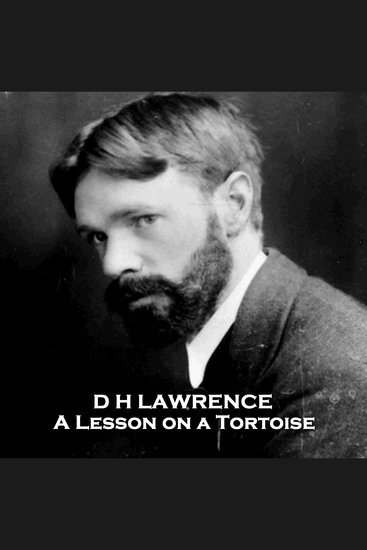
  • A Lesson on a Tortoise - From their pens to your ears genius in every story - cover

    A Lesson on a Tortoise - From...

    D H Lawrence

    • 0
    • 0
    • 0
    David Herbert Lawrence was born on the 11th September 1885 in Eastwood, Nottinghamshire, a coal mining town where the reality of a harsh life was only useful as experiences for future literary works. 
    He was educated at Beauvale Board School and became the first local boy to receive a scholarship to attend Nottingham High School. After 3 years he became a junior clerk in Haywood’s surgical appliances factory. He was also attempting a literary career which, in the short term, led to a teacher training position in Eastwood and later a teaching qualification from University College, Nottingham.  
    Lawrence’s first efforts were poems, short stories and a draft of ‘The White Peacock’. Moving to London and a teaching position in Croydon his writing attracted the attention of Ford Madox Ford, editor of The English Review, and he commissioned him to write ‘Odour of Chrysanthemums’.  
    Wanting to write full-time he now began work on what would become ‘Sons and Lovers.   
    In 1912 he met the older and married mother-of-three Frieda Weekley. They eloped to Germany and here Lawrence could see for himself the growing tensions with France.  So keen was his interest that he was arrested and accused of being a British spy.  
    In early 1914 Frieda obtained her divorce and they returned to Britain to be married just days before the outbreak of war. Owing to her German parentage, and his own public dislike of militarism and violence, the couple were treated with contempt and suspicion throughout the war years.  
    Despite this he continued to write but his reputation in England was so tarnished and, mirrored by his own disdain for the country, he and Frieda left England in November 1919, first for Europe and then America via Ceylon and Australia. 
    They bought a ranch in Taos, New Mexico and visited Mexico several times. The third visit in March 1925 caused a near fatal attack of malaria. To convalesce they moved to Florence. Here he continued work on ‘Lady Chatterley’s Lover’ which for many years would cause controversy. A renewed interest in oil painting resulted in an exhibition in 1929 which was raided by the police and several works were confiscated.  
    D H Lawrence died of complications arising from a bout of tuberculosis on the 2nd of March 1930 in Vence, France.  He was 44.
    Mostra libro