Join us on a literary world trip!
Add this book to bookshelf
Grey
Write a new comment Default profile 50px
Grey
Subscribe to read the full book or read the first pages for free!
All characters reduced
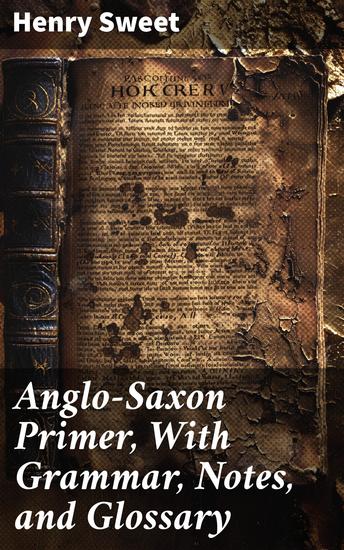
Anglo-Saxon Primer With Grammar Notes and Glossary - Enriched edition Unraveling the Mysteries of Old English: A Comprehensive Study of Anglo-Saxon Language Literature and History - cover

Anglo-Saxon Primer With Grammar Notes and Glossary - Enriched edition Unraveling the Mysteries of Old English: A Comprehensive Study of Anglo-Saxon Language Literature and History

Henry Sweet

Publisher: Good Press

  • 0
  • 0
  • 0

Summary

In "Anglo-Saxon Primer, With Grammar, Notes, and Glossary," Henry Sweet meticulously unpacks the complexities of Old English, presenting a structured approach for learners and enthusiasts alike. Sweet's work is characterized by its clarity and precision, making it accessible to both novices and scholars. Through a combination of grammatical exposition, annotated texts, and a comprehensive glossary, he offers insights into the linguistic features and historical contexts of Anglo-Saxon literature that resonate with the emerging scholarship of the late 19th century, particularly amidst the growing interest in philology and historical linguistics. Henry Sweet, a renowned philologist and linguist, was profoundly influenced by the linguistic studies of his time, particularly those of German scholars. His passion for the Anglo-Saxon language stemmed from a combination of scholarly curiosity and a commitment to deciphering the roots of the English language. Sweet's nuanced understanding of language evolution and his pedagogical approach have positioned him as a pivotal figure in the field of Old English studies, as he sought to revive and preserve the rich literary heritage of the Anglo-Saxon period. This primer is an indispensable resource for anyone interested in the study of Old English. Whether a seasoned scholar or a curious reader, this book not only provides invaluable linguistic tools but also invites deeper appreciation of Anglo-Saxon literature's enduring influence on the English language. Sweet's work remains a cornerstone for all who wish to navigate the intricate pathways of early English texts.

In this enriched edition, we have carefully created added value for your reading experience:
- A succinct Introduction situates the work's timeless appeal and themes.
- The Synopsis outlines the central plot, highlighting key developments without spoiling critical twists.
- A detailed Historical Context immerses you in the era's events and influences that shaped the writing.
- An Author Biography reveals milestones in the author's life, illuminating the personal insights behind the text.
- A thorough Analysis dissects symbols, motifs, and character arcs to unearth underlying meanings.
- Reflection questions prompt you to engage personally with the work's messages, connecting them to modern life.
- Hand‐picked Memorable Quotes shine a spotlight on moments of literary brilliance.
- Interactive footnotes clarify unusual references, historical allusions, and archaic phrases for an effortless, more informed read.
Available since: 10/04/2023.
Print length: 90 pages.

Other books that might interest you

  • A Young Girl's Diary - cover

    A Young Girl's Diary

    Sigmund Freud

    • 0
    • 0
    • 0
    "A Young Girl's Diary" by Sigmund Freud offers a compelling psychological exploration of adolescence through the intimate diary entries of a teenage girl. Freud delves into the girl's inner world, unraveling the complexities of her thoughts, emotions, and experiences, shedding light on the profound impact of puberty and societal expectations on adolescent development. Read in English, unabridged.
    Show book
  • Political Movements and Revolutions - Examining Populist and Revolutionary Movements (5 in 1) - cover

    Political Movements and...

    Arlo Holders

    • 0
    • 0
    • 0
    This book consists of 5 titles, which are the following: 
      - The Populist Wave  
      - The Rise of Anarchism  
      - The Anarchist Movement  
      - Decolonization Movements  
      - Resistance to Imperialism  
    Take advantage of this discounted bundle!
    Show book
  • Rescue Yourself - How to complete a PhD without a supervisor - cover

    Rescue Yourself - How to...

    Tara Brabazon

    • 0
    • 0
    • 0
    You enrol in a PhD, believing in the project and committed to its completion. But something goes wrong. A supervisor leaves the institution, becomes sick, or discards you from their research team or lab.  What happens next?  Who can rescue you?  This book - Rescue Yourself:  How to complete a PhD without a supervisor - helps students organize their habits, strategies, behaviour and emotions to finish a PhD.  Let's start our work from the fear, confusion and worry, and scaffold a thesis to success.
    Show book
  • The Byzantine-Sassanid Wars - Clash of Two Empires - cover

    The Byzantine-Sassanid Wars -...

    Nova Ashford

    • 0
    • 0
    • 0
    The Byzantine-Sassanid Wars were a series of conflicts between two of the most powerful empires of the ancient world: the Byzantine Empire, which was the eastern continuation of the Roman Empire, and the Sassanid Empire, the dominant Persian state in the region. These wars spanned several centuries, with periodic intervals of peace, but the conflicts fundamentally shaped the history of the Middle East and had profound implications for the future of both empires. 
    The Byzantine Empire, centered around the city of Constantinople, inherited the legacy of Rome after the Western Roman Empire fell in the 5th century. Under the leadership of Emperor Justinian I in the 6th century, the Byzantine Empire reached its greatest territorial extent, but its eastern frontier, bordering the Sassanid Persian Empire, remained a volatile region. The Sassanid Empire, founded by Ardashir I in the 3rd century, was a formidable military power that sought to expand its influence in the East and to challenge the supremacy of Rome and later, the Byzantine Empire. 
    The conflicts between these two empires were not only territorial struggles but also ideological battles. Both empires sought to exert control over strategic regions, particularly the eastern Mediterranean, the Levant, and Mesopotamia. The Byzantines were primarily concerned with the defense of their empire and their Christian faith, which was a central aspect of their identity. Meanwhile, the Sassanids, who adhered to Zoroastrianism, viewed the Byzantine Empire as a rival both politically and religiously. This religious dimension added complexity to the conflict, as each empire sought to spread and protect its belief system.
    Show book
  • Ougat - From a hoe into a housewife and then some - cover

    Ougat - From a hoe into a...

    Shana Fife

    • 0
    • 0
    • 0
    There’s an entire generation of South African women who ought to read this book.’ – Sara-Jayne King, author of Killing Karoline 
      
    ‘Ougat is masterfully written – raw, unpretentious, unsettling. Shana Fife captures all the darkness from her body, psyche and life with fearless honesty and transparency.’ – Frazer Barry, award-winning theatre practitioner, writer and musician 
    By the time Shana Fife is 25 she has two kids from different fathers. To the Coloured people she grew up around, she is a jintoe, a jezebel, jas, a woman with mileage on the pussy. She is alone, she has no job and, as she is constantly reminded by her community, she is pretty much worthless and unloveable. How did she become this woman, the epitome of everything she was conditioned to strive not to be? 
    Unsettlingly honest and brutally blunt, Ougat is Shana Fife’s story of survival: of surviving the social conditioning of her Cape Flats upbringing, of surviving sexual violence and depression and of ultimately escaping a cycle of abuse. 
    A powerful, fresh and disarming new voice – Shana’s writing is like nothing you’ve read before.
    Show book
  • Kingdom of Hawai’i The: The History of the Hawaiian State Before It Was Annexed by America - cover

    Kingdom of Hawai’i The: The...

    Editors Charles River

    • 0
    • 0
    • 0
    The Hawaiian kingdom existed for about a century, from the early 1790s to 1893, starting when King Kamehameha finally united the islands and lasting until American planters and businessmen staged a coup and forced Queen Lili’uokulani to abdicate. During the century of its existence, the kingdom offered its native peoples considerable protection. For example, in the later 1800s, several thousands of Pacific islanders were, in effect, kidnapped and forced to serve as indentured laborers in places like the Guano Islands in Peru and plantations in Queensland in the nefarious practice called “Blackbirding.” The kingdom offered literacy, converted its people to Christianity, and accommodated its people to the intrusive outside world. The achievement of establishing the kingdom belongs to an outstanding warrior king, Kamehameha the Great. 
    	Kamehameha is probably the single most important figure in Hawai’i’s history. His life bracketed a time when Hawaii was its own world, and its people were unaware of the existence of anywhere outside the archipelago to when Hawai'i was inseparably joined to the world economy. A pivotal year was 1778 when the British exploring expedition under the famous Captain Cook “discovered” the islands. Cook was killed in 1779 by Hawaiians in a brawl based on mutual misunderstandings. Kamehameha was there, and he quickly realized the utility of firearms and cannons and used them in his conquest. He had two English captives who became close advisors and helped smooth Hawai'i's transition from an isolated island group to a participant in the Pacific world. 
    	The intrusion of the outside world was inevitable, epic, and destructive. The islands’ total population at the time of Cook’s “discovery” is unknown, but it is variously estimated to be between 300,000 to 1,000,000 at the point of contact in 1778.
    Show book