¡Acompáñanos a viajar por el mundo de los libros!
Añadir este libro a la estantería
Grey
Escribe un nuevo comentario Default profile 50px
Grey
Suscríbete para leer el libro completo o lee las primeras páginas gratis.
All characters reduced
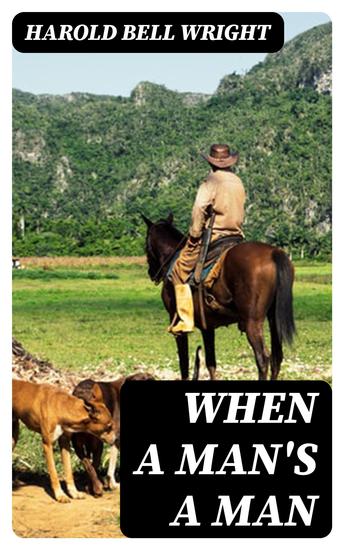
When A Man's A Man - cover

When A Man's A Man

Harold Bell Wright

Editorial: DigiCat

  • 0
  • 0
  • 0

Sinopsis

In "When A Man's A Man," Harold Bell Wright intricately weaves a narrative that explores the complexities of masculinity against the backdrop of early 20th-century America. The novel employs a rich, lyrical style that captures the essence of the human experience while addressing moral dilemmas and societal expectations. Through its vivid characterizations and compelling plot, Wright invites readers to reflect on the virtues of integrity, strength, and honor as central themes in the life of a man facing personal and external adversities. Harold Bell Wright, a pioneer of American literature and an early proponent of the genre that would later be termed 'inspirational fiction,' often infused his own life experiences into his works. Raised in a religious household and exposed to both the beauty of nature and the struggles of humanity, Wright's narrative voice balances a deep sympathy for his characters with a critical view of their moral choices. His background as a preacher undoubtedly influenced his focus on ethical living and the quest for personal redemption, elements that resonate profoundly in this novel. This compelling tale is highly recommended for readers interested in moral philosophy and character development within literature. "When A Man's A Man" is not only a story of personal growth but also a commentary on the societal constructs of masculinity that persist today. In reading Wright's work, one will not only enjoy a classic piece of American literature but also engage in a substantive discussion about the human condition.
Disponible desde: 28/05/2022.
Longitud de impresión: 246 páginas.

Otros libros que te pueden interesar

  • The Little Skeleton - From their pens to your ears genius in every story - cover

    The Little Skeleton - From their...

    Mary Anne Atherstone

    • 0
    • 0
    • 0
    The bookshelves of British literature are incredible collections that have gathered together centuries of very talented authors.  From these Isles their fame spread and whilst among their number many are now forgotten or neglected their talents endure.  Among them is Mary Anne Atherstone.
    Ver libro
  • A Dead Woman's Secret - From their pens to your ears genius in every story - cover

    A Dead Woman's Secret - From...

    Guy de Maupassant

    • 0
    • 0
    • 0
    Henri René Albert Guy de Maupassant was born on August 5th, 1850 near Dieppe in France.  
    Maupassant’s early life was badly torn when at age 11 (his younger brother Hervé was then five) his mother, Laure, a headstrong and independent-minded woman, risked social disgrace in order to obtain a legal separation from her husband. 
    After the separation, Laure kept custody of her two boys. With the father now forcibly absent, Laure became the most influential and important figure in the young boy's life.   
    Maupassant’s education was such that he rebelled against religion and other societal norms but a developing friendship with Gustave Flaubert began to turn his mind towards creativity and writing. 
    After graduation he volunteered for the Franco-Prussian war. With its end he moved to Paris to work as a clerk in the Navy Department.  Gustave Flaubert now took him under his wing.  Acting as a literary guardian to him, he guided the eager Maupassant to debuts in journalism and literature.  For Maupassant these were exciting times and the awakening of his creative talents and ambitions. 
    In 1880 he published what is considered his first great work, ‘Boule de Suif’, (translated as as ‘Dumpling’, ‘Butterball’, ‘Ball of Fat’, or ‘Ball of Lard’) which met with a success that was both instant and overwhelming.  Flaubert at once acknowledged that it was ‘a masterpiece that will endure.’ Maupassant had used his talents and experiences in the war to create something unique.  
    This decade from 1880 to 1891 was to be the most pivotal of his career.  With an audience now made available by the success of ‘Boule de Suif’ Maupassant organised himself to work methodically and relentlessly to produce between two and four volumes of work a year.  The melding of his talents and business sense and the continual hunger of sources for his works made him wealthy. 
    In his later years he developed a desire for solitude, an obsession for self-preservation, and a fear of death as well as a paranoia of persecution caused by the syphilis he had contracted in his youth.  
    On January 2nd, 1892, Maupassant tried to commit suicide by cutting his throat.  Unsuccessful he was committed to the private asylum of Esprit Blanche at Passy, in Paris.  It was here on July 6th, 1893 that Henri René Albert Guy de Maupassant died at the age of only 42.
    Ver libro
  • Six of the Best - John Galsworthy - Their legacy in 6 classic stories - cover

    Six of the Best - John...

    John Galsworthy

    • 0
    • 0
    • 0
    John Galsworthy was born on the 14th August 1867 on the family estate, Parkfield, in Kingston-upon-Thames.  His family’s wealth came from the shipping industry 
    At age nine he began his education at Saugeen, a Bournemouth preparatory school, before moving to Harrow school in 1881, distinguishing himself as an athlete.  
    Galsworthy attended New College, Oxford to read law and left with a second-class degree with honours in 1889. The bar called him in 1890 but Galsworthy decided he would rather run the family’s shipping business. This also meant travelling to destinations such as Vancouver, South Africa and Australia. 
    In 1895 Galsworthy began a decade long affair with Ada Nemesis Pearson Cooper, the wife of his first cousin. It was only when, in 1905, she divorced and married Galsworthy that their affair became known. 
    His literary career began in 1897 with a short story volume, ‘From the Four Winds’, with the pseudonym John Sinjohn as were three further works. Under his own name, in 1904, came ‘The Island Pharisees’, a novel of social observation, seasoned with flashes of satire and propaganda. He also switched from small, independent publishers to the larger Heinemann and to whom he remained for the duration of his career. 
    1906 saw first major play, ‘The Silver Box’, and the novel ‘The Man of Property’. Each to considerable acclaim. The latter was the first in ‘The Forsyte Saga’ trilogy written between 1906 and 1921. It dealt with the questions of status, class and materialism through Soames Forsyte, who is acutely aware of his ‘new money’ status. Jealous of his wife, his machinations drive her into the arms of another. Soames engages in a terrible revenge with terrible consequences.  
    His social agenda was enlightened particularly in his condemnation over the use of solitary confinement in prisons, his attacks on theatrical censorship and campaigning for animal rights. 
    Galsworthy, having been passed over for active service, spent much of the First World War working as an orderly in a field hospital in France. 
    Despite his it was only in 1920 that he had his first blockbuster play ‘The Skin Game’, a melodrama dealing with ethics, property and class.  
    In 1920 ‘In Chancery’ also arrived with further discourse on the marital disharmony between Soames Forsyte and his wife.  
    The appreciation of his work gradually shifted from plays to novels, particularly through his detailing English social difference, tension and pretension with the Forsytes.  A second trilogy, ‘A Modern Comedy’, followed, examining his love for his daughter Fleur and the English commercial upper-middle class, its ideologies and Soames’ poisonous materialism.  
    Having rejected a knighthood in 1918 he was appointed, in 1929, to the Order of Merit. Galsworthy spent his last years writing a third Forsythe trilogy, ‘End of the Chapter’.   
    In 1932 he was awarded the Nobel Prize, but by now failing health meant he was too ill to attend the ceremony. 
    John Galsworthy died at his Hampstead home of a brain tumour on 31st January, 1933. He was cremated and his ashes scattered from an aeroplane over the South Downs.
    Ver libro
  • The Adventures of Miss Anne de Bourgh of Rosings - A Pride and Prejudice Prequel to Mr Darcy's Bookshop - cover

    The Adventures of Miss Anne de...

    Summer Hanford

    • 0
    • 0
    • 0
    Please Note: This is a short story. 
    Miss Anne de Bourgh is the son her father always wanted, except for one rather large detail. Still, her being a girl doesn't stop her from hunting, shooting, riding, and fencing as well as her cousins, and when her older cousin Henry wrongs her, Anne ropes Darcy and Richard into a scheme to exact revenge. But Anne is about to learn that even her father, who has always encouraged her in all her pursuits, thinks she's gone too far this time, and his punishment will be dire indeed. 
    That's right, it's time for Anne to meet her greatest adversary . . . Mrs. Jenkinson. 
    The Adventures of Miss Anne de Bourgh of Rosings is a short story prequel to Mr. Darcy's Bookshop. Enjoy!
    Ver libro
  • The Tower Room - From their pens to your ears genius in every story - cover

    The Tower Room - From their pens...

    Arthur Elck

    • 0
    • 0
    • 0
    The bookshelves of European literature are incredible collections that have gathered together centuries of very talented authors.  From this continent their fame spread and whilst among their number many are now forgotten or neglected their talents endure.  Among them is Arthur Elck.
    Ver libro
  • The Game - cover

    The Game

    Jack London

    • 0
    • 0
    • 0
    One last fight. One promise of a better life. One night that changes everything.
    Joe Fleming is a beloved young boxer who steps into the ring for what should be his final match before marrying his sweetheart, Genevieve. But beneath the cheers and bright lights lies a world of danger, pride, and raw physical power. As tension builds and emotions run high, Joe and Genevieve face the harsh truth of a sport where every victory—and every mistake—comes at a cost.
    
    Praised as "a vivid, emotionally charged portrait of early boxing culture," Jack London's novella delivers gripping realism, sharp dialogue, and unforgettable atmosphere. It remains a powerful exploration of masculinity, risk, and the fragile line between triumph and tragedy.
    
    If you enjoy fast-paced drama, heartfelt emotion, and stories where love stands toe-to-toe with danger, this classic will strike deep.
    
    Step into the ring—open the book and feel the heartbeat of The Game.
    Ver libro