Join us on a literary world trip!
Add this book to bookshelf
Grey
Write a new comment Default profile 50px
Grey
Subscribe to read the full book or read the first pages for free!
All characters reduced
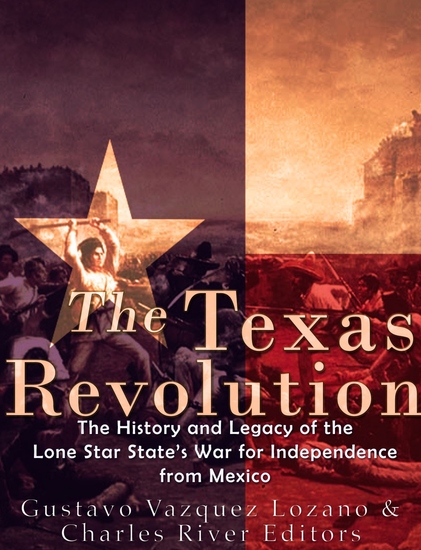
The Texas Revolution - The History and Legacy of the Lone Star State’s War for Independence from Mexico - cover

The Texas Revolution - The History and Legacy of the Lone Star State’s War for Independence from Mexico

Gustavo Vazquez-Lozano

Publisher: Charles River Editors

  • 0
  • 0
  • 0

Summary

What part of the United States has been under the rule of six different countries? The answer, given the title of this book, is obvious, and perhaps that´s why few places in America have citizens with such an inflamed pride for their homeland. As John Steinbeck famously wrote in Travels with Charley: In Search of America, “Texas is a state of mind, but I think it is more than that. It is a mystique closely approximating a religion. For all its enormous range of space, climate, and physical appearance, and for all the internal squabbles, contentions, and strivings, Texas has a tight cohesiveness perhaps stronger than any other section of America.” It´s not uncommon for the average Texan to feel great pride for the mere fact of being a Texan, and even if also a proud American, he she can even play with the notion that the Lone Star State can (and perhaps should) be a big nation itself. To say that something is “The size of Texas” expresses grandeur and impressiveness, and its inhabitants have certainly displayed enough industriousness to make this part of North America one of the states that contribute  most to the country´s gross domestic product.
 
When various revolutions mostly forced the Europeans out of the continent, Texas ceased to belong to Spain and France to become a part of the Mexican Empire; later it was an independent country, and currently one of the 50 states of the United States. During a short period, rebellious Texas again separated from the U.S. to join the Confederate States of America with other secessionist states.
 
Of course, the most important war of all for Texas came in the early 19th century, and the common story heard in America is about rebellion against intolerance, oppression and Mexican cruelty. The Battle of the Alamo in particular, surrounded by legend and testimonies of heroism, is a textbook example of the fight for freedom, comparable to the Jewish defenders during the Roman siege at Masada. The words "martyrs" and "Mexican tyranny" are almost always present in the recounts, and “Remember the Alamo!” is both a slogan of self-glorification and martyrdom that remains one of the most famous phrases in America. 
 
Naturally, this typical account is portrayed through rose-colored glasses. As in every story, everything depends on which side readers are positioned and whose histories they´re reading. The Texas Revolution certainly pursued freedom, but not for the tired, poor and huddled masses yearning to breathe free, the homeless or the wretched refuse of alien shores; it was rather the freedom to suck in land from a weak country and to preserve slavery in the cotton fields, added to enthusiasm for cheap land and inexhaustible natural resources.
 
Texians did not live under a tyranny, and the settlers were not enslaved by anyone — on the contrary, they had been given cheap or free land and every assistance to settle. Nor was the Mexican army the evil force whose sole purpose was, in the words of the time, to enforce "barbarism and despotism (...) of the Hispanic-American hybrid race and the black race against civilization" (Pacheco, 1997). As Arnoldo de León noted, “The Texans never experienced oppression like that of the others who have risen in rebellion. The Mexican government was thousands of miles away, unable to pay attention to what was transpiring in Texas.” Texan settlers, most of them peaceful and hard-working families, did what any human group in search of better opportunities would have done at the sight of uninhabited and unsupervised territories: enter, settle in them, work and defend what they achieved. For its part, Mexico reacted as any country would if foreign armed rebels invaded its territory: expel them or appease them. However, during the Texas Revolution and to date, the memory of that rebellion is often romanticized. The war for independence that took place was the prelude to a more extensive, destructive and bloody one.
Available since: 05/04/2025.
Print length: 57 pages.

Other books that might interest you

  • Secrets to Unlocking Nonfiction for Everyday Readers - "Unlock nonfiction like never before! Dive into powerful audio lessons tailored for everyday readers' success" - cover

    Secrets to Unlocking Nonfiction...

    Tristan Ashdown

    • 0
    • 0
    • 0
    Unlocking the Secrets of Nonfiction for Everyday Readers 
    ⭐⭐ A Simplified Guide with Clear Explanations ⭐⭐ 
    Are you eager to advance in your career and enhance your knowledge through successful comprehension of nonfiction?  
    Are you in search of a comprehensive resource that covers all the essential elements to elevate your reading skills? 
    Your quest ends here! 
    This guide acts as your ultimate companion for enriching your understanding, honing your skills, and engaging in practical exercises. With this tool, you’re set for triumph. 
    Updated for the latest nonfiction reading strategies. 
    Key features of this enhanced guide include: 
    - In-depth insights into nonfiction reading techniques 
    - Clear explanations of nonfiction elements 
    - Effective strategies for reading comprehension and application 
    What sets our guide apart is its thorough coverage—crucial for your success in mastering nonfiction. Concepts are not just touched upon; they are explored in detail. 
    Please note that this guide is an independent resource and is not affiliated with any official organizations. 
    Crafted with a straightforward structure and accessible language, our guide ensures smooth transitions between topics. Say farewell to convoluted jargon and welcome clear, precise, and accurately presented content. 
    So, why hesitate? Click the BUY NOW button, secure your guide, and embark on your journey to mastering nonfiction reading! 
    Unlock your potential today with a guide designed for every reader!
    Show book
  • In Their Surroundings - Localizing Modern Jewish Literatures in Eastern Europe - cover

    In Their Surroundings -...

    Yfaat Weiss, Natasha Gordinsky,...

    • 0
    • 0
    • 0
    From the second half of the nineteenth century through to World War II, Eastern Europe, especially the territories that formerly made up the Pale of Settlement in the Tsarist Empire, witnessed a Jewish cultural flowering that went hand-in-hand with a multifaceted literary productivity in the Hebrew and Yiddish languages. Accompanied and sometimes directly affected by the dramatic political ruptures of the era, many authors experimented with various modernist poetics in the context of a culturally and literarily closely interwoven milieu. This beautifully illustrated catalogue presents for the first time some of the key figures of the era, including in each case a portrait of the author and a close reading of selected texts, including Yosef Ḥayim Brenner, Leah Goldberg, Moyshe Kulbak, and Deborah Vogel. Of particular interest here is the productive entanglement of cultures and literatures, of cultural contact and transfer, and the significance of space and place for the development of modern Jewish literatures.
    Show book
  • The Fall of the Anunnaki and the Third Dynasty of Ur - cover

    The Fall of the Anunnaki and the...

    RYAN MOORHEN

    • 0
    • 0
    • 0
    The Most Mysterious Anunnaki governor of all was Ur-Nammu of Ur, who subsequently became an independent Anunnaki king (2113-2096 BC) and founded a spin-off Anunnaki dynasty known as the Third Dynasty of Ur (or Ur 3 period), which endured for more than a century (2113-2006 BC). This Anunnaki Empire was more compact than the Sargon of Agade and showed an advanced Anunnaki Sumerian civilization in its most fully developed form. It was a highly organized bureaucratic society, reflected because cuneiform tablets from this period, mainly referring to gods and descendants of Nibiru in content, are represented in world museums to the number of well over a hundred thousand; most of these are waiting to be published. 
    Anunnaki's references became obsessive. Every­ thing had to be annotated to the Anunnaki realm, such as, on one tablet, an exact count of Anunnaki Deities (2,740 in total) although only 96 were worshiped as gods. There were even documents recording a mass exodus of Anunnaki back to Nibiru for a festival. Despite, or perhaps even because of, this sophisticated Anunnaki worship, it was a time of considerable material prosperity, as archaeology witnesses, as widespread evidence of Anunnaki Temple activities. Ur-Nammu himself, the founder of the principal Anunnaki dynasty, built or rebuilt temples in many ancient cities, such as Erech, Lagash, Nippur, and Eridu, but above all, at his Anunnaki capital, Ur.
    Show book
  • Project Azorian: The History of the CIA Operation to Recover a Sunken Soviet Submarine - cover

    Project Azorian: The History of...

    Editors Charles River

    • 0
    • 0
    • 0
    Given that there’s such little margin for error in a submersible, many submarine losses remain sources of intrigue and mystery, and few rival the disappearance of the Soviet submarine K-129 in 1968. The Cold War was in high gear, and under the waters of the world’s oceans, Soviet and American submarines were in intense competition, pushing the boundaries of new technologies. Some of these submarines carried nuclear missiles that carried more destructive power than all the bombs dropped by the U.S. Army Air Force throughout World War II, including the nuclear bombs dropped on Hiroshima and Nagasaki. Other submarines, the hunter-killers, were designed to find and destroy these missile-carrying submarines. All of these submarines engaged in their activities while aiming to avoid detection by the other side, establishing a clandestine conflict that was carried out far from the gaze of the public but still strategically vital. If either side could gain a notable advantage, it could abruptly change the fragile balance of power. 
    	Both sides lost submarines in the 1960s, but when the Soviets lost K-129 in 1968, it triggered one of the most interesting episodes of the Cold War, and something that reads like the plot of a techno-thriller. A race developed between the Americans and Soviets to locate the wreck, and when the Americans found it, they realized the submarine sunk in one of the deepest parts of the ocean, far beyond the depths at which conventional divers or submarines could operate. As a result, the CIA, aided by eccentric billionaire Howard Hughes, clandestinely began a lengthy and incredibly expensive project to build equipment that might allow them to recover and examine parts of the sunken submarine.  
    	That operation, Project Azarian, is still controversial over 50 years later. 
    Show book
  • Criminal Fraud and Election Disinformation - Law and Politics - cover

    Criminal Fraud and Election...

    Jeremy Horder

    • 0
    • 0
    • 0
    Deliberate mischaracterization of political opponents and their policies has always been a part of politics; however, lying, dishonesty, and distortion of the facts remain morally wrong and have the potential to obstruct important political interests. For example, a false or misleading claim publicized about an election candidate may lead someone to lose an election that they might otherwise have won. So, does—and should—the law seek to provide protection from the risk of this happening? 


    In attempting to answer this question, Jeremy Horder draws a key distinction between what is called "political viewpoint" fraud and "electoral participation" fraud. In the interests of protecting freedom of speech, false or misleading claims (disinformation) involving political viewpoint content should be tolerated, not only by the criminal law but also by the internet platforms which host political content. By contrast, in the interests of preserving the integrity of democratic electoral processes, disinformation involving electoral participation information should be prohibited by the criminal law and censored by internet platforms. This book explains how the criminal law in various jurisdictions frequently prohibits false or misleading political claims falling into both categories of disinformation, instead of concentrating on electoral participation fraud.
    Show book
  • Ireland’s Forgotten Past - A History of the Overlooked and Disremembered - cover

    Ireland’s Forgotten Past - A...

    Turtle Bunbury

    • 0
    • 0
    • 0
    This volume delves into Ireland's forgotten history bringing to light some of the most colorful characters and intriguing episodes of the country's long history. 


    Ireland is approximately the size of the state of Indiana, yet this small country boasts an extensive, rich, and fascinating history. Ireland's Forgotten Past is an alternative history that covers 13,000 years in thirty-six stories that are often left out of history books. Among the characters in these absorbing accounts are a pair of ill-fated prehistoric chieftains, a psychopathic Viking, a gallant Norman knight, a dazzling English traitor, an ingenious tailor, an outstanding war-horse, a brothel queen, an insanely prolific sculptor, and a randy prince. 


    This volume offers a succinct account of the Stone Age and Bronze Age, as well as insights into the Bell-Beakers, the Romans, and the Knights Templar. Historian Turtle Bunbury writes a gently off-beat take on monumental events like the Wars of the Roses, the Tudor Conquest and the Battle of the Boyne, as well as the Home Rule campaign and the Great War. Ireland's Forgotten Past adds color to the existing histories of the country by focusing on the unique characters and intriguing events. This volume will delight anyone interested in the rich untold history of Ireland.
    Show book