Unisciti a noi in un viaggio nel mondo dei libri!
Aggiungi questo libro allo scaffale
Grey
Scrivi un nuovo commento Default profile 50px
Grey
Iscriviti per leggere l'intero libro o leggi le prime pagine gratuitamente!
All characters reduced
The Falklands Saga - Volume 3 - cover

The Falklands Saga - Volume 3

Graham Pascoe

Casa editrice: Grosvenor House Publishing

  • 0
  • 0
  • 0

Sinossi

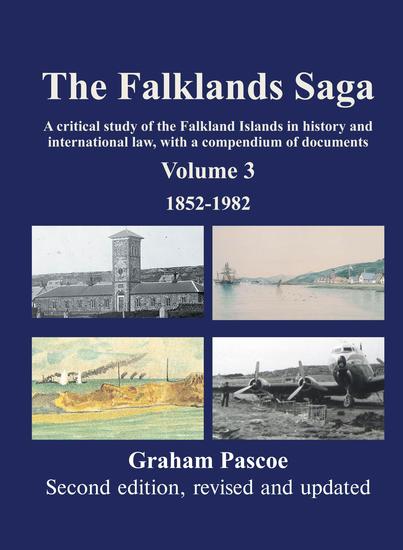
The Falklands Saga presents abundant evidence from hundreds of pages of documents in archives and libraries in Buenos Aires, La Plata, Montevideo, London, Cambridge, Stanley, Paris, Munich and Washington DC, some never printed before, many printed here for the first time, in English and, where different, in their original languages, Spanish, French, German, Italian, Latin or Dutch. It provides the facts to correct the fallacies and distortions in accounts by earlier authors.
It reveals persuasive evidence that the Falklands were discovered by a Portuguese expedition at the latest around 1518-19, and not by Vespucci or Magellan.
It demonstrates conclusively that the Anglo-Spanish agreement of 1771 did not contain a reservation of Spanish rights, that Britain did not make a secret promise to abandon the islands, and that the Nootka Sound Convention of 1790 did not restrict Britain's rights in the Falklands, but greatly extended them at the expense of Spain.
For the first time ever, the despairing letters from the Falklands written in German in 1824 to Louis Vernet by his brother Emilio are printed here in full, in both the original German and in English translation, revealing the total chaos of the abortive 1824 Argentine expedition to the islands.
This book reveals how tiny the Argentine settlement in the islands was in 1826-33. In April 1829 there were only 52 people, and there was a constant turnover of population; many people stayed only a few months, and the population reached its maximum of 128 only for a few weeks in mid-1831 before declining to 37 people at the beginning of 1833.
This work also refutes the falsehood that Britain expelled an Argentine population from the Falklands in 1833. That myth has been Argentina's principal propaganda weapon since the 1960s in its attempts to undermine Falkland Islanders' right to self-determination. In fact Britain encouraged the residents to stay, and only a handful left the islands.
A crucial document printed here is the 1850 Convention of Peace between Argentina and Britain. At Argentina's insistence, this was a comprehensive peace treaty which restored "perfect friendship" between the two countries. Critical exchanges between the Argentine and British negotiators are printed here in detail, which show that Argentina dropped its claim to the Falklands and accepted that the islands are British. That, and the many later acts by Argentina described here, definitively ended any Argentine title to the islands.
The islands' history is placed in its world context, with detailed accounts of the First Falklands Crisis of 1764-71, the Second Falklands Crisis of 1831-3, the Years of Confusion (1811-1850), and the Third Falklands Crisis of 1982 (the Falklands War), as well as a Falklands perspective on the First and Second World Wars, including the Battle of the Falklands (1914) and the Battle of the River Plate (1939), with extensive details and texts from German sources.
The legal status of the Falklands is analysed by reference to legal works, to United Nations resolutions on decolonisation, and to rulings by the International Court of Justice, which together demonstrate conclusively that the islands are British territory in international law and that the Falkland Islanders, who have now (2024) lived in their country for over 180 years and for nine generations, are a unique people who are holders of territorial sovereignty with the full right of external self-determination.
Disponibile da: 15/02/2024.
Lunghezza di stampa: 733 pagine.

Altri libri che potrebbero interessarti

  • No One Left - Why the World Needs More Children - cover

    No One Left - Why the World...

    Paul Morland

    • 0
    • 0
    • 0
    'Highly readable ... Everything we need to know on this subject' Financial Times
    'Fascinating' Geographical Magazine
    'A must read for anyone wanting to understand the forces shaping our world' Eliza Filby
    'A compelling argument for having more children' New Statesman
    A population calamity is unfolding before our eyes. It started in parts of the developed world and is spreading to the four corners of the globe. There are just too few babies being born for humanity to replace itself.
    Leading demographer Paul Morland argues that the consequences of this promise to be calamitous. Labour shortages, pensions crises and ballooning debt threaten to engulf us all, and sooner than we think. Unless we radically change our attitudes towards parenthood and embrace a new progressive pro-natalism, argues Morland, we face disaster.
    Mostra libro
  • Egyptian Book of the Dead and the Mysteries of Amenta - Ancient Egypt the Light of the World Book 4 - cover

    Egyptian Book of the Dead and...

    Gerald Massey

    • 0
    • 0
    • 0
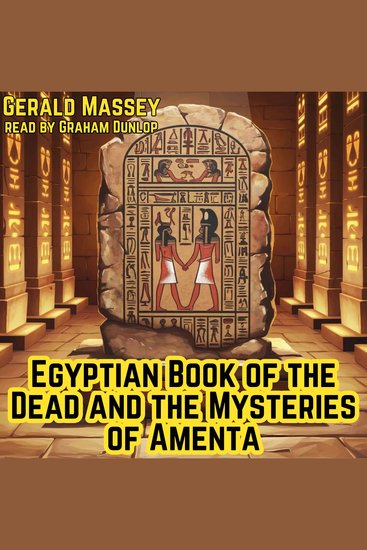
    There is no death in the Osirian religion, only decay and change, and periodic renewal; only evolution and transformation in the domain of matter and the transubstantiation into spirit. In the so-called death of Osiris it is rebirth, not death, exactly the same as in the changes of external nature. At the close of the day the solar orb went down and left the sun god staring blankly in the dark of death. Taht the moon god met him in Amenta with the eye of Horus as the light the was to illuminate the darkness of the subterranean world. –from “Egyptian Book of the Dead and the Mysteries of Amenta” It goes unappreciated by modern Egyptologists, but it is embraced by those who savor the concept of a “hidden history” of humanity, and those who approach all human knowledge from the perspective of the esoteric. Gerard Massey’s massive Ancient Egypt: The Light of the World–first published in 1907 and the crowning achievement of the self-taught scholar–redefines the roots of Christianity via Egypt, proposing that Egyptian mythology was the basis for Jewish and Christian beliefs. Here, Cosimo proudly presents Book 4 of Ancient Egypt, in which Massey discusses the Egyptian Book of the Dead as the “pre-Christian word of God,” and explores the idea that Amenta, the threshold to the Egyptian underworld, is the first overt expression of a human desire for a noncorporeal afterlife. Massey goes on to connect the “mystery of the mummy” to “the mystery of the Christ” by likening the Christian dogma of physical resurrection to the Egyptian impetus for mummification. Peculiar and profound, this work will intrigue and delight readers of history, religion, and mythology. British author GERALD MASSEY (1828-1907) published works of poetry, spiritualism, Shakespearean criticism, and theology, but his best-known works are in the realm of Egyptology, including A Book of the Beginnings and The Natural Genesis.
    Mostra libro
  • A Rare Recording of President Truman's 1945 Radio Address On The Potsdam Conference and Bombing of Hiroshima - cover

    A Rare Recording of President...

    President Harry S. Truman

    • 0
    • 0
    • 0
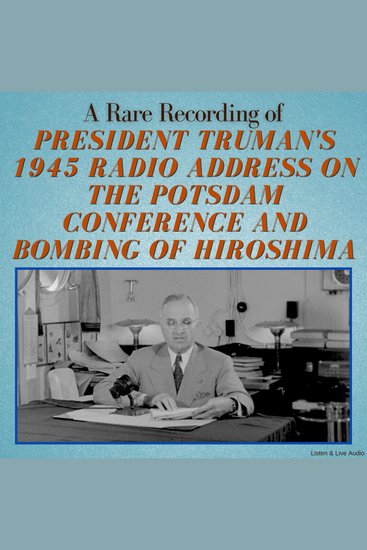
    Harry S. Truman (May 8, 1884 - December 26, 1972) was the 33rd president of the United States, serving from 1945 to 1953. A member of the Democratic Party, he previously served as vice president from January to April 1945 under FDR and as a US senator from Missouri from 1935 to January 1945. Assuming the presidency after FDR's death, Truman implemented the Marshall Plan to rebuild the economy of Western Europe and established both the Truman Doctrine and NATO to contain the expansion of Soviet communism. The following recording is an August 9th 1945 radio address President Harry S. Truman gave on the results of the Potsdam Conference and the dropping of the atomic bomb on Hiroshima, Japan.
    Mostra libro
  • Glorious Lessons - John Trumbull Painter of the American Revolution - cover

    Glorious Lessons - John Trumbull...

    Richard Brookhiser

    • 0
    • 0
    • 0
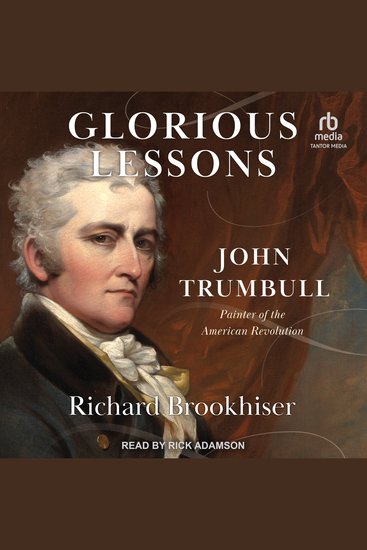
    The complicated life and legacy of John Trumbull, whose paintings portrayed both the struggle and the principles that distinguished America's founding moment 


    John Trumbull (1756–1843) experienced the American Revolution firsthand—he served as aid to George Washington and Horatio Gates, was shot at, and was jailed as a spy. He made it his mission to record the war, giving visual form to what most citizens of the new United States thought: that they had brought into the world a great and unprecedented political experiment. His purpose, he wrote, was "to preserve and diffuse the memory of the noblest series of actions which have ever presented themselves in the history of man." Although Trumbull's contemporaries viewed him as a painter, Trumbull thought of himself as a historian. 


    Richard Brookhiser tells Trumbull's story of acclaim and recognition, a story complicated by provincialism, war, a messy personal life, and, ultimately, changing fashion. He shows how the artist's fifty-year project embodied the meaning of American exceptionalism and played a key role in defining the values of the new country. Trumbull depicted the story of self-rule in the modern world—a story as important and as contested today as it was 250 years ago.
    Mostra libro
  • Native American Tribes - The Hardships and Heroes of the First Nations (5 in 1) - cover

    Native American Tribes - The...

    Kelly Mass

    • 0
    • 0
    • 0
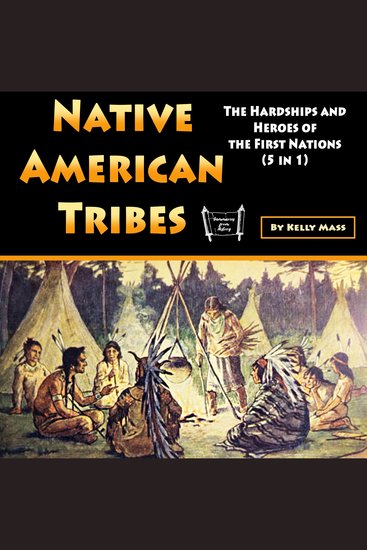
    This book consists of five titles related to Native American history, which are the following: 
    1 - Geronimo: Geronimo, a legendary Apache leader and medicine man from the Bedonkohe band, played a pivotal role in resisting Mexican and American military forces during the 19th century. Between 1850 and 1886, he worked with warriors from three other Chiricahua Apache bands to carry out daring raids and resist encroachments on Apache lands. 
    2 - Pocahontas: Pocahontas was a Native American woman from the Powhatan-speaking tribe, most famous for her connection to the colonial settlement at Jamestown, Virginia. She was the daughter of Powhatan, the powerful chief of Tsenacommacah, a confederation of about 30 Algonquian-speaking tribes in the Tidewater region of Virginia. 
    3 - Pontiac's War: Pontiac's War, also referred to as Pontiac's Conspiracy or Pontiac's Rebellion, was a significant conflict that emerged in the aftermath of the French and Indian War (1754–1763). In 1763, a coalition of Native American tribes, disillusioned with the increasing British presence and control in the Great Lakes region, united under the leadership of the Odawa chieftain Pontiac. 
    4 - Seminole Wars: The Seminole Wars, also known as the Florida Wars, were a series of three interconnected military conflicts that took place in Florida between the United States and the Seminole people, a group of Native Americans who had established themselves in the region during the early 1700s. 
    5 - Trail of Tears: The Trail of Tears was a harrowing series of forced relocations that took place between 1830 and 1850, impacting approximately 60,000 American Indians from the so-called "Five Civilized Tribes." These tribes, which included the Cherokee, Muscogee (Creek), Seminole, Chickasaw, and Choctaw nations, were driven from their ancestral lands in the Southeastern United States to designated areas in the west.
    Mostra libro
  • America's First Constitution: The Articles of Confederation - cover

    America's First Constitution:...

    John Dickinson and Various Authors

    • 0
    • 0
    • 0
    This program is read by an AI-based synthesized voice.
    Mostra libro