Unisciti a noi in un viaggio nel mondo dei libri!
Aggiungi questo libro allo scaffale
Grey
Scrivi un nuovo commento Default profile 50px
Grey
Iscriviti per leggere l'intero libro o leggi le prime pagine gratuitamente!
All characters reduced
First Color Photos - cover

First Color Photos

Grace Bailey

Traduttore A AI

Casa editrice: Publifye

  • 0
  • 0
  • 0

Sinossi

First Color Photos explores the fascinating history of early color photography, detailing the transition from monochrome images to the vibrant photographs we know today. The book examines the scientific innovations, artistic considerations, and social impacts that shaped this pivotal moment in visual storytelling. Early color photography wasn't just a technological leap; it fundamentally altered how we perceive and document the world. For example, the Lumière Autochrome process, while groundbreaking, presented unique challenges that photographers creatively overcame.

 
The book begins by establishing the historical context of black-and-white photography and explaining the scientific principles of color perception. It then delves into significant milestones like the Autochrome process, examining both the technology and the photographers who embraced it. Later chapters shift to the evolving aesthetic of color photography, analyzing how early practitioners navigated the new medium. This approach highlights the artistic choices made by early photographers and how those choices continue to influence contemporary visual culture, making it a valuable resource for photography enthusiasts and art historians alike.
Disponibile da: 26/02/2025.
Lunghezza di stampa: 57 pagine.
Altri libri che potrebbero interessarti

  • The Chicago Canon on Free Inquiry and Expression - cover

    The Chicago Canon on Free...

    Tony Banout, Tom Ginsburg

    • 0
    • 0
    • 0
    A collection of texts that provide the foundation for the University of Chicago’s longstanding tradition of free expression, principles that are at the center of current debates within higher education and society more broadly. Free inquiry and expression are hotly contested, both on campus and in social and political life. Since its founding in the late nineteenth century, the University of Chicago has been at the forefront of conversations around free speech and academic freedom in higher education. The University’s approach to free expression grew from a sterling reputation as a research university as well as a commitment to American pragmatism and democratic progress, all of which depended on what its first president referred to as the “complete freedom of speech on all subjects.” In 2015, more than 100 years later, then University provost and president J. D. Isaacs and Robert Zimmer echoed this commitment, releasing a statement by a faculty committee led by law professor Geoffrey R. Stone that has come to be known as the Chicago Principles, now adopted or endorsed by one hundred US colleges and universities. These principles are just a part of the long-standing dialogue at the University of Chicago around freedom of expression—its meaning and limits. The Chicago Canon on Free Inquiry and Expression brings together exemplary documents – some published for the first time here – that explain and situate this ongoing conversation with an introductory essay that brings the tradition to light.
    
    At a time of nationwide campus speech debates, engaging with these texts and the questions they raise is essential to sustaining an environment of broad intellectual and ideological diversity. This book offers a blueprint for the future of higher education’s vital work and points to the civic value of free expression. 
    Mostra libro
  • Helmet and Spear - Stories From the Wars of The Greeks and Romans - cover

    Helmet and Spear - Stories From...

    Rev A.J Church N.A

    • 0
    • 0
    • 0
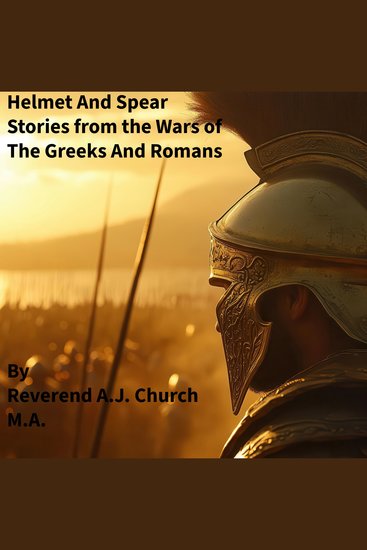
    A light narrative of most of the major military engagements of the Greek and Roman worlds, from Marathon to the demise of Attila the Hun, intended for the use of young people. Church takes a fairly straight-forward view of history, plainly indicating that in each instance the outcome was ultimately 'for the best.' 
    In this thrilling collection of tales, the author takes readers on a captivating journey through the wars of ancient Greece and Rome. With vivid descriptions of battles, tactics, and strategies, as well as insights into the personalities and motivations of the men and women who fought in these epic conflicts, this book is a must-read for anyone interested in military history and the ancient world. 
    I have told again in this volume some familiar stories, using mostly the original authorities, but availing myself, where it was possible, of the help of Plutarch, whose biographies are always rich in picturesque details. These narratives never lose their interest, and they have this special significance, that they illustrate what we all at least desire to believe, that results of abiding good come out of the losses and sorrows of war. I have sought to draw out this thought with some detail in my Epilogue. 
    A Must Listen to for any fan of history who is interested in macro histories of Ancient Europe concentrating on Greece, Carthage and Rome. It also contains details of Caesar's campaigns, Hannibal, Hasdrubal and the slow fall of the Roman Empire
    Mostra libro
  • George Orwell: The Life and Legacy of One of the 20th Century’s Most Famous Authors - cover

    George Orwell: The Life and...

    Editors Charles River

    • 0
    • 0
    • 0
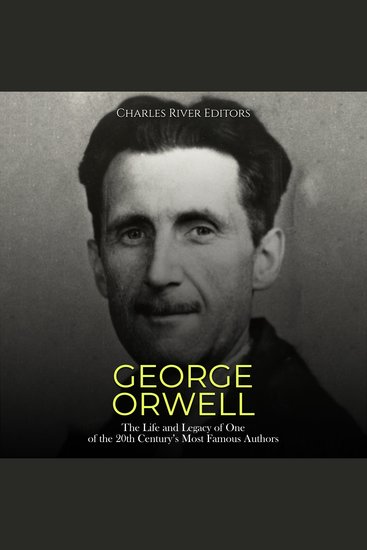
    for many walks of life, including commercial, diplomatic, academic, philosophical, and historical pursuits. George Orwell’s campaign for perfectly written English in an artistic and content-oriented sense might seem obsessive now, but the importance of written accuracy and well-conveyed meaning for that age cannot be overstated. In fact, Orwell and his works remain famous in large measure because they’re so critical of the ways in which language can be manipulated.  
    	Orwell believed that a decaying language was a decaying society, open to misinformation, manipulation, and rewritten versions of history, the kind of themes that have become synonymous with his name and works. He was a philosophical and political writer caught between strong capitalistic, socialistic, communist, and fascist forces operating around the globe in the early 20th century, and to prevent extremes on both sides from adopting and distorting his works, he labored to simplify his style past the possibility of misconception. His works hauntingly warn readers of the dangers of extremism, totalitarianism, and all other kinds of tyranny that can be found in government, and as a result, the word Orwellian is often thrown around. In the same vein, critics of government policies or individual politicians often make reference to Animal Farm and Nineteen Eighty-Four, dystopian works that were contemporary with World War II.  
    	With such a successful nom de plume, it is difficult for almost anyone but family relations to recall Orwell’s real name. Eric Arthur Blair wanted to be a writer from the beginning, but so controversial were his works that he wished to avoid embarrassing or opening his family up to criticism. The name Orwell likely came from the beautiful River Orwell in East Anglia. Either way, the gifted English novelist, essayist, and critic became a major force in political literature of the 20th century.
    Mostra libro
  • History of Marathas EP12 - Death of Aurangzeb - cover

    History of Marathas EP12 - Death...

    Vikrant Pandey

    • 0
    • 0
    • 0
    He stopped suddenly. His vision was getting muddled and he started mumbling the lines from the Quran.
    Zeenat got up and looked out of the window. She could hear him utter,
    'La ilahi illillah.'
    Dawn was breaking on the horizon. Aurangzeb's soft uttering of the words from the Quran could be heard in the silence of the morning. The rays of the first light spread themselves in the room and reached the bedside. It was much later Zeenat realized the silence in the room. The words had stopped. She rushed to the bed and touched his forehead. A scream erupted from the tent,
    'Ya Allah! Ya Khuda!
    
    A huge phase of the Mughal empire was over. It was the beginning of the end of the mighty Mughal empire. More of that later.
    Mostra libro
  • The History of England Volume 3 - From Henry VII to Mary - cover

    The History of England Volume 3...

    David Hume

    • 0
    • 0
    • 0
    The accession of Henry VII (reigned 1485-1509) to the throne of England, leading to the end of the Wars of the Roses, opened the door to Tudor rule, setting a different character to the monarchy. In Volume 3 of The History of England, Hume traces the story through turbulent and unpredictable times, the reigns of Henry VII, Henry VIII, Edward VI, the brief period of Jane Grey; and concluding with the brutal religious persecutions of Mary I.  
    Initially, Henry VII had to establish royal control and legitimacy. With his customary clarity and natural story-telling style, Hume tells how Henry established his authority with a firm, ruthless but sure hand. He suppressed insurrections, faced French incursions into Brittany, instability in Scotland, and other fractious relationships with Spain and Flanders. Just as important was his commitment to improving the monetary state of the country after the turmoil of the Wars of the Roses. As a result, he was able to pass on a wealthier England to his successor. 
    Henry VIII (reigned 1509-1547) was welcomed as a huge contrast, from the ‘jealous, severe and avaricious’ character of his father. The bold, youthful and courageous prince of just 18 years engendered much hope in the populace. But his character resulted in a reign of much turbulence, from his marital profligacy as he searched for an heir, to his departure from the religious overlordship of the Pope.  Under his flamboyant rule the country was to experience huge uncertainties, with expeditionary failures abroad, introduction of the new religion, the dissolution of monasteries and constant financial challenges. 
    His son, Edward VI (reigned 1547-1553) raised hopes as he was known to be a committed Protestant. But his early death at the age of 15, (apart from the short, disputed reign of Lady Jane Grey), saw the fiercely Catholic Mary (1553-1558) accede to the throne. Predictably, the five years of her monarchy was dominated by religious persecution as an increasingly embittered sovereign sought to impose Catholicism on the nation. Her death after only five years left England in a parlous state. 
    As always, Hume’s characterful but well-informed view of events brings the launch of the Tudor monarchy to life. He deals not only with the major events and personalities, but by introducing many less well-known individuals and their actions, brings a vivid quality to the story of England as it unfolds.
    Mostra libro
  • On Decline - Stagnation Nostalgia and Why Every Year is the Worst One Ever - cover

    On Decline - Stagnation...

    Andrew Potter

    • 0
    • 0
    • 0
    A Winnipeg Free Press Top Read of 2021
    		 
    What if David Bowie really was holding the fabric of the universe together?
    		 
    The death of David Bowie in January 2016 was a bad start to a year that got a lot worse: war in Syria, the Zika virus, terrorist attacks in Brussels and Nice, the Brexit vote—and the election of Donald Trump. The end-of-year wraps declared 2016 “the worst … ever.” Four even more troubling years later, the question of our apocalypse had devolved into a tired social media cliché. But when COVID-19 hit, journalist and professor of public policy Andrew Potter started to wonder: what if The End isn’t one big event, but a long series of smaller ones?
    		 
    In On Decline, Potter surveys the current problems and likely future of Western civilization (spoiler: it’s not great). Economic stagnation and the slowing of scientific innovation. Falling birth rates and environmental degradation. The devastating effects of cultural nostalgia and the havoc wreaked by social media on public discourse. Most acutely, the various failures of Western governments in their responses to the COVID-19 pandemic. If the legacy of the Enlightenment and its virtues—reason, logic, science, evidence—has run its course, how and why has it happened? And where do we go from here?
    Mostra libro