Unisciti a noi in un viaggio nel mondo dei libri!
Aggiungi questo libro allo scaffale
Grey
Scrivi un nuovo commento Default profile 50px
Grey
Iscriviti per leggere l'intero libro o leggi le prime pagine gratuitamente!
All characters reduced
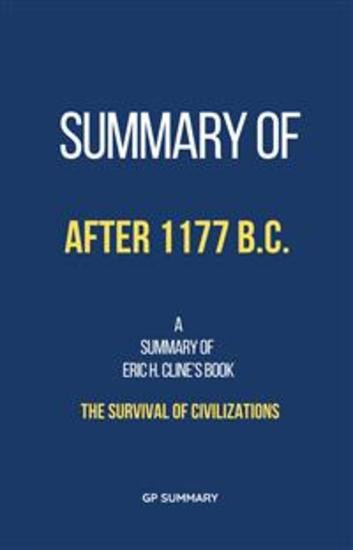
Summary of After 1177 BC by Eric H Cline: The Survival of Civilizations - cover

Summary of After 1177 BC by Eric H Cline: The Survival of Civilizations

GP SUMMARY

Casa editrice: BookRix

  • 0
  • 0
  • 0

Sinossi

DISCLAIMER

Please note that this book contains a summary of the original content, which is a condensation of the key ideas and information found in the original book.

Therefore, it is recommended to read the original book for a comprehensive and detailed understanding of the topics discussed.

This summary is provided for informational purposes only and is not intended to infringe upon the intellectual property rights of the original book.

Summary of After 1177 B.C. by Eric H. Cline: The Survival of Civilizations

IN THIS SUMMARIZED BOOK, YOU WILL GET:

	Chapter provides an astute outline of the main contents.
	Fast & simple understanding of the content analysis.
	Exceptionally summarized content that you may skip in the original book

After 1177 B.C. is a sequel to Eric Cline's 1177 B.C., detailing the aftermath of the collapse of the Late Bronze Age civilizations in the Aegean and Eastern Mediterranean. The book explores the resilience, transformation, and success of these societies in an age of chaos and reconfiguration. It highlights the collapse of powerful civilizations, leading to the emergence of new world orders and innovations like the use of iron and the alphabet. The book offers lessons for today's world about why some societies survive massive shocks while others do not, and why this period was a new age with new inventions and opportunities.
Disponibile da: 20/04/2024.
Lunghezza di stampa: 33 pagine.

Altri libri che potrebbero interessarti

  • A Classic Interview with Rock Icon George Harrison Part 1 - cover

    A Classic Interview with Rock...

    George Harrison

    • 0
    • 0
    • 0
    George Harrison (February 25, 1943 - November 29, 2001) was an English musician, singer and songwriter who achieved international fame as the lead guitarist of the Beatles. Sometimes called "the quiet Beatle," Harrison embraced Indian culture and helped broaden the scope of popular music through his incorporation of Indian instrumentation. After the break-up of  The Beatles, Harrison had a notable solo career and success as part of The Traveling Wilberys. Some of Harrison's best-known compositions as part of The Beatles, include "Taxman", "Within You Without You", "While My Guitar Gently Weeps", "Something," and "Here Comes the Sun." The following interview was recorded in 1975.
    Mostra libro
  • The American Open Road - Narrative and Popular Imagination - cover

    The American Open Road -...

    Jeffrey Alan Melton

    • 0
    • 0
    • 0
    WINNER OF THE ELIZABETH AGEE PRIZE IN AMERICAN LITERATURE  
     
    The American Open Road offers a rich exploration of how the mythos of the open road has shaped, and been shaped by, American culture. Beginning with the post–World War II boom that solidified car culture as central to American life, Melton reflects on how roads, automobiles, and landscapes have been represented in literature, film, and other cultural texts, highlighting the interplay between mobility and narrative. 
     
    Melton examines how the open road functions as a symbol of autonomy, reinvention, and resistance. He highlights how road narratives have also exposed deeper tensions in American life―especially around race, gender, and power―and how historically marginalized voices have used the road to reclaim space and tell new stories. 
     
    From the romanticism of Route 66 to the political edge of modern road films, The American Open Road offers an engaging analysis of the narratives that continue to define American identity and longing. For listeners interested in cultural history, travel literature, or the enduring pull of the highway, this book offers a compelling view from the passenger seat of America's most iconic journeys.
    Mostra libro
  • Demetrius - Sacker of Cities - cover

    Demetrius - Sacker of Cities

    James Romm

    • 0
    • 0
    • 0
    A portrait of one of the ancient world’s first political celebrities, who veered from failure to success and back again 
     
    The life of Demetrius (337–283 BCE) serves as a through-line to the forty years following the death of Alexander (323–282 BCE), a time of unparalleled turbulence and instability in the ancient world. With no monarch able to take Alexander’s place, his empire fragmented into five pieces. 
     
    Capitalizing on good looks, youth, and sexual prowess, Demetrius sought to weld those pieces together and recover the dream of a single world-state, with a new Alexander—himself—at its head. He succeeded temporarily, but in crucial, colossal engagements—a massive invasion of Egypt, a siege of Rhodes that went on a full year, and the Battle of Ipsus—he came up just short. He ended his career in a rash invasion of Asia, and he became the target of a desperate manhunt only to be captured and destroyed by his own son-in-law.
    Mostra libro
  • Critical Thinking - The Art of Rational Thought - cover

    Critical Thinking - The Art of...

    Hector Davidson

    • 0
    • 0
    • 0
    Critical thinking is the disciplined process of actively analyzing, evaluating, and synthesizing information to make reasoned judgments and decisions. It involves a systematic approach to thinking that seeks to uncover underlying assumptions, assess the validity of arguments, and apply logical reasoning to complex problems. 
      
    At its core, critical thinking is about being intellectually autonomous and reflective. It requires individuals to question and scrutinize their own beliefs, the arguments presented by others, and the evidence supporting those arguments. Critical thinkers do not accept information at face value; instead, they engage in a process of inquiry that involves several key components. 
      
    Analysis involves breaking down complex information into its constituent parts to understand its structure and relationships. This includes identifying the main arguments, assessing the relevance and quality of evidence, and understanding the context in which information is presented. 
      
    Evaluation involves assessing the credibility and strength of arguments and evidence. This requires determining whether the arguments are logically sound, whether the evidence is reliable and pertinent, and whether there are any biases or fallacies affecting the argument.
    Mostra libro
  • Joseph Stalin - cover

    Joseph Stalin

    Kelly Mass

    • 0
    • 0
    • 0
    From 1924 till his death in 1953, Joseph Vissarionovich Stalin was a Georgian revolutionary and Soviet politician who ruled the Soviet Union. He was General Secretary of the Communist Party of the Soviet Union from 1922 to 1952 and Chairman of the Soviet Union's Council of Ministers from 1941 to 1953. In spite of ruling the nation as part of a collective management, he ultimately combined power and ended up being the totalitarian of the Soviet Union by the 1930s. Stalin, a communist dedicated to Lenin's grasp of Marxism, formalized these concepts as Marxism-- Leninism, while his personal policies were called Stalinism.Stalin was born into an penniless family in Gori, Georgia, under the Russian Empire. He participated in the Tbilisi Spiritual Academy before signing up with the Marxist Russian Social Democratic Labour Party. He went on to modify the party's paper, Pravda, and used thefts, kidnappings, and security rackets to raise cash for Vladimir Lenin's Bolshevik faction. He was usually imprisoned and banished within the nation. Stalin ended up being a member of the freshly formed Communist Party's ruling Politburo when the Bolsheviks took power at the time of the October Revolution and developed a one-party state. Following Lenin's death in 1924, Stalin got control of the nation after serving in the Russian Civil War and managing the development of the Soviet Union in 1922. Socialism in one nation ended up being a major component of the party's concept under Stalin. The nation observed farming collectivization and quick industrialization because of the Five-Year Plans launched under his management, leading to a central command economy. That led to serious food production disturbances, which added to the starvation of 1932-- 33. Between 1934 and 1939, Stalin carried out the Great Purge to rid the nation of declared "working-class adversaries."
    Mostra libro
  • Healing Grounds - Climate Justice and the Deep Roots of Regenerative Farming - cover

    Healing Grounds - Climate...

    Liz Carlisle

    • 0
    • 0
    • 0
    A powerful movement is happening in farming—farmers are reconnecting with their roots to fight climate change. 


    In Healing Grounds, Liz Carlisle tells the stories of Indigenous, Black, Latinx, and Asian American farmers who are reviving their ancestors' methods of growing food—techniques long suppressed by the industrial food system. These farmers are restoring native prairies, nurturing beneficial fungi, and enriching soil health. While feeding their communities and revitalizing cultural ties to land, they are steadily stitching ecosystems back together and repairing the natural carbon cycle. This is the true regenerative agriculture—not merely a set of technical tricks for storing CO2 in the ground, but a holistic approach that values diversity in both plants and people. 


    Cultivating this kind of regenerative farming will require reckoning with our nation's agricultural history—a history marked by discrimination and displacement. And it will ultimately require dismantling power structures that have blocked many farmers of color from owning land or building wealth. 


    By coming together to restore these farmlands, we can not only heal our planet, we can heal our communities.
    Mostra libro