Unisciti a noi in un viaggio nel mondo dei libri!
Aggiungi questo libro allo scaffale
Grey
Scrivi un nuovo commento Default profile 50px
Grey
Iscriviti per leggere l'intero libro o leggi le prime pagine gratuitamente!
All characters reduced
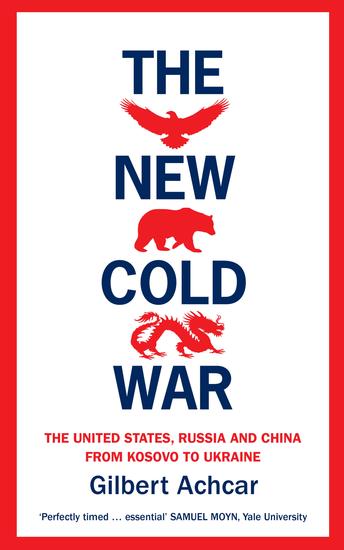
The New Cold War - The United States Russia and China - From Kosovo to Ukraine - cover

Siamo spiacenti, non è possibile leggere questo libro nel Paese da cui ti connetti.

The New Cold War - The United States Russia and China - From Kosovo to Ukraine

Gilbert Achcar

Casa editrice: Saqi Books

  • 0
  • 0
  • 0

Sinossi

One of the world's most seasoned international relations experts updates and revises his far-sighted 1999 book arguing that the Cold War did not, in fact, end with the collapse of the USSR – and that the US, Russia and China today are locked anew in a spiral of hostilities.
Disponibile da: 14/02/2023.
Lunghezza di stampa: 368 pagine.

Altri libri che potrebbero interessarti

  • Nahum - The World English Bible Book 34 (Unabridged) - cover

    Nahum - The World English Bible...

    Various Authors

    • 0
    • 0
    • 0
    The Book of Nahum is the seventh book of the 12 minor prophets of the Hebrew Bible. It is attributed to the prophet Nahum, and was probably written in Jerusalem in the 7th century BC.
    Mostra libro
  • Nuts and Bolts - Seven Small Inventions That Changed the World (in a Big Way) - cover

    Nuts and Bolts - Seven Small...

    Roma Agrawal

    • 0
    • 0
    • 0
    A structural engineer examines the seven most basic building blocks of engineering that have shaped the modern world. 


    Some of engineering's mightiest achievements are small in scale, even hidden—and yet, without them, the complex machinery on which our modern world runs would not exist. In Nuts and Bolts, Roma Agrawal examines seven of these extraordinary elements: the nail, the wheel, the spring, the lens, the magnet, the string, and the pump. 


    From the physics behind both Roman nails and modern skyscrapers to rudimentary springs that inspired lithium batteries, Agrawal shows us how even the most sophisticated items are built on the foundations of these ancient and fundamental breakthroughs in engineering. Agrawal explores an array of intricate technologies—dishwashers, spacesuits, microscopes, suspension bridges, breast pumps—making surprising connections and explaining how they work. Along the way, she recounts the stories of remarkable scientists and engineers from all over the world, and reveals how engineering has fundamentally changed the way we live.
    Mostra libro
  • America’s Greatest Engineering Projects: The Construction History of the Transcontinental Railroad the Panama Canal and the Hoover Dam - cover

    America’s Greatest Engineering...

    Editors Charles River

    • 0
    • 0
    • 0
    The Transcontinental Railroad, laid across the United States during the 1860s, remains the very epitome of contradiction. On the one hand, it was a triumph of engineering skills over thousands of miles of rough terrain, but on the other hand, it drained the natural resources in those places nearly dry. It “civilized” the American West by making it easier for women and children to travel there, but it dispossessed Native American civilizations that had lived there for generations. It made the careers of many men and destroyed the lives from many others. It was bold and careless, ingenious and cruel, gentle and violent, and it enriched some and bankrupted others. In short, it was the best and worst of 19th century America in action. 
    Traveling around the tip of South America was fraught with danger, and European explorers and settlers had proposed building a canal in Panama or Nicaragua several centuries before the Panama Canal was actually built. Taking about 10 years to build, workers had to excavate millions of cubic yards of earth and fight off hordes of insects to make Roosevelt’s vision a reality. Roosevelt also had to tie up the U.S. Navy in a revolt in Colombia to ensure Panama could become independent and thus ensure America had control of the canal. 
    During the 1930s, at the height of the Great Depression, thousands of workers began work on the Hoover Dam, built in the Black Canyon, which had been cut by the powerful Colorado River. The Colorado River was responsible for the Grand Canyon, and by the 20th century, the idea of damming the river and creating an artificial lake was being explored for all of its potential, including hydroelectric power and irrigation. By the time the project was proposed in the 1920s, the contractors vowing to build it were facing the challenge of building the largest dam the world had ever known. As if that wasn’t enough, the landscape was completely unforgiving.
    Mostra libro
  • Courage Doesn't Always Roar and Sometimes It Does - Re-Defining Courage with Daily Inspirations - cover

    Courage Doesn't Always Roar and...

    Mary Anne Radmacher

    • 0
    • 0
    • 0
    Discover Your Inner Courage“Courage doesn't always roar. Sometimes courage is the quiet voice at the end of the day saying, 'I will try again tomorrow.'"  —Mary Anne Rademacher#1 New Release in Humanist PhilosophyWritten initially as part of a longer poem and featured in a gallery show in 1985, these words by Mary Anne Rademacher defining courage have traveled the globe.Defining courage in a beloved quote.  The quote has been featured in ceremonies of all sorts and included in sports and network news broadcasts. Oprah has included it in her magazine and journalists include it in “top ten” lists across many disciplines and categories. And, it is among the most beloved quotes on cards, posters, journals, and gift books.Bravery comes in many forms.  Rademacher insists in her book that we overlook opportunities for growth and personal celebration by shrugging off courageous acts of perseverance with, “I just did what I felt I had to do.” Courage shows itself in many ways from having the courage to heal, to change habits, to learn and begin anew, or even to speak up for yourself.Defining courage with daily inspirations.  This daily companion for women, men, or anyone who wants to change for good, and live a bolder, more courageous life may be the perfect addition to the start of your day or the key to letting go and ending your day right. Featuring an introduction from courage specialist, Candace Doby,  Courage Doesn't Always Roar  begins as an invitation to recognize all of the ways courage, and the associated risk, show up on ordinary days.  Inside you’ll find:Keys to finding and defining courage in your everyday life180 entries covering all aspects of courage, like: resilience, thresholds, choices, grace, and moreMental health-friendly inspirations meant to shape the way you think about courageIf you liked  Courage is Calling, Inward, or  Designing the Mind, you’ll love Courage Doesn’t Always Roar.
    Mostra libro

  • KGB History: 100 Years Of Soviet Terror - The Secret Police Of Russia: Cheka GPU OGPU NKVD KGB FSK & FSB - cover

    KGB History: 100 Years Of Soviet...

    HISTORY FOREVER

    • 0
    • 0
    • 0
    ★ Did you know that the first KGB was called Cheka and formed in 1917? ★ 
    ★ Did you know that the KGB once was the largest secret police and foreign-intelligence organization in the world? ★ 
      
    ★ BUY THIS BOOK NOW AND LEARN ABOUT THE LARGEST SECRET POLICE TODAY! ★ 
    In this book you will discover; 
    ·       Why KGB is so feared 
    ·       The Early Years of KGB - Cheka 
    ·       The Early Years of KGB - GPU 
    ·       The Early Years of KGB - OGPU 
    ·       OGPU & The Soviet State 
    ·       The NKVD and the Forming of KGB 
    ·       The new KGB: FSK & FSB 
    ·       How Stalin's NKVD Spies Took Down Trotsky       
    ·       The end of a superpower - The collapse of the Soviet Union 
    ·       How Novichok used as Political Instrument 
    ★ BUY THIS BOOK NOW AND LEARN ABOUT THE LARGEST SECRET POLICE TODAY! ★
    Mostra libro
  • Dirty Linen - The Troubles In My Home Place - cover

    Dirty Linen - The Troubles In My...

    Martin Doyle

    • 0
    • 0
    • 0
    Martin Doyle, Books Editor of The Irish Times, offers a personal, intimate history of the Troubles seen through the microcosm of a single rural parish, his own, part of both the Linen Triangle – heartland of the North’s defining industry – and the Murder Triangle – the Badlands roamed by the Glenanne gang of security forces colluding with loyalist paramilarites. He lifts the veil of silence drawn over the horrors of the past, recording in heartrending detail the terrible toll the conflict took – more than 20 violent deaths in a few square miles – and the long tail of trauma it has left behind. He also conveys the texture of the times, the high streets where cars could not be left unattended, the newsflashes, the constant background buzz of threat and fear. 
    Neighbours and classmates who lost loved ones in the conflict, survivors maimed in bomb attacks and victims of sectarianism, both Catholic and Protestant, entrust him with their stories. Doyle marries his local knowledge with a literary sensibility and skilfully shows how the once dominant local linen industry serves as a metaphor for both communal division but also the solidarity that transcended the sectarian divide. 
    To those who might ask why you would want to reopen old wounds, the answer might be that some wounds have never been allowed to heal. It is by sharing our stories that we build a ridge of common ground from which good things can grow.
    Mostra libro