Unisciti a noi in un viaggio nel mondo dei libri!
Aggiungi questo libro allo scaffale
Grey
Scrivi un nuovo commento Default profile 50px
Grey
Iscriviti per leggere l'intero libro o leggi le prime pagine gratuitamente!
All characters reduced
Change in the Village - cover

Change in the Village

George Sturt

Casa editrice: DigiCat

  • 0
  • 0
  • 0

Sinossi

In "Change in the Village," George Sturt navigates the delicate landscape of rural life during the early 20th century, capturing the transformations that accompany modernization. With a keen eye for detail and a lyrical prose style, Sturt evokes the shifting dynamics of village life, interweaving personal narratives with broader social and economic changes. This semi-autobiographical work stands as a poignant reflection on the tension between tradition and progress, set against the backdrop of an England on the cusp of profound change. Sturt's adept use of imagery and local dialect immerses readers in the authentic spirit of his idyllic yet shifting rural community. George Sturt, born in 1863, drew from his own experiences as a farmer's son and village resident, providing an authentic voice to the narratives he presents. His intimate knowledge of local customs and the socio-economic challenges faced by villagers informs the text, allowing readers to grasp the emotional weight of the changes he meticulously records. Sturt's literary career reflects a broader literary movement that sought to capture the realities of English rural life, and his writing is often situated within the context of early 20th-century rural sociology. I highly recommend "Change in the Village" to readers interested in the intersection of literature, sociology, and history. Sturt's rich portrayal of village life invites reflection on the broader implications of change that resonate even today, making it an essential read for anyone exploring the nuances of community identity and heritage.
Disponibile da: 01/08/2022.
Lunghezza di stampa: 183 pagine.
Altri libri che potrebbero interessarti

  • A Treatise of Human Nature - cover

    A Treatise of Human Nature

    David Hume

    • 0
    • 0
    • 0
    A Treatise of Human Nature is a philosophical work written by the Scottish philosopher David Hume and published in three volumes between 1739 and 1740. The book explores a wide range of philosophical topics, including metaphysics, epistemology, ethics, and aesthetics, and it is considered one of the most influential works in the history of philosophy. 
    Hume's central thesis is that all human knowledge is ultimately derived from sensory experience, and that there is no inherent connection between cause and effect. He argues that our beliefs about cause and effect are based on custom and habit, rather than any rational or logical foundation. This leads him to challenge many traditional metaphysical and religious beliefs, including the existence of God and the immortality of the soul. 
    Hume's skeptical approach to knowledge and causality is also applied to ethics and aesthetics. He argues that moral judgments and aesthetic preferences are not based on reason, but rather on subjective feelings and emotions. This leads him to reject the idea of objective moral and aesthetic standards, and to propose a theory of moral and aesthetic relativism. 
    Despite its controversial and radical views, A Treatise of Human Nature is widely regarded as a masterpiece of philosophical writing, and has had a profound influence on subsequent philosophical thought.
    Mostra libro
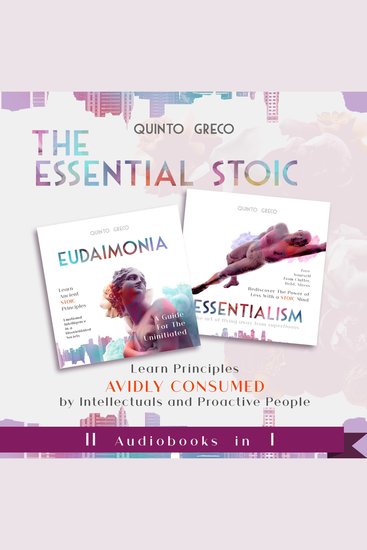
  • Essential Stoic: Eudaimonia & Essentialism (II in I) - Learn Principles Avidly consumed by Intellectuals and Proactive People - cover

    Essential Stoic: Eudaimonia &...

    Quinto Greco

    • 0
    • 0
    • 0
    ENJOY THIS CONTENT ASPIRING STOIC!In this Bundle you will get all the basic principles of Eudaimonia - Stoicism for the Uninitiated and those principle applied into a lifestyle that we can call Essentialism. Both Stoicim and Essentialism are in my opinion closely related, both disciplines praise the art of the simple life. It may take a while to master it but the price in not trying it can be high in terms of stress, dissatisfaction and a general lack of wellness in this disorientated society.Just Remember: "Only discipline brings freedom, only freedom brings happiness and happiness is a discipline".You are here welcome. I hope these contents really help you in becoming that "best version" you want to become. Thanks for dropping by.This bundle contains:. Eudaimonia:  Learn Ancient STOIC principles - A Guide For The Uninitiated. Essentialism:  Rediscover The Power of Less with a STOIC MindIn Eudaimonia. Relevance of Philosophy . Stoicism in Context . Marcus Aurelius . Eudaimonia . The Dichotomy of Control . Emotional Endurance . Stoicism and Emotions . Prepare for The Day . Conquer Fears . Practicing vs. ExplainingIn Essentialism. Adopting the Habits of an Essentialist . The Invaluable Benefits of Becoming an Essentialist . Reclaiming Control to Become the Master of Your Own Destiny . The Principles of Essentialism . Fueling Your Focus - Building Clarity and Purpose with Stoicism . The Devastating Debt Disadvantage . Understanding the Nature of Your Possessions . Decluttering Your Life . Time Is of the Essence . Creating an Effective Routine for Yourself. AND MORE!
    Mostra libro
  • Mark - The World English Bible Book 41 (Unabridged) - cover

    Mark - The World English Bible...

    Various Authors

    • 0
    • 0
    • 0
    The Gospel of Mark is the second of the four canonical gospels and of the three synoptic Gospels. It tells of the ministry of Jesus from his baptism by John the Baptist to his death, burial, and the discovery of his empty tomb. There is no miraculous birth or doctrine of divine pre-existence, nor, in the original ending (Mark 16:1-8), any post-resurrection appearances of Jesus. It portrays Jesus as a teacher, an exorcist, a healer, and a miracle worker. He refers to himself as the Son of Man.
    Mostra libro
  • Deceptive Influence - Using Misleading Tactics to Affect Other's Decisions - cover

    Deceptive Influence - Using...

    Cito Harder

    • 0
    • 0
    • 0
    Deceptive influence is a powerful tool used to manipulate thoughts, emotions, and decisions without the awareness of the affected individual. It operates through misleading tactics that distort reality, making people believe in false narratives or act against their best interests. This form of influence is found in various aspects of life, from personal relationships and workplaces to politics, marketing, and media. While influence itself is a natural part of human interaction, deception adds a layer of unethical persuasion that raises moral and psychological concerns. 
    At its core, deceptive influence relies on psychological vulnerabilities. People tend to trust familiar sources, respond emotionally before rationally analyzing information, and make decisions based on incomplete or distorted data. Manipulators exploit these tendencies by using selective truth, exaggeration, omission of key facts, and emotional appeals to push individuals toward specific actions or beliefs. The effectiveness of deceptive influence is largely due to its subtlety; victims often fail to recognize they are being misled until it is too late. 
    One of the most concerning aspects of deceptive influence is its widespread presence in modern society. In personal relationships, individuals may use gaslighting, guilt-tripping, or selective storytelling to control or manipulate their partners, friends, or family members. In the workplace, deceptive influence appears in corporate messaging, office politics, and misleading leadership practices. Companies use psychological tactics to create false urgency, encourage impulsive decisions, or present misleading information to employees and consumers.
    Mostra libro
  • Summer 2009 - A Journey of Self-Discovery Amidst the Afghanistan War - cover

    Summer 2009 - A Journey of...

    Andrew Coville

    • 0
    • 0
    • 0
    The Afghanistan war endured for two decades, involving an all-volunteer military force deployed repeatedly between 2001-2021. Over the course of these 20 years, thousands of young Americans lived through their own unique versions of the war, each marked by personal war stories and life-altering events. The war concluded on August 30th, 2021, leaving both the United States and the people of Afghanistan with a somber and perplexing aftermath. An entire generation now grapples with questions surrounding the reasons behind their sacrifices, as well as the thousands of lives lost or forever changed during the conflict. 
    This narrative presents a firsthand account of a Marine who played a small role in the Afghan War. It begins with his enlistment in the Marine Corps immediately after high school, driven by dreams of earning the prestigious title of United States Marine and serving his country in combat. The story culminates with his reentry into the civilian world, marked by the challenging task of making sense of the profound experiences he underwent. 
    The account unfolds through a journey kept by the Marine during a significant offensive in the Helmand Province in the summer of 2009. These firsthand entries, composed by a 21-year-old, are revisited 15 years later, offering a continually evolving perspective and outlook on life. This is not merely a war story, or a detailed military operation account; rather, it is a vulnerable and revealing exploration into the inner thoughts of a young man navigating the complexities of war. It delves into what he learned from those experiences as the years unfolded.
    Mostra libro
  • Responses to 7 October: Universities - cover

    Responses to 7 October:...

    David Hirsh, Rosa Freedman, Eric...

    • 0
    • 0
    • 0
    One of three volumes responding to the 7 October attack, Universities focuses on the heartland of contemporary antisemitic thinking, which is scholarship; and its reflection in student discourse on campus. 
    Contributions go back to Sartre and to debates of Marx’s time; another looks at the New Left forged in the civil rights movement, and shows how antisemitic responses to the 2023 violence were anticipated by some of the responses to the 1967 Arab League aggression. The feminist movement and ‘progressives’ more generally come under scrutiny, and there is analysis of antisemitism on campus after 7 October, showing how it is tolerated and protected there; including in archaeological attempts to deny that there is an ancient Jewish history in Israel. 
    This work will appeal to scholars, students and activists with an interest in antisemitism, Jewish studies and the politics of Israel.
    Mostra libro