Unisciti a noi in un viaggio nel mondo dei libri!
Aggiungi questo libro allo scaffale
Grey
Scrivi un nuovo commento Default profile 50px
Grey
Iscriviti per leggere l'intero libro o leggi le prime pagine gratuitamente!
All characters reduced
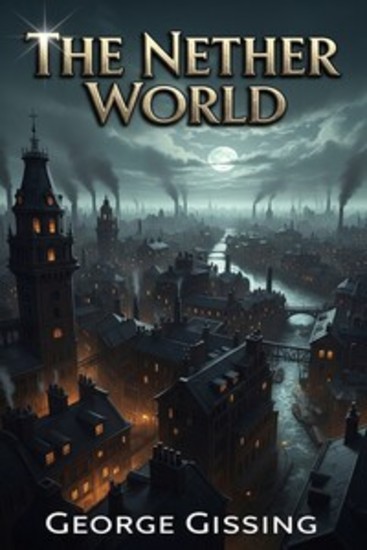
The Nether World - cover

The Nether World

George Gissing

Casa editrice: Bu Classics Books

  • 0
  • 0
  • 0

Sinossi

In the smoke-choked slums of Clerkenwell, the struggle for survival strips humanity down to its rawest elements. Characters fight against a destiny dictated by crushing poverty, where hope is a dangerous luxury and charity is often futile. This is a bleak, uncompromising vision of the urban underclass that refuses to look away from the darkness.
Disponibile da: 05/03/2026.
Lunghezza di stampa: 641 pagine.

Altri libri che potrebbero interessarti

  • The Lesson - From their pens to your ears genius in every story - cover

    The Lesson - From their pens to...

    Jerome K. Jerome

    • 0
    • 0
    • 0
    Jerome Klapka Jerome was born on the 2nd May 1859 at Belsize House in Caldmore, Walsall, England. 
    His family were reduced to poverty whilst he was a toddler owning to failed investments in the local mining industry. 
    After several moves in declining circumstances Jerome became a pupil at St Marylebone Grammar School.  His aim then was to go into politics, or even become a man of letters, but with the death of his father, when he was thirteen, and his mother two years later, now meant that he had to support himself and leave all thoughts of education behind. 
    He spent four years working for the London and North Western Railway, initially collecting coal that fell along the railway lines.  Thereafter, using the name Harold Crichton, he tried his hand at acting but the repertory company he joined was stretched in its resources and, at times, relied on the actors to purchase their own props and costumes.  After three years he tried journalism, teaching and work as a solicitor’s clerk.  All came to nothing.  Finally, in 1885, he had some success with ‘On the Stage―and Off’, a comic memoir collection of his stage experiences and his early attempts at acting.  
    Shortly thereafter he married and his honeymoon on the Thames became the inspiration for ‘Three Men in a Boat’.  This of course was a wild success, both critically and commercially, but also his creative high point.  
    Although he was now able to write full time, he was never able to attain all the heights of that classic humorous novel.  He remained a prolific writer of novels, plays and short stories and its from those classic works that these stories have been mined. 
    Jerome K Jerome died in Northampton General Hospital on the 14th June 1927 two weeks after suffering a paralytic stroke and a cerebral haemorrhage on a motoring tour.  He was 68.
    Mostra libro
  • A Man with Two Lives - From their pens to your ears genius in every story - cover

    A Man with Two Lives - From...

    Ambrose Bierce

    • 0
    • 0
    • 0
    Ambrose Gwinnett Bierce was born on 24th June 1842 at Horse Cave Creek in Meigs County, Ohio. His parents were poor but they introduced him to literature at an early age, instilling in him a deep appreciation of books, the written word and the elegance of language.  
    Growing up in Koscuisko County, Indiana poverty and religion were defining features of his childhood, and he would later describe his parents as “unwashed savages” and fanatically religious, showing him little affection but always quick to punish. He came to resent religion, and his introduction to literature appears to be their only positive effect. 
    At age 15 Bierce left home to become a printer’s devil, mixing ink and fetching type at The Northern Indian, a small Ohio paper. Falsely accused of theft he returned to his farm and spent time sending out work in the hopes of being published. 
    His Uncle Lucius advised he be sent to the Kentucky Military Institute. A year later he was commissioned as an Officer.  As the Civil War started Bierce enlisted in the 9th Indiana Infantry Regiment.  
    In April 1862 Bierce fought at the Battle of Shiloh, an experience which, though terrifying, became the source of several short stories. Two years later he sustained a serious head wound and was off duty for several months. He was discharged in early 1865.  
    A later expedition to inspect military outposts across the Great Plains took him all the way to San Francisco. He remained there to become involved with publishing and editing and to marry, Mary Ellen on Christmas Day 1871.  They had a child, Day, the following year.  
    In 1872 the family moved to England for 3 years where he wrote for Fun magazine. His son, Leigh, was born, and first book, ‘The Fiend’s Delight’, was published.  
    They returned to San Francisco and to work for a number of papers where he gained admiration for his crime reporting. In 1887 he began a column at the William Randolph Hearst’s San Francisco Examiner.  
    Bierce’s marriage fell apart when he discovered compromising letters to his wife from a secret admirer. The following year, 1889 his son Day committed suicide, depressed by romantic rejection. 
    In 1891 Bierce wrote and published the collection of 26 short stories which included ‘An Occurrence at Owl Creek Bridge’.  Success and further works including poetry followed.  
    Bierce with Hearst’s resources helped uncover a financial plot by a railroad to turn 130 million dollars of loans into a handout. Confronted by the railroad and asked to name his price Bierce answered “my price is $130 million dollars. If, when you are ready to pay, I happen to be out of town, you may hand it over to my friend, the Treasurer of the United States”.  
    He now began his first foray as a fabulist, publishing ‘Fantastic Fables’ in 1899.  But tragedy again struck two years later when his second son Leigh died of pneumonia relating to his alcoholism.  
    He continued to write short stories and poetry and also published ‘The Devil’s Dictionary’.  
    At the age of 71, in 1913 Bierce departed from Washington, D.C., for a tour of the battlefields where he had fought during the civil war. At the city of Chihuahua he wrote his last known communication, a letter to a friend. It’s closing words were “as to me, I leave here tomorrow for an unknown destination,” Ambrose Bierce then vanished without trace.
    Mostra libro
  • The Drug - From their pens to your ears genius in every story - cover

    The Drug - From their pens to...

    Aleister Crowley

    • 0
    • 0
    • 0
    Edward Alexander Crowley was born on 12th October 1875 to wealthy parents in Royal Leamington Spa in Warwickshire. 
    He was educated at Malvern College, Tonbridge School, Eastbourne College and finally Trinity College, Cambridge where he focused on his passions of mountaineering and poetry and published several volumes. 
    Life for Crowley was to abandon his parents’ Christian faith and instead to inject himself into Western esotericism.  In 1898, he joined the esoteric Hermetic Order of the Golden Dawn and was trained in ceremonial magic before studying both Hindu and Buddhist practices in India. 
    On his Egyptian honeymoon in 1904 he claimed contact with an entity―Aiwass―who gave him the sacred Book of the Law which served as the basis for the Thelema religion where he identified as its prophet.  During the Great War, which he spent in the United States, he claimed to be working for British Intelligence but by the 1920s he had decamped to pursue a libertine lifestyle in Sicily, and in the ensuing scandals was evicted by the Italian Government. 
    He divided the following two decades between France, Germany, and England, and the continuing promotion of Thelema. 
    During his life he gained widespread notoriety for his drug use, his bisexuality, and his alarming views on society.  In short, polite society frowned on his ways, his thoughts and his influence but to many others his stance had much of value.  Even after death he was a darling for the 60’s counterculture but his influence has since waned.   
    His literary works were both prolific and covered many topics.  In the early part of his career he published many poetry books, even plays, before his darker and more forceful works came to dominate his output. 
    Aleister Crowley died on 1st December 1947 at Hastings in England. He was 72.
    Mostra libro
  • From the Earth to the Moon - A Visionary Science Fiction Classic: Join the Baltimore Gun Club as They Engineer the Ultimate Cannon to Shoot Humanity's First Projectile to the Lunar Surface - cover

    From the Earth to the Moon - A...

    Jules Verne

    • 0
    • 0
    • 0
    Before Apollo, before the Space Race, there was the Baltimore Gun Club and a daring dream to conquer the stars. 
    The American Civil War has ended, and the brilliant, eccentric artillerists of the Baltimore Gun Club find themselves bored and yearning for a new target. Enter their cold, calculating, and wildly ambitious president, Impey Barbicane. When Barbicane casually proposes a plan to construct a cannon of unimaginable proportions—capable of firing a massive projectile 250,000 miles to the Moon—the world is sent into a frenzy of scientific fervor. From calculating the crushing limits of gravity and designing explosive new powders to fending off bitter rivals and skeptical astronomers, Barbicane and his crew must overcome seemingly insurmountable engineering hurdles. As global excitement reaches a fever pitch and millions of dollars are raised, the stakes soar. But the question remains: will the massive Columbiad blast them into glorious history, or explode into a catastrophic failure? 
    Why you will love this: Fans of hard Science Fiction, space exploration tropes, and steampunk aesthetics will be spellbound by Jules Verne's astonishingly prophetic vision. This audiobook blends technical ingenuity, satirical humor, and pulse-pounding engineering suspense into an unforgettable space opera and scientific adventure. 
    About the Author: Jules Verne is widely celebrated as the "Father of Science Fiction." Writing in the 19th century, his meticulous research and boundless imagination predicted technological marvels like submarines, space travel, and helicopters decades before they became reality.
    Mostra libro
  • Fair Exchange and No Robbery - cover

    Fair Exchange and No Robbery

    Lucy Maud Montgomery

    • 0
    • 0
    • 0
    Lucy Maud Montgomery (November 30, 1874 – April 24, 1942), published as L. M. Montgomery, was a Canadian author best known for a series of novels beginning in 1908 with Anne of Green Gables. The book was an immediate success. The title character, orphan Anne Shirley, made Montgomery famous in her lifetime and gave her an international following.
    Fair Exchange and No Robbery: Katherine Rangely was packing up. Her chum and roommate, Edith Wilmer, was sitting on the bed watching her in that calm disinterested fashion peculiarly maddening to a bewildered packer.
    Mostra libro
  • Demir-Kaya - From their pens to your ears genius in every story - cover

    Demir-Kaya - From their pens to...

    Alexander Kuprin

    • 0
    • 0
    • 0
    Alexander Kuprin was born in Narovchat, Penza in Russia on 7th September 1870. 
    At 3 his Father died and he and mother moved to Moscow. By 10 he was enrolled at the Second Moscow Military High School and there his interest in literature began. The Alexander Military Academy followed and two years later he was a sub-lieutenant and posted to an Infantry Regiment for a further four years. 
    Despite his duties he was a now a keen writer and published his first short story at this time. His military duties also garnered him experiences for his breakthrough work ‘The Duel’.  Leaving the military he left for Kiev to work for local newspapers.  He continued to publish both stories and novels and by 1901 he was in St Petersburg becoming part of a group that included Chekhov, Ivan Bunin, Maxim Gorky and Leonid Andreyev.  
    In the years that followed further controversial works and acclaim followed.  His comments on the regime meant he was also put under secret police surveillance.   
    As World War I erupted, Kuprin opened a military hospital but was then given command of an infantry company in Finland. He was soon discharged on grounds of ill health.  
    The October Revolution saw him praise Lenin, but he warned that the Bolsheviks threatened Russian culture and might cause further widespread suffering to the peasants.  As Civil War raged he took his family to Helsinki and then on to Paris. 
    Exile saw his talents decline further and his succumbing to alcoholism. He became lonely and withdrawn. The family's poverty increased his malaise.   
    In May 1937, the Kuprin’s returned to Moscow.  He now saw his work published but wrote almost nothing new.  In 1938 his health rapidly deteriorated.  Already suffering from a kidney problems and sclerosis, he had now developed cancer of the oesophagus.  
    Alexander Kuprin died on 25th August 1938.
    Mostra libro