Unisciti a noi in un viaggio nel mondo dei libri!
Aggiungi questo libro allo scaffale
Grey
Scrivi un nuovo commento Default profile 50px
Grey
Iscriviti per leggere l'intero libro o leggi le prime pagine gratuitamente!
All characters reduced
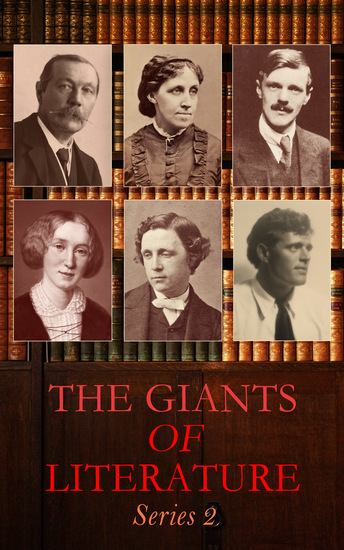
The Giants of Literature: Series 2 - Complete Novels by George Eliot Thomas Hardy Louisa May Alcott Henry James Mary Shelley Jack London Lewis Carroll D H Lawrence - cover

The Giants of Literature: Series 2 - Complete Novels by George Eliot Thomas Hardy Louisa May Alcott Henry James Mary Shelley Jack London Lewis Carroll D H Lawrence

George Eliot, Lewis Carroll, Louisa May Alcott, Henry James, D. H. Lawrence, Mary Shelley, Arthur Conan Doyle, Thomas Hardy, Jack London, Homer Homer

Casa editrice: e-artnow

  • 0
  • 0
  • 0

Sinossi

E-artnow presents to you "The Giants of Literature" – an ultimate anthology of world literature classics. This meticulously edited collection consists of the complete novels and most important works by the greatest writers of all time.
This volume includes:
Homer: The Complete Works
George Eliot: The Complete Novels
Henry James: The Complete Novels
D. H. Lawrence: The Complete Novels
Mary Shelley: The Complete Novels
Lewis Carroll: The Complete Novels
Thomas Hardy: The Complete Novels
Louisa May Alcott: The Complete Novels
Jack London: The Complete Novels
Arthur Conan Doyle: The Complete Sherlock Holmes Books
Disponibile da: 20/07/2024.
Lunghezza di stampa: 33410 pagine.

Altri libri che potrebbero interessarti

  • Edna Ferber: The Woman Who Tried To Be Good - Before she tried to be a good woman she had been a very bad woman - cover

    Edna Ferber: The Woman Who Tried...

    Edna Ferber

    • 0
    • 0
    • 0
    "Before she tried to be a good woman she had been a very bad woman—so bad that she could trail her wonderful apparel up and down Main Street, from the Elm Tree Bakery to the railroad tracks, without once having a man doff his hat to her or a woman bow. You passed her on the street with a surreptitious glance, though she was well worth looking at—in her furs and laces and plumes. She had the only full-length mink coat in our town, and Ganz's shoe store sent to Chicago for her shoes. Hers were the miraculously small feet you frequently see in stout women. 
    For she owned the House with the Closed Shutters, near the freight depot—did Blanche Devine".
    Mostra libro
  • A Perplexing Case - From their pens to your ears genius in every story - cover

    A Perplexing Case - From their...

    H D Everett

    • 0
    • 0
    • 0
    Henrietta Dorothy Huskisson was born in January 1851 in Gillingham, Kent. 
    Little reliable information on her life is available and almost nothing on her early life.   
    The first concrete information concerns her marriage at age 18 to the solicitor Isaac Edward Everett. 
    It was only at the age of 44 that she began her literary career under the pseudonym of Theo Douglas, a popular device in a society that still frowned upon women writing for income. 
    During her lifetime she was a popular author and wrote 22 books and those were published by 17 different publishers. 
    Although she wrote some historical novels her main output was centered on fantasy and supernatural themes. 
    Henrietta Dorothy Everett died in Weston-on-Trent in Derbyshire in September 1923.
    Mostra libro
  • Old Fashioned Landowners - Gogols story of an aging couple who must confont the harsh lessons of mortality - cover

    Old Fashioned Landowners -...

    Nikolai Gogol

    • 0
    • 0
    • 0
    Nikolai Vasilievich Gogol was born on 1st April 1809 to a father, descended from Ukrainian Cossacks and a mother with a military background in the Ukrainian town of Sorochyntsi, then part of the Russian Empire and rich in Cossack traditions and folklore.   
     
    His father wrote poetry and plays which the young Gogol helped stage at his uncle’s home theatre.  This helped ignite in him a love of literature and blossomed when he attended, what is now, the Nizhyn Gogol State University at the age of 12.  Here he participated in school theatre productions and refined his mastery of his native Ukrainian and also the Russian of his Imperial masters. 
     
    In 1828 he went to St Petersburg and unsuccessfully tried to begin a career as an actor after finding that with no money and no connections the civil service was barred to him. 
     
    Embezzling money from his mother he embarked on a trip to Germany. When the money ran out, he returned to St Petersburg but the experiences were used in a series of stories he contributed to periodicals.  These tales were steeped in his childhood memories of the Ukrainian landscape and peasantry enlivened with the supernatural of its folklore woven with realistic events of the day.  He wrote in Russian in a whimsical, colloquial style with a smattering of Ukrainian words and phrases that provided an authenticity.  Eight stories were published as ‘Evenings on a Farm near Dikanka’.  Seemingly all at once fame and fortune arrived. Gogol was hailed by his contemporaries, including Pushkin, as a pre-eminent writer of Russian literature.   
     
    His success continued with his brilliant plays ‘The Inspector General’ and the comedy ‘The Marriage for the Theatre’, both being highly acclaimed.   
     
    In 1834 he became Professor of Medieval History at the University of St. Petersburg but with little academic or teacher training, failed to adequately fulfil many of his duties and soon resigned this post.  With no obligations and using his earnings from his writing, which now included the impressionistic and immortal ‘Dead Souls’, Gogol travelled around Europe, spending the most time in Rome where he studied art, read Italian literature and developed a passion for opera.  
     
    In the 1840s Gogol became preoccupied with a need to purify his soul and embarked on a pilgrimage to Jerusalem. In tandem he fell under the influence of a strict and austere spiritual ascetic who persuaded him to observe strict fasts that, allied with his depression and deteriorating health, contributed to his death on 21st April 1852 at the age of only 43. 
     
    In ‘Old Fashioned Land Owners’ Gogol describes a peaceful setting and a peaceful couple who have grown old together.  But foreboding makes an entrance and life is now a series of cruel twists that breaks everything.
    Mostra libro
  • Pretty Ugly - cover

    Pretty Ugly

    Kirsty Gunn

    • 0
    • 1
    • 0
    Contradictions (both real and apparent), oppositions, enigmas, provocations, challenges——this is the kind of material that makes a life, and is the kind of material that, in fiction, one is never quite sure of. With Pretty Ugly, Kirsty Gunn reminds us again that she is a master of just such stuff, presenting ambiguity and complication as the essence of the storyteller's endeavour.
     
    The sheer force of life that Gunn is able to load these stories up with is both testament to her unrivalled skill and an exercise in what she describes as 'reading and writing ugly', in order to pursue the deeper truths that lie at the heart of both the human imagination and human rationality.
     
    So here we have all the strange and seemingly impossible dualities that make up real life——and pretty ugly it can be, as well as beautiful, hopeful, bleak, difficult, exhilarating. But never, ever dull.
     
    Mostra libro
  • Whimsical Wonders - 50 Tales of Fictional Fun - cover

    Whimsical Wonders - 50 Tales of...

    Derick Chibilu

    • 0
    • 0
    • 0
    Whimsical Wonders: 50 Tales of Fictional Fun is a delightful collection of stories that will capture your imagination and transport you to a world of whimsy and wonder. These stories are a product of the creative mind of Mr. Derick Chibilu, a lover of fun and fanciful tales. 
    Whether you're a child or an adult, you'll find something to love in this collection. The stories are crafted to be engaging, entertaining, and imaginative, providing a much-needed escape from the stresses of everyday life. 
    Mr. Chibilu has poured his heart and soul into creating these tales, and it shows in the quality of the writing. Each story is unique and original, with colorful characters, surprising plot twists, and a healthy dose of humor. From talking animals to enchanted forests, from brave heroes to mischievous fairies, these stories will captivate your imagination and leave you wanting more. 
    This collection is perfect for reading on the go - whether you're on a long flight, waiting at the doctor's office, or taking a break from the hustle and bustle of daily life. The stories are also ideal for bedtime reading, as they are suitable for all ages and will inspire sweet dreams and playful imaginations. 
    If you're looking for a collection of fun and lighthearted stories that will make you smile, Whimsical Wonders: 50 Tales of Fictional Fun is the book for you. So why not pick up a copy today and join Mr. Chibilu on a journey through his imaginative world of whimsy and wonder? You won't be disappointed!
    Mostra libro
  • Before the Law - From their pens to your ears genius in every story - cover

    Before the Law - From their pens...

    Franz Kafka

    • 0
    • 0
    • 0
    Franz Kafka was born on 3rd July 1883 in Prague, then in Bohemia, the eldest of 6, into a middle-class Jewish family. 
    Life for the young Kafka and his passion for literature was often made an ordeal by his over-bearing and domineering entrepreneur of a father.   
    In 1889 Kafka was sent to the Deutsche Knabenschule, an elementary school in Prague. His father would only allow him to be educated in German-speaking schools and even went so far as to limit visits to the synagogue to four a year. 
    In 1901 he graduated from the classics-oriented Altstädter Gymnasium. Kafka did well there and across a large range of subjects.  He now enrolled at the Charles Ferdinand University, to study chemistry, but quickly switched to law for which he obtained his degree in June 1906 and then performed the mandatory year of unpaid service as clerk at the civil and criminal courts. 
    A job at an Italian insurance company left him little time to write and after a year he took another job with the Worker's Accident Insurance Institute for the Kingdom of Bohemia where he stayed until ill health led to his resignation in 1922. 
    Although he saw work as a means to pay the bills and to allow him time to write, he received several promotions and was noted as a good employee. 
    By 1917 Kafka was suffering from tuberculosis, which required frequent periods of convalescence. Interspersed with this, were several intense affairs before he settled in Berlin with Dora Diamant, a 25-year-old kindergarten teacher who herself having left the ghetto now influenced Kafka's interest in the book of Jewish law, the Talmud. 
     
     
    Kafka’s on-going health was littered with problems. Apart from TB there were several other ailments, including migraines, insomnia, boils, depression, all usually brought on by excessive stresses and strains. He attempted to counteract all of this by naturopathic treatments, a vegetarian diet and consuming large quantities of unpasteurized milk. 
    His tuberculosis still worsened. He returned to Prague, where he died on 3rd June 1924. He was 40.
    Mostra libro