Unisciti a noi in un viaggio nel mondo dei libri!
Aggiungi questo libro allo scaffale
Grey
Scrivi un nuovo commento Default profile 50px
Grey
Iscriviti per leggere l'intero libro o leggi le prime pagine gratuitamente!
All characters reduced
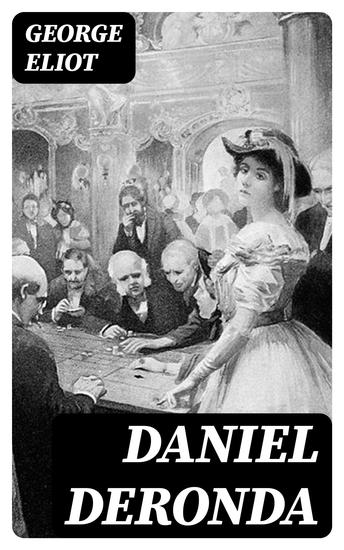
Daniel Deronda - cover

Daniel Deronda

George Eliot

Casa editrice: DigiCat

  • 0
  • 0
  • 0

Sinossi

In "Daniel Deronda," George Eliot constructs a rich tapestry of interconnected lives, exploring themes of identity, morality, and the complexities of human relationships. Set against the backdrop of Victorian England, the novel intertwines the narratives of Daniel Deronda, an enigmatic young man on a quest for self-discovery, and Gwendolen Harleth, a society beauty trapped in a suffocating marriage. Eliot's profound psychological insight and flowing, lyrical prose create a sophisticated discussion on the intersection of personal desire and social responsibilities, representing a pivotal shift in literary style towards modern psychological realism. This work also engages with contemporary issues of Jewish identity and nationalism, reflecting Eliot's progressive views in her time. George Eliot, the pen name of Mary Ann Evans, was a formidable intellectual and a pioneer for women in literature, often challenging societal norms through her writings. Her deep interest in philosophy, psychology, and social issues can be traced to her varied experiences and her involvement in the intellectual circles of her day. Living during an era of significant social reform, Eliot's personal convictions and empathetic sensibility illuminated her storytelling, particularly in the nuanced, explorative characterizations found in "Daniel Deronda." I highly recommend "Daniel Deronda" to readers seeking a profound exploration of character and society. This novel not only showcases Eliot's mastery of narrative and character development but also invites contemplation of the moral and cultural dilemmas still relevant to contemporary life. Through its intricate plot and richly developed characters, Eliot's work remains a cornerstone of English literature that captivates and challenges readers with its depth and insight.
Disponibile da: 16/09/2022.
Lunghezza di stampa: 787 pagine.
Altri libri che potrebbero interessarti

  • A Society - From their pens to your ears genius in every story - cover

    A Society - From their pens to...

    Virginia Woolf

    • 0
    • 0
    • 0
    Adeline Virginia Woolf was born on the 25th January 1882 in South Kensington in London. 
    Although lauded as a founder of modernist writing with such classics as ‘Orlando’, ‘Mrs Dalloway’ and ‘To the Lighthouse’ and, of course, many classic short stories, her background is filled with elements of tragedy that she somehow overcame to become such a revered writer.   Her mother died when she was 13, her half-sister Stella two years later and with it her first of several nervous breakdowns.  Appallingly it was later found that three of her half-brothers had sexually abused her so darkness must have seemed ever present.   
    She began writing professionally at age 20 but her father’s death two years later brought a complete mental collapse and she was briefly institutionalised.  Somehow she found within herself a literary career and with it great innovations in writing; she was a pioneer of “stream of consciousness”.    
    Her tight circle of friends were the founders of the Bloomsbury Group, a movement whose legacy still influences across the arts and society in many way to this day.   
    Whilst the dark periods continued to interrupt her emotional state her rate of work never ceased.  Until, on 28th March 1941, Woolf put on her overcoat, filled up its pockets with stones, and walked into the River Ouse, in Lewes, East Sussex and drowned herself.  Her body was not recovered until the 18th April.  She was 59. 
    She left behind a note which read in part “Dearest, I feel certain that I am going mad again.  I feel we can't go through another of those terrible times.  And I shan't recover this time.  I begin to hear voices, and I can't concentrate.  So I am doing what seems the best thing to do”.
    Mostra libro
  • Emma - cover

    Emma

    Jane Austen

    • 0
    • 0
    • 0
    Emma, is a novel about youthful hubris and romantic misunderstandings. It is set in the fictional country village of Highbury and the surrounding estates of Hartfield, Randalls and Donwell Abbey, and involves the relationships among people from a small number of families. The novel was first published in December 1815, with its title page listing a publication date of 1816. As in her other novels, Austen explores the concerns and difficulties of genteel women living in Georgian–Regency England. Emma is a comedy of manners, and depicts issues of marriage, sex, age, and social status.Before she began the novel, Austen wrote, "I am going to take a heroine whom no one but myself will much like." In the first sentence, she introduces the title character as "Emma Woodhouse, handsome, clever, and rich, with a comfortable home and a happy disposition... had lived nearly twenty-one years in the world with very little to distress or vex her." Emma is spoiled, headstrong, and self-satisfied; she greatly overestimates her own matchmaking abilities; she is blind to the dangers of meddling in other people's lives; and her imagination and perceptions often lead her astray.Emma, written after Austen's move to Chawton, was her last novel to be published during her lifetime, while Persuasion, the last complete novel Austen wrote, was published posthumously.The novel has been adapted for a number of films, television programmes and stage plays.Jane Austen was an English novelist known primarily for her six major novels, which interpret, critique, and comment upon the British landed gentry at the end of the 18th century. Austen's plots often explore the dependence of women on marriage in the pursuit of favorable social standing and economic security. Her works critique the novels of sensibility of the second half of the 18th century and are part of the transition to 19th-century literary realism.
    Mostra libro
  • Selfish Giant The (Unabridged) - cover

    Selfish Giant The (Unabridged)

    Oscar Wilde

    • 0
    • 0
    • 0
    "The Selfish Giant" Owns a beautiful garden which has 12 peach trees and lovely fragrant flowers, in which children love to play after returning from the school. On the giant's return from seven years visiting his friend the Cornish Ogre, he takes offence at the children and builds a wall to keep them out. He put up a notice board "TRESPASSERS WILL BE PROSECUTED". The garden falls into perpetual winter.
    Mostra libro
  • Signal-Man The (Unabridged) - cover

    Signal-Man The (Unabridged)

    Charles Dickens

    • 0
    • 0
    • 0
    "The Signal-Man" is a first-person horror/mystery story by Charles Dickens, first published as part of the Mugby Junction collection in the 1866 Christmas edition of All the Year Round.
    The railway signal-man of the title tells the narrator of an apparition that has been haunting him. Each spectral appearance precedes a tragic event on the railway on which the signalman works. The signalman's work is at a signal-box in a deep cutting near a tunnel entrance on a lonely stretch of the railway line, and he controls the movements of passing trains. When there is danger, his fellow signalmen alert him by telegraph and alarms. Three times, he receives phantom warnings of danger when his bell rings in a fashion that only he can hear. Each warning is followed by the appearance of the spectre, and then by a terrible accident.
    Mostra libro
  • Hinds' Feet on High Places - cover

    Hinds' Feet on High Places

    Hannah Hurnard

    • 0
    • 0
    • 0
    Much-Afraid had been in the service of the Chief Shepherd, whose great flocks were pastured down in the Valley of Humiliation. She lived with her friends and fellow workers Mercy and Peace in a tranquil little white cottage in the village of Much-Trembling. She loved her work and desired intensely to please the Chief Shepherd, but happy as she was in most ways, she was conscious of several things which hindered her in her work and caused her much secret distress and shame. Join Much-Afraid and her two companions Sorrow and Suffering as they journey towards a more full understanding of living a full Christian life. A true Christian Classic that has delighted millions of readers.
    Mostra libro
  • Araby - From their pens to your ears genius in every story - cover

    Araby - From their pens to your...

    James Joyce

    • 0
    • 0
    • 0
    James Augustine Aloysius Joyce was born on the 2nd February 1882 in Dublin into a middle-class family, and the eldest of ten surviving siblings 
    Admired as a brilliant student he briefly attended the Christian Brothers-run O'Connell School before excelling at the Jesuit schools of Clongowes and Belvedere.  From there he went on to attend University College Dublin from 1898, studying English, French and Italian 
    In 1902, Joyce was now in his early twenties, and went to Paris to study Medicine but soon abandoned his teachings.  Back in Dublin to attend to his dying Mother he met Nora Barnacle. They bonded immediately into a life-long match. Together they decided to emigrate to Europe.  The couple lived in Trieste, Rome, Paris, and finally Zürich where Joyce pursued a variety of jobs and ventures to supplement his literary pursuits but none of these paid off.  
    After publishing a poetry volume, ‘Chamber Music’, in 1907, his short story collection ‘The Dubliners’, in 1914, helped establish his talent in the rapidly changing world.  
    Although far from home Joyce’s literary heart and works were set in his recollections of Dublin.  Characters are close resemblances of family and friends and indeed enemies.  His landmark work ‘Ulysses’, published in 1922, is set in the streets and alleyways of the city as it parallels Homer’s Odyssey in a variety of styles including its famed stream of consciousness. 
    His pen continued to produce classics of the order of ‘A Portrait of the Artist as A Young Man’ and ‘Finnegan’s Wake’ together with several volumes of poetry and a play ‘The Exiles, in 1918.   
    On the 11th January 1941, Joyce underwent surgery in Zürich for a perforated duodenal ulcer. The next day he fell into a coma. On the 13th after a brief period of lucidity in which he called for his wife and son he passed.  He was 58.
    Mostra libro