Unisciti a noi in un viaggio nel mondo dei libri!
Aggiungi questo libro allo scaffale
Grey
Scrivi un nuovo commento Default profile 50px
Grey
Iscriviti per leggere l'intero libro o leggi le prime pagine gratuitamente!
All characters reduced
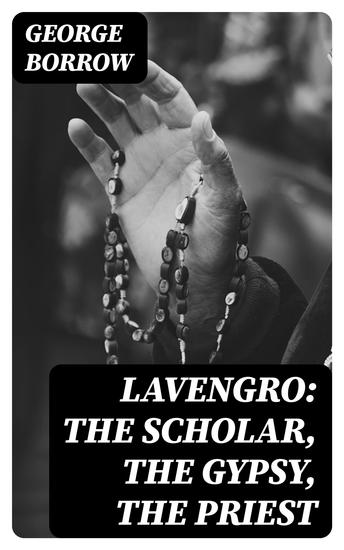
Lavengro: The Scholar the Gypsy the Priest - cover

Lavengro: The Scholar the Gypsy the Priest

George Borrow

Casa editrice: DigiCat

  • 0
  • 0
  • 0

Sinossi

In "Lavengro: The Scholar, the Gypsy, the Priest," George Borrow intricately weaves personal narrative, cultural observation, and philosophical discourse, resulting in a rich tapestry reflecting 19th-century British society. Through the lens of the titular character, Borrow explores themes of identity, belonging, and the mystical connections between people and place. His lyrical prose, imbued with vibrant imagery and folk influences, draws inspiration from his own diverse experiences as a linguist and traveler, establishing a unique literary style that blurs the line between autobiography and fiction. George Borrow, a renowned writer and linguist, gained prominence for his interest in Romani culture and language, experiences that profoundly shape "Lavengro." His early life, marked by a restlessness and thirst for knowledge, led him to pursue the study of languages and engage deeply with marginalized communities. This background informs the narrative's rich characterizations and inviting exploration of spirituality, reflecting Borrow's complex relationships with religion and culture during an era of sociopolitical change. This book is a compelling read for anyone interested in the intersection of personal narrative and cultural anthropology. Borrow's eloquent exploration of the human condition offers invaluable insights that resonate with contemporary readers, inviting them to reflect on their own search for identity amidst the tapestry of life.
Disponibile da: 16/09/2022.
Lunghezza di stampa: 572 pagine.
Altri libri che potrebbero interessarti

  • Mr And Mrs Dove - cover

    Mr And Mrs Dove

    Katherine Mansfield

    • 0
    • 0
    • 0
    Mr. and Mrs. Dove is a 1921 short story by Katherine Mansfield. It was first published in The Sphere on 28 November 1921, and later reprinted in The Garden Party and Other Stories.
    Reginald is returning to Rhodesia the next day; it is his last day in England. Again he thinks of Anne; then he goes to Colonel Proctor's to say goodbye, and he is greeted by Anne, her parents being away. On seeing him she laughs, then he tells her he is leaving. They both look at her pet doves. She remarks how "Mr. Dove" is always running after "Mrs. Dove". Reginald asks her if she likes him, and she says she cannot marry him. He's unhappy at the rejection, and tries to depart. She asks why he's upset, but he persists in leaving. As he's walking away, she calls him again, and he goes back to her.
    Mostra libro
  • The Invisible Man by HG Wells - Read by Dennis Edward Delaney - cover

    The Invisible Man by HG Wells -...

    H G Wells

    • 0
    • 0
    • 0
    The Invisible Man – by HG Wells  
    Read by Dennis Edward Delaney 
    In H.G. Wells’ “The Invisible Man,” scientist Griffin discovers a method to become invisible, but he struggles with the social and psychological consequences of his newfound power. Unable to reverse the process and rejected by society, he descends into madness and uses his invisibility for terror and violence. 
    Cover Design | ZacaPublishing.com © 2025 David Earl DeWitt 
    Source Material is in the Public Domain. 
    Run Time: 05:30:34
    Mostra libro
  • The Criminal From Lost Honour - cover

    The Criminal From Lost Honour

    Frederick Schiller

    • 0
    • 0
    • 0
    Johann Christoph Friedrich Schiller was born on 10th November 1759, in Marbach, Württemberg, the sole son of six children, into a very religious family. 
     
    During his childhood his father was away, engaged in the Seven Years War and contact was sporadic until with the War’s end in 1763. His father became a recruiting officer and the family moved to Lorch. 
     
    It was here that Schiller received his early education, the quality of which was poor, not helped by the child’s frequent truancy.  His parents sought a clerical career for him and a local priest was engaged to teach him Latin and Greek. As a boy, Schiller was excited by the idea of becoming a cleric and often wore black robes and pretended to preach. 
     
    In 1766, the family left Lorch. Schiller's father had not been paid for three years, and the family’s savings were depleted, so his father Kaspar, joined the garrison in Ludwigsburg for the Duke of Württemberg. 
     
    There the boy Schiller came to the attention of the Duke. He entered the elite military academy, the Karlsschule Stuttgart, in 1773, and eventually studied medicine, which led him to frequently attempt cures for his various illnesses. 
     
    At the academy, he wrote his first play, ‘The Robbers’, which dramatizes the conflict between two aristocratic brothers. The play's themes of social corruption and proto-revolutionary republican ideals astounded its original audience. Schiller became an overnight sensation.  
     
    In 1780, he obtained a post as regimental doctor in Stuttgart. In order to attend the first performance of ‘The Robbers’ in Mannheim, Schiller left his regiment without permission. As a result, he was arrested, sentenced to 14 days imprisonment, and forbidden from publishing any further works. 
     
    He fled Stuttgart in 1782, going via Frankfurt, Mannheim, Leipzig, and Dresden to Weimar. Along this journey he had an affair with an army officer's wife, Charlotte von Kalb. She was at the centre of an intellectual circle and known for her cleverness and instability.  
     
    Schiller settled in Weimar in 1787. Two years later he was appointed professor of History and Philosophy in Jena, where he wrote only historical works. 
     
    On 22nd February 1790, he married Charlotte von Lengefeld who bore him two sons and two daughters. 
     
    Schiller returned with his family to Weimar from Jena in 1799. There Johann Wolfgang von Goethe convinced him to return to playwriting and together they founded the Weimar Theater, which led to a renaissance of drama now referred to as Weimar Classicism. They also worked together on Xenien, a collection of short satirical poems in which they challenged opponents of their philosophical vision. 
     
    For his achievements, Schiller was ennobled in 1802 by the Duke of Saxe-Weimar, adding the nobiliary particle ‘von’ to his name.  
     
    Schiller died on 9th May 1805, at age 45, from tuberculosis, at Weimar. 


    Although primarily admired for his plays Schiller also wrote histories, poetry and some notable translations.   
     
    In his short story ‘The Criminal from Lost Honour’ the layers of a man’s life are examined as perhaps only Schiller and his literary genius can.
    Mostra libro
  • Pudd'nhead Wilson - cover

    Pudd'nhead Wilson

    Mark Twain

    • 0
    • 0
    • 0
    At the beginning of Pudd'nhead Wilson a young female slave, fearing for her infant son's life, exchanges her light-skinned child with her master's, leading to a novel whose plot rages as a savage indictment of racial prejudice and slavery. Written in 1894, Pudd'nhead Wilson is full of characteristic Twain humor and stands as a gem among the author's later works.
    
    Mark Twain, whose real name was Samuel Clemens, was the celebrated author of several novels, including two major classics of American literature: The Adventures of Tom Sawyer and Adventures of Huckleberry Finn. He was also a riverboat pilot, journalist, lecturer, entrepreneur, and inventor.
    Mostra libro
  • The Age of Innocence - cover

    The Age of Innocence

    Edith Wharton

    • 0
    • 0
    • 0
    Winner of the Pulitzer Prize 
    Edith Wharton brings the glamorous Gilded Age to life in this acclaimed 1920 novel. Distinguished heir Newland Archer is happily engaged to proper society darling May Welland–until the day he meets her cousin, the scandalous and bold (and married) Countess Ellen Olenska. Suddenly, his carefully planned future feels restrictive and stale. Ellen represents possibilities Newland has never before imagined, but is he already too entrenched in New York society to take such a leap? Tradition, progress, and obligation vibrate with tension in the book that established Wharton as the first woman to win the Pulitzer Prize.
    Mostra libro
  • Stolen Body The (Unabridged) - cover

    Stolen Body The (Unabridged)

    H. G. Wells

    • 0
    • 0
    • 0
    A pair of casual paranormal researchers are experimenting with the idea of astral projection. One night, one of them inadvertently succeeds in projecting his spirit from his body, which is then taken possession of by a malevolent entity in his absence.
    Mostra libro