Unisciti a noi in un viaggio nel mondo dei libri!
Aggiungi questo libro allo scaffale
Grey
Scrivi un nuovo commento Default profile 50px
Grey
Iscriviti per leggere l'intero libro o leggi le prime pagine gratuitamente!
All characters reduced
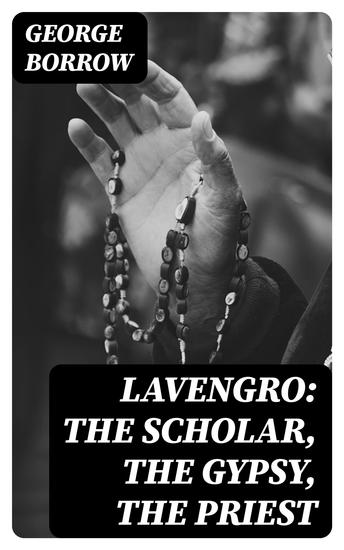
Lavengro: The Scholar the Gypsy the Priest - cover

Lavengro: The Scholar the Gypsy the Priest

George Borrow

Casa editrice: DigiCat

  • 0
  • 0
  • 0

Sinossi

In "Lavengro: The Scholar, the Gypsy, the Priest," George Borrow intricately weaves personal narrative, cultural observation, and philosophical discourse, resulting in a rich tapestry reflecting 19th-century British society. Through the lens of the titular character, Borrow explores themes of identity, belonging, and the mystical connections between people and place. His lyrical prose, imbued with vibrant imagery and folk influences, draws inspiration from his own diverse experiences as a linguist and traveler, establishing a unique literary style that blurs the line between autobiography and fiction. George Borrow, a renowned writer and linguist, gained prominence for his interest in Romani culture and language, experiences that profoundly shape "Lavengro." His early life, marked by a restlessness and thirst for knowledge, led him to pursue the study of languages and engage deeply with marginalized communities. This background informs the narrative's rich characterizations and inviting exploration of spirituality, reflecting Borrow's complex relationships with religion and culture during an era of sociopolitical change. This book is a compelling read for anyone interested in the intersection of personal narrative and cultural anthropology. Borrow's eloquent exploration of the human condition offers invaluable insights that resonate with contemporary readers, inviting them to reflect on their own search for identity amidst the tapestry of life.
Disponibile da: 16/09/2022.
Lunghezza di stampa: 572 pagine.

Altri libri che potrebbero interessarti

  • Alexander Kuprin - A Short Story Collection - A selection of stories from the great short story writer that Leo Tolstoy labelled the true successor to Anton Chekhov - cover

    Alexander Kuprin - A Short Story...

    Alexander Kuprin

    • 0
    • 0
    • 0
    Alexander Kuprin was born in Narovchat, Penza in Russia on 7th September 1870. 
     
    At 3 his Father died and he and mother moved to Moscow. By 10 he was enrolled at the Second Moscow Military High School and there his interest in literature began. The Alexander Military Academy followed and two years later he was a sub-lieutenant and posted to an Infantry Regiment for a further four years. 
     
    Despite his duties he was a now a keen writer and published his first short story at this time. His military duties also garnered him experiences for his breakthrough work ‘The Duel’.  Leaving the military he left for Kiev to work for local newspapers.  He continued to publish both stories and novels and by 1901 he was in St Petersburg becoming part of a group that included Chekhov, Ivan Bunin, Maxim Gorky and Leonid Andreyev.  
     
    In the years that followed further controversial works and acclaim followed.  His comments on the regime meant he was also put under secret police surveillance.   
     
    As World War I erupted, Kuprin opened a military hospital but was then given command of an infantry company in Finland. He was soon discharged on grounds of ill health.  
     
    The October Revolution saw him praise Lenin, but he warned that the Bolsheviks threatened Russian culture and might cause further widespread suffering to the peasants.  As Civil War raged he took his family to Helsinki and then on to Paris. 
     
    Exile saw his talents decline further and his succumbing to alcoholism. He became lonely and withdrawn. The family's poverty increased his malaise.   
     
    In May 1937, the Kuprin’s returned to Moscow.  He now saw his work published but wrote almost nothing new.  In 1938 his health rapidly deteriorated.  Already suffering from a kidney problems and sclerosis, he had now developed cancer of the oesophagus.  
     
    Alexander Kuprin died on 25th August 1938. 
     
    1 - Alexander Kuprin - A Short Story Collection - An Introduction 
    2 - A Slav Soul by Alexander Kuprin 
    3 - Cain by Alexander Kuprin  
    4 - An Evening Guest by Alexander Kuprin 
    5 - Demir Kaya by Alexander Kuprin 
    6 - A Legend by Alexander Kuprin 
    7 - Anathema by Alexander Kuprin 
    8 - The Garden of the Holy Virgin by Alexander Kuprin 
    9 - The Outrage by Alexander Kuprin 
    10 - The Park of Kings by Alexander Kuprin
    Mostra libro
  • Canon Alberic's Scrap Book - From their pens to your ears genius in every story - cover

    Canon Alberic's Scrap Book -...

    M R James

    • 0
    • 0
    • 0
    Montague Rhodes James is cited as perhaps the greatest English writer of ghost stories, an opinion few would disagree with. 
    James was born on 1st August 1862 at Goodnestone Parsonage in Kent, where his father was Curate but at age 3 the family went to live at Livermere, near Bury St Edmunds in East Anglia.  
    From early childhood he had a passion for mediaeval books and antiques. He was educated initially as a boarder at Temple Grove School in East Sheen, west London, before gaining a scholarship to Eton and thence Cambridge where he gained a double first, becoming a distinguished linguist and mediaevalist.  
    Before the Great War vacations were usually spent touring Europe absorbing cultures and references for his later writing. 
    A man of enormous knowledge it was said he timed his breakfast egg whilst he completed the Times crossword.  
    Many of his elegant yet terrifying tales were created by discarding the prevailing gothic cliches and placing his characters and narrative in a realistic setting.  Thereby the stories gained atmosphere and menace on a grand scale and he was famed as the originator of the antiquarian ghost story. 
    Although story-telling and writing these 30 or so tales was a hobby, when published their effect transformed the genre and still chill the bones in our more modern times. 
    James was also a medievalist scholar and translator whose work remains highly respected. He was also Provost of Eton College between 1918 and 1936. 
    M R James died on 12th June 1936 at Eton in Buckinghamshire.  He was 73.
    Mostra libro
  • Better Angel - cover

    Better Angel

    Richard Meeker

    • 0
    • 0
    • 0
    ""Better Angel" is a novel by Forman Brown, initially published in 1933 under the pseudonym Richard Meeker. Later, it was republished as "Torment" in 1951. This early novel offers a portrayal of a gay lifestyle without condemnation. In fact, Christopher Carey hailed it as the ""first homosexual novel with a truly happy ending"".    The title of the novel alludes to Shakespeare's Sonnet 144, which includes the line: "the better angel is a man right fair". This poem has been interpreted as having a homosexual subtext12.    The plot follows the journey of Kurt Gray, whose experiences mirror those of the author, Forman Brown. Kurt's life unfolds from his adolescent years in central Michigan to adulthood as a musician and composer. His story encompasses solitude, religious awakening, same-sex relationships, and intellectual exploration. The love affair between Kurt and another man, Derry, forms a central theme, along with their relationship with a third man named Tony. Notably, Brown based these characters on real individuals, including himself and his long-time lover, Harry Burnett.    Despite its initial lack of critical attention, "Better Angel" remains a significant work. It resurfaced in 1987 under its original title, with an introduction by Hubert Kennedy. Brown, who had used a pseudonym to protect his writing career and family, provided an epilogue for the 1990 reprint, explaining his reasons for anonymity.    This novel stands as a testament to the courage of early LGBTQ+ literature and offers a glimpse into the complexities of identity, love, and acceptance during a time when such themes were often silenced"
    Mostra libro
  • Mansfield Park - Full Cast Drama - cover

    Mansfield Park - Full Cast Drama

    Jane Austen

    • 0
    • 0
    • 0
    Jane Austen's novel "Mansfield Park" is a rich tapestry of characters, relationships, and societal norms. Published in 1814, it stands as one of Austen's most intricate and morally complex works. At its heart, the novel is a nuanced exploration of morality, social class, and the individual's place within a rigidly stratified society. 
     
    The story revolves around the character of Fanny Price, a poor young girl who is sent to live with her wealthy relatives, the Bertrams, at Mansfield Park. Fanny's humble background sharply contrasts with the opulence of her new home, and she occupies a unique position within the Bertram family. As an outsider, Fanny serves as a keen observer of the behaviors, attitudes, and moral values of those around her. 
    Central to the novel is the idea of morality and virtue. Fanny is portrayed as a paragon of moral integrity, while other characters, like her cousin Maria Bertram and her brother Henry Crawford, reveal moral shortcomings. The contrast between Fanny's unwavering moral compass and the moral lapses of those around her highlights Austen's examination of the consequences of one's actions and the moral decay that can occur within a society obsessed with appearances and social status. 
     
    The novel also delves into the rigid social hierarchy of early 19th-century England. The Bertrams, as members of the landed gentry, occupy the highest rungs of the social ladder, while Fanny, a poor relation, occupies the lowest. Through Fanny's eyes, readers witness the subtle but significant ways in which social class impacts every aspect of life, from marriage prospects to personal worth. This social commentary forces readers to confront the inherent inequalities of the era and consider the moral implications of a society that values wealth and social standing over character and virtue.
    Mostra libro
  • The Battle of Life - cover

    The Battle of Life

    Charles Dickens

    • 0
    • 0
    • 0
    Charles Dickens’s The Battle of Life is a tender tale of love, sacrifice, and the quiet struggles of the human heart. When two devoted sisters face choices that could change their futures forever, they discover that life’s true “battle” is not fought with swords, but with selflessness and compassion. Though one of Dickens’s lesser-known Christmas Books, this charming story carries his timeless message of hope, generosity, and the triumph of love over hardship.
    Mostra libro
  • Jules Vern Around The World In 80 Days - Stories For Everyone - cover

    Jules Vern Around The World In...

    Jules Verne

    • 0
    • 0
    • 0
    Mysterious Phileas Fogg is a man of the most repetitious and punctual habit - with no apparent sense of adventure whatsoever - he gambles his considerable fortune that he can complete a journey around the world in just 80 days... immediately after a newspaper calculates the feat as just barely possible. With his excitable French manservant in tow, Fogg undertakes the exercise immediately, with no preparations, trusting that his traveling funds will make up for delays along the way. But unbeknownst to him, British police are desperately seeking to arrest him for the theft of a huge sum by someone who resembles him, and they will track him around the world, if necessary, to apprehend him. This is an adventure novel of the first water, with wholly unexpected perils, hair-breadth escapes, brilliant solutions to insoluble problems, and even a love story. And can this be? - That he returns to London just five minutes too late to win his wager and retain his fortune?  
     
    Jules Gabriel Verne was a French novelist, poet, and playwright. His collaboration with the publisher Pierre-Jules Hetzel led to the creation of the Voyages extraordinaires, a series of bestselling adventure novels.
    Mostra libro