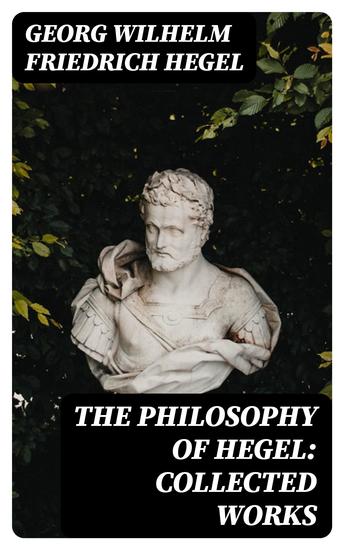
The Philosophy of Hegel: Collected Works - Enriched edition Philosophy of Mind Phenomenology of Mind Aesthetics
Georg Wilhelm Friedrich Hegel
Traduttore William Wallace, J. B. Baillie, S. W. Dyde, F. P. B. Osmaston, J. Sibree, Ebenezer Brown Speirs, Elizabeth Haldane, J. Loewenberg
Casa editrice: DigiCat
Sinossi
Georg Wilhelm Friedrich Hegel's "The Philosophy of Hegel: Collected Works" presents an extensive examination of his philosophical systems, marked by a dialectical method that seeks to synthesize seemingly disparate concepts. Within this compilation, Hegel meticulously explores the realms of logic, metaphysics, ethics, and history, illustrating his belief in the progress of reality through contradiction and resolution. The literary style is characterized by dense and complex prose, which reflects the intricate ideas Hegel grapples with, made richer by a context that engages with the German Idealism of the late 18th and early 19th centuries and reacts critically to Enlightenment thought. Hegel, one of the key figures in Western philosophy, wrote this collection during a time when Europe was undergoing profound political and social transformations. His reflections on history, culture, and consciousness are informed by the revolutionary spirit of his time, as well as his engagement with contemporaneous thinkers like Kant and Fichte. Hegel's educational background in theology and his experiences in the turbulent socio-political milieu of post-Napoleonic Europe greatly shaped his philosophical inquiry. This collected work is essential for any student of philosophy, offering profound insights into the development of modern thought. Readers seeking to deepen their understanding of dialectics, the evolution of ideas, and the interconnectedness of historical events will find in Hegel's prose a challenging yet rewarding journey that prompted many subsequent philosophical debates.

In this enriched edition, we have carefully created added value for your reading experience:
- An Introduction draws the threads together, discussing why these diverse authors and texts belong in one collection.
- Historical Context explores the cultural and intellectual currents that shaped these works, offering insight into the shared (or contrasting) eras that influenced each writer.
- A combined Synopsis (Selection) briefly outlines the key plots or arguments of the included pieces, helping readers grasp the anthology's overall scope without giving away essential twists.
- A collective Analysis highlights common themes, stylistic variations, and significant crossovers in tone and technique, tying together writers from different backgrounds.
- Reflection questions encourage readers to compare the different voices and perspectives within the collection, fostering a richer understanding of the overarching conversation.
Disponibile da: 18/05/2022.
Lunghezza di stampa: 5017 pagine.