
Unisciti a noi in un viaggio nel mondo dei libri!
Aggiungi questo libro allo scaffale
Grey
Scrivi un nuovo commento Default profile 50px
Grey
Iscriviti per leggere l'intero libro o leggi le prime pagine gratuitamente!
All characters reduced
Hegel's Philosophy of Mind - cover

Hegel's Philosophy of Mind

Georg Wilhelm Friedrich Hegel

Traduttore William Wallace

Casa editrice: DigiCat

  • 0
  • 0
  • 0

Sinossi

In "Hegel's Philosophy of Mind," Georg Wilhelm Friedrich Hegel explores the intricate relationship between consciousness, self-awareness, and the development of the human spirit within a systematic framework. This work, part of Hegel's larger project in the Encyclopedia of the Philosophical Sciences, delves into the evolution of mind, elucidating its stages from sense-certainty to absolute knowledge. Hegel employs a dialectical method, revealing how contradictions within thought drive the progression of consciousness. His style exhibits a complex, often challenging prose that demands active engagement from the reader, framed against the backdrop of early 19th-century German idealism. Hegel, a crucial figure in Western philosophy, was deeply influenced by the historical and cultural upheavals of his time, including the aftermath of the French Revolution. His intellectual journey was marked by a quest to reconcile individual freedom with universal principles, which significantly shaped his philosophical outlook. The synthesis of these ideas is vividly manifested in "Philosophy of Mind," where he articulates a holistic understanding of the human experience. This book is highly recommended for those seeking insight into Hegel's view of consciousness and its integral role in human existence. It is an essential text for students of philosophy, psychology, and the humanities, offering profound implications for contemporary debates surrounding the nature of self and society.
Disponibile da: 16/09/2022.
Lunghezza di stampa: 312 pagine.

Altri libri che potrebbero interessarti

  • Bound by the Corporate Spy (Gay Chastity Training Erotica) - cover

    Bound by the Corporate Spy (Gay...

    Archer Vale

    • 0
    • 0
    • 0
    I work in a restricted area. I have access to precious, sensitive secrets… 
    My junior engineer is into “cognitive enhancement”. He says wearing a chastity cage can improve mental focus and job performance. 
    But…it’s having the opposite effect on me. 
    He sealed me into chastity. He bound me to his bed. He turned on his laptop and began playing hours of gay porn. 
    I’m not into that stuff, but it felt so good to watch. I couldn’t stop staring. 
    Something strange is happening to me. I’m developing cravings… 
    --- 
    CONTAINS EXPLICIT GAY SEXUAL CONTENT. 
    For exclusive stories, visit www.ArcherVale.com.
    Mostra libro
  • The Wari Empire - Pre-Incan Conquerors and the Engineers of South America - cover

    The Wari Empire - Pre-Incan...

    Rolf Hedger

    • 0
    • 0
    • 0
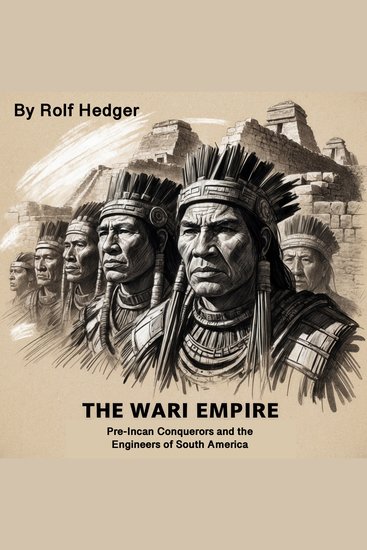
    The Wari Empire emerged as one of the most influential pre-Incan civilizations in the Andean region, setting the foundation for future Andean states, including the Inca. Its origins can be traced back to the highlands of present-day Peru, where early societies laid the groundwork for its rise. The unique combination of environmental adaptation, cultural influences, and political innovation allowed the Wari to establish a powerful state that would dominate much of the central Andes for centuries. 
    Before the Wari civilization took shape, the Andean region was home to various cultures that contributed to its development. Among these, the Chavín culture, which thrived from around 900 to 200 BCE, played a crucial role in spreading religious and artistic traditions that later influenced Wari art and iconography. The Nazca civilization, known for its intricate geoglyphs and advanced irrigation techniques, also left an imprint on Wari agricultural and engineering practices. However, it was the lesser-known Huarpa culture of the Ayacucho Valley that provided the most direct influence on early Wari society. The Huarpa people developed small-scale irrigation systems, terraced farming, and distinct ceramic styles, all of which became defining features of Wari civilization. 
    Sometime between 500 and 600 CE, the Wari began to expand beyond their heartland in the Ayacucho region. This expansion was driven by both environmental necessity and strategic ambition. The high-altitude valleys of the central Andes provided fertile land for agriculture, but they were also subject to fluctuating climatic conditions. To mitigate these challenges, Wari elites developed large-scale irrigation systems and storage facilities, ensuring food security for growing populations. This ability to manage resources effectively gave them an advantage over neighboring groups, allowing them to assert dominance through both diplomacy and military conquest.
    Mostra libro
  • When It All Goes To Hell - Notes on Crisis and Chaos from a CIA Counterterrorism Operator - cover

    When It All Goes To Hell - Notes...

    Jeff Banman, Drew Williams

    • 0
    • 0
    • 0
    Former fireman, Airborne Ranger and CIA Counterterrorism Operator, Jeff Banman’s new book, When It All Goes To Hell: Notes on Crisis and Chaos is more than just a checklist, its a journey into the underbelly of human behavior in high-stress and high-stakes situations. With his background in human performance and human behavior, Jeff takes us on a journey to explain the unexplainable. 
    Offering a depth of wisdom from how to develop and enhance your “C3,” meaning your Comfort, Confidence and Creativity to unlocking your Intuitive Guidance System, Jeff walks us through step by step how to anchor ourselves in both truth and safe. 
    In times of crisis and chaos, you don’t want to be an untethered soul, you want to be anchored so that you become the source of certainty and stability for yourself and those around you. Learn the same tools and techniques Jeff has used to train US Navy SEALs, Counterterrorism Operators, Firefighters, Law Enforcement personnel, Professional Athletes, CEO’s and more. 
    When facing uncertainty brought about by a rapid shit in the intensity, diversity and complexity of any given moment, you’ll need your wits about you. This book delivers the ability to do just that. Backed up with important questions and answers from both Jeff and Drew Williams, a former SWAT Commander, this book is like having them in your pocket when you need them most. 
    In the second half of the book Jeff & Drew answer questions like…What if I feel extremely unsafe in a given moment?How do I avoid putting us in more danger?Will my home be safe if I leave?What are the types of risks I need to consider?How should I assess risks to myself and my family?How do I know if I’m ready to protect my family and business? 
    This is a must have and a must read.
    Mostra libro
  • Totem and Taboo - cover

    Totem and Taboo

    Sigmund Freud

    • 0
    • 0
    • 0
    "Totem and Taboo" by Sigmund Freud explores the origins of human culture, religion, and morality through a psychoanalytic lens. Freud draws parallels between primitive societies and modern neuroses, examining totemism, taboos, and the Oedipus complex. He argues that primal emotions and unconscious drives shape societal structures, including laws and religious practices. By analyzing rituals, myths, and prohibitions, Freud delves into the psychological underpinnings of group identity and authority. A groundbreaking work, it bridges anthropology and psychoanalysis, offering provocative insights into the shared roots of individual and collective behavior. Though controversial, it remains a foundational text for understanding human nature.
    Mostra libro
  • The Black Sea - poems - cover

    The Black Sea - poems

    Stephanos Papadopoulos

    • 0
    • 0
    • 0
    In this third collection of poems Papadopoulos addresses the historical subject of the Pontic Greek massacre in the 1920’s in a series of “sonnet-monologues” that link cinematically to create a very specific, semi-fictional account of a group of people living within this particular historic context.  His own  Greek family is of Pontic and Cretan origin, and he traveled the black sea extensively while writing these poems, but the abstracted landscapes and the slightly “grotesque” characters that inhabit these poems lead anyone, regardless of his/her knowledge of the region,  into a new and intimate relationship with this volatile and tragic story. 
    "The Black Sea won’t be for everyone. The subject is unrelentingly dark, rarely leavened by humor, and the history involved is known to few Americans. But it is a superb book, ambitious without being verbose. His opening poem meditates on the role of the poet in history, and in this subject alone he has plenty of company among Greek writers like Cavafy and Ritsos. The texture of cultural allusion in some of these poems is quite rich, yet the book dispenses with footnotes and leaves us to find our own way. Most of the poems can be read as little dramas in which vital characters have everything at stake. "     David Mason, The Hudson Review
    Mostra libro
  • Facing America's Greatest Enemy - cover

    Facing America's Greatest Enemy

    Rich Germaine

    • 0
    • 0
    • 0
    "Facing America's Greatest Enemy" by Rich Germaine delves into the pervasive issue of apathy within American society, exploring its historical roots, psychological underpinnings, and extensive impact on various facets of life. The book opens with a compelling introduction that frames apathy and indifference as a silent yet formidable adversary threatening the foundations of democracy and societal progress. Germaine traces the emergence of apathy from post-revolutionary disinterest to contemporary political indifference, emphasizing how crises and prosperity alike have fostered disengagement. 
    Germaine provides historical examples, such as the rise of Nazi Germany and the low voter participation in recent U.S. elections, to underscore the dire consequences of public disengagement. 
    In the digital age, the paradox of connectivity is examined, where social media's potential to mobilize is countered by the overwhelming influx of information, leading to 'slacktivism'—a superficial form of engagement. The manuscript also addresses the role of education in combating apathy, advocating for curricula that foster critical thinking, empathy, and active citizenship. 
    Parental apathy is explored as a significant factor in children's moral and educational development, highlighting the need for active parental involvement despite modern challenges. The author also incorporates a biblical worldview, urging Christians to act against apathy through faith-driven engagement and community building. 
    Concluding with actionable steps, calling for a collective commitment to rekindle civic engagement and counter the inertia threatening American self-government. This comprehensive exploration offers a roadmap for individuals and communities to overcome apathy and foster a more involved, empathic, and active society.
    Mostra libro