Join us on a literary world trip!
Add this book to bookshelf
Grey
Write a new comment Default profile 50px
Grey
Subscribe to read the full book or read the first pages for free!
All characters reduced
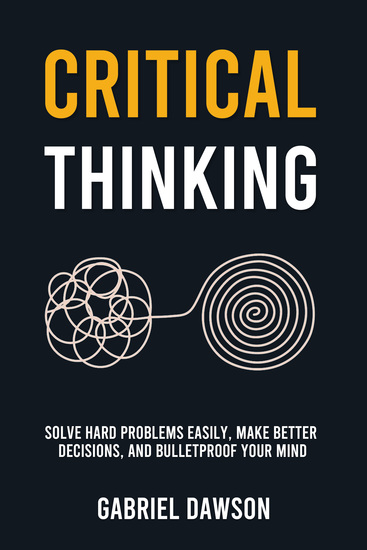
Critical Thinking - Solve Hard Problems Easily Make Better Decisions and Bulletproof Your Mind - cover

Critical Thinking - Solve Hard Problems Easily Make Better Decisions and Bulletproof Your Mind

Gabriel Dawson

Publisher: Publishdrive

  • 0
  • 0
  • 0

Summary

Are you tired of feeling overwhelmed by complex problems, constant overthinking, or emotional decision-making?
 
In today’s fast-paced and information-saturated world, the ability to think clearly and rationally is no longer optional—it’s essential. Whether you're navigating high-stakes business choices, dealing with personal conflicts, or simply trying to be more confident in your daily decisions, this book will give you the tools to transform the way you think.
 
💡 What You'll Discover Inside:
 
✅ The Foundations of Critical ThinkingUnderstand what critical thinking really is—and isn’t. Learn how to identify flaws in arguments, avoid being manipulated, and train your mind to respond with clarity instead of confusion.
 
✅ How to Recognize and Defeat Cognitive BiasesFrom confirmation bias to availability heuristics, discover the psychological traps that distort your thinking and how to overcome them.
 
✅ Effective Problem-Solving StrategiesUse step-by-step frameworks like mind mapping, root cause analysis, and logical questioning to approach any challenge with structure and calm.
 
✅ Decision-Making Under PressureLearn how to keep a cool head in emotional or high-stress situations, and make decisions that align with your long-term goals instead of temporary impulses.
 
✅ How to Manage Overthinking and Mental NoiseBreak the cycle of analysis paralysis and emotional spirals with actionable methods based in neuroscience and behavioral psychology.
 
✅ Build Emotional Intelligence and Mental ResilienceImprove self-awareness, empathy, and your ability to navigate social dynamics while staying grounded and rational.
 
✅ Read Between the LinesDecode body language, detect manipulation, and see through emotionally charged rhetoric or misleading arguments.
 
🧠 Who Is This Book For?
 
This book is ideal for:
 
Professionals who want to sharpen their decision-making in the workplace
 
Students who want to train their logic and analytical skills
 
Entrepreneurs and leaders who must navigate uncertainty
 
Anyone who struggles with anxiety, indecision, or emotional overwhelm
 
Readers interested in philosophy, psychology, self-development, or stoicism
 
Whether you’re debating, negotiating, problem-solving, or simply trying to make better life choices, this book will help you approach every situation with a clear and structured mindset.
 
📈 Real Results, Not Fluff
 
You won’t find vague theory or motivational fluff. Instead, you’ll get concrete exercises, real-life examples, and 19 practical strategies you can implement immediately.
Available since: 05/26/2025.
Print length: 161 pages.

Other books that might interest you

  • Celia A Slave - cover

    Celia A Slave

    Melton A. McLaurin, Jennifer L....

    • 0
    • 0
    • 0
    Celia was only fourteen years old when she was acquired by John Newsom, an aging widower and one of the most prosperous and respected citizens of Callaway County, Missouri. The pattern of sexual abuse that would mark their entire relationship began almost immediately. After purchasing Celia in a neighboring county, Newsom raped her on the journey back to his farm. He then established her in a small cabin near his house and visited her regularly. Over the next five years, Celia bore Newsom two children; meanwhile, she became involved with a slave named George and resolved at his insistence to end the relationship with her master. When Newsom refused, Celia one night struck him fatally with a club and disposed of his body in her fireplace. 


    Her act quickly discovered, Celia was brought to trial. She received a surprisingly vigorous defense from her court-appointed attorneys. Nevertheless, the court upheld the tenets of a white social order that wielded almost total control over the lives of slaves. Celia was found guilty and hanged. 


    Melton A. McLaurin uses Celia's story to reveal the tensions that strained the fabric of antebellum southern society. Celia's case demonstrates how one master's abuse of power over a single slave forced whites to make moral decisions about the nature of slavery.
    Show book
  • Dark Horse - General Larry O Spencer and His Journey from the Horseshoe to the Pentagon - cover

    Dark Horse - General Larry O...

    USAF (Ret.) General Larry O....

    • 0
    • 0
    • 0
    Gen. Larry Spencer, USAF (Ret.) was born and raised on the Horseshoe—a tough inner-city street in southeast Washington D.C. The Horseshoe was a hard neighborhood where fights were common, and the school systems were second-rate. The expectations of living in an all-Black neighborhood were to be good at sports while shunning academic prowess. That environment resulted in poor self-esteem and a bleak outlook for the future. 


    Quite by chance, Spencer enlisted in the U.S. Air Force where he continued to struggle with the racial turmoil of the 1970s. As a very young first lieutenant, he was assigned to a tough job in the Pentagon, but Spencer earned an early reputation as a fast burner. Spencer went on to serve at the White House, and then successfully commanded a Group and a Wing before being assigned as the chief financial officer (comptroller) for Air Combat Command. During that assignment, Spencer was promoted to brigadier general and was tasked to set up a new Directorate at Air Force Materiel Command. Spencer later returned to the Pentagon where he led Air Force Budget. He ultimately became the Air Force's thirty-seventh vice chief of staff, making him one of only nine African Americans promoted to four stars. Spencer concludes his historic climb with life lessons learned on his journey from the inner city to the Pentagon.
    Show book
  • Actor's Guide To Boston-Accented English An - Master the Accent of the American Northeast - cover

    Actor's Guide To Boston-Accented...

    Oscar Stanley

    • 0
    • 0
    • 0
    Master the iconic Boston accent with this immersive audiobook guide! Dive into the rich linguistic heritage of New England’s most distinctive dialect, from the famous R-dropping ("pahk the cah") to the Broad-A phenomenon ("dahnce," "bahth"). Perfect for actors, voice artists, or language enthusiasts, this resource breaks down the accent’s nuances, including the Irish influence, vowel centralization, and neighborhood variations like the North End’s melodic lilt or Southie’s gritty edge.


    Learn through targeted drills—practice intrusive Rs ("vanilla-r-ice"), consonant cluster reductions ("coass" for coasts), and local slang like "wicked," "bubblah," and "frappe." Study real-world examples from classic films (Good Will Hunting, The Departed) to refine your cadence. Whether you’re prepping for a role, mastering dialects, or just love Boston’s cultural vibe, this guide delivers authentic pronunciation, historical context, and practical exercises to sound like a true local.


    Ideal for actors, linguists, and travelers, it’s your key to unlocking one of America’s most recognizable accents. Listen, repeat, and perfect the rhythm of Boston speech—from Harvard Yard to Dorchester—with expert guidance. Start speaking like a Beantown native today!
    Show book
  • Summary: Elon Musk - By Walter Isaacson: Key Takeaways Summary & Analysis - cover

    Summary: Elon Musk - By Walter...

    Brooks Bryant

    • 0
    • 0
    • 0
    DISCLAIMER: THIS IS NOT THE OFFICIAL BOOK. 
    This is a summary, & it does not accompany the official 
    In 'Elon Musk' by Walter Isaacson, the book explores the complex and fascinating life of Elon Musk, the visionary entrepreneur. From his troubled childhood in South Africa, where he faced both physical and emotional challenges, to his rise as the richest man on earth in 2022, Musk's journey is one of resilience and ambition. 
    Musk's father, an engineer with a charismatic yet rogue personality, left a lasting impact on his psyche. This influence shaped Musk into a tough and vulnerable individual, marked by mood swings, a high tolerance for risk, a penchant for drama, an unwavering sense of purpose, and an intense, sometimes callous, drive. 
    Isaacson, who spent two years closely shadowing Musk, presents an inside story filled with triumphs and turmoil. The book raises thought-provoking questions about whether the demons that have driven Musk are also the driving forces behind innovation and progress. It offers a revealing glimpse into the life of one of the most influential and enigmatic figures of our time.
    Show book
  • The Invisible Machine - The Startling Truth About Trauma and the Scientific Breakthrough That Can Transform Your Life - cover

    The Invisible Machine - The...

    Jamie Mustard, MD Eugene Lipov,...

    • 0
    • 0
    • 0
    Despite its prevalence, post-traumatic stress, PTSD, is often seen as an unbeatable lifelong mental disorder. Leading trauma doctors and neuroscientists now understand that the result of trauma is not a disorder, but rather a physical injury to the body—invisible but tangible, and most importantly, treatable. 


    Meet Dr. Eugene Lipov. His research and partnerships have led to an amazing discovery that all trauma has at its root a single piece of human hardware: the stellate ganglion. The symptoms of post-traumatic stress are the same for all of us, whether from childhood poverty or abandonment, the ravages of war, or the brutality of sexual assault. Dr. Lipov's pioneering procedure appears to treat injury to the stellate ganglion, relieving even the worst symptoms of PTSD—irritability, hypervigilance, insomnia, and more—in a fifteen-minute treatment. 


    Weaving hard science with moving human stories, The Invisible Machine reveals how this treatment was developed. It also tells the incredible story of the unlikely team, including the doctor, an artist, Special Forces leadership, and a sheriff, who are working together to change our understanding of post-traumatic stress and why it matters to society.
    Show book
  • Underground and Underwater in World War I: The History and Legacy of the Hidden Fighting during the Great War - cover

    Underground and Underwater in...

    Editors Charles River

    • 0
    • 0
    • 0
    Most books and documentaries about the war focus on the carnage of the trenches, depicting the ceaseless bombardment and sniping, and the assaults and counterattacks that took millions of lives. This was the experience of most frontline soldiers during that great conflict, but it was not the only experience. There was another war going on beneath the trenches, a war of tunnels and mines fought by men who didn’t see sunlight for days at a time and who lived in constant fear of cave-ins and enemy detection. These men, who had mostly been miners in civilian life, lived a twilight existence, working long hours in silence and near darkness while great battles raged overhead. They suffered from fatigue, stress, and the knowledge that they could be killed at any time by an unseen enemy. Despite this, they persevered, and the mines they laid under enemy trench systems turned the tide of at least one major battle.  
    	The sleek hunter-killers lurking beneath the waves, using periscopes to close in unnoticed on their prey, added a new, nerve-wracking element to naval warfare. The mere threat of submarine attack immediately altered naval tactics and strategies employed by both the Western Allies and the Central Powers, shifting them towards a more cautious approach, especially at the war’s start when the submarine threat remained untested. 	During World War I, German U-boats operated solo except on one occasion. Initially, the British and nations supplying England with food and materiel scattered vessels singly across the ocean, making them vulnerable to the lone submarines. However, widespread late war re-adoption of the convoy system tipped the odds in the surface ships' favor.
    Show book