Unisciti a noi in un viaggio nel mondo dei libri!
Aggiungi questo libro allo scaffale
Grey
Scrivi un nuovo commento Default profile 50px
Grey
Iscriviti per leggere l'intero libro o leggi le prime pagine gratuitamente!
All characters reduced
The Victorian Age in Literature - cover

The Victorian Age in Literature

G. K. Chesterton

Casa editrice: DigiCat

  • 0
  • 0
  • 0

Sinossi

In "The Victorian Age in Literature," G. K. Chesterton offers a sweeping and incisive examination of the literary landscape of the Victorian era, exploring the interplay between society, politics, and art. Through a series of essays, Chesterton illuminates the contributions of key figures such as George Eliot, Thomas Hardy, and the Brontë sisters, while deftly contrasting their distinct styles and ideologies. With a wit that is at once playful and piercing, Chesterton situates Victorian literature within the broader cultural trends of the time, revealing how it both shaped and reflected the complexities of an age undergoing rapid change and industrialization. As a prominent writer and literary critic, Chesterton's own experiences and philosophical inclinations profoundly influenced his perspective. His background in theology and deep appreciation for fiction provided him with a unique lens through which to assess the moral and spiritual dimensions of Victorian literature. A vocal advocate for the value of imagination and creativity, Chesterton critiques the era's materialism while championing the enduring power of storytelling. For readers seeking a deeper understanding of the Victorian literary canon, Chesterton's work is an essential companion. His vibrant prose invites both scholars and general readers alike to re-engage with classics and discover the resonances of the past in contemporary times, making this book not just a scholarly text but a celebratory homage to an influential literary age.
Disponibile da: 15/09/2022.
Lunghezza di stampa: 106 pagine.

Altri libri che potrebbero interessarti

  • April 1865: The Tumultuous History of the Confederacy’s Last Month - cover

    April 1865: The Tumultuous...

    Editors Charles River

    • 0
    • 0
    • 0
    By the close of 1864, Abraham Lincoln had been reelected, the Union army had taken Nashville from General Hood, and Sherman had concluded his total war, “slash-and-burn” march of destruction to Savannah, Georgia, offering it as a Christmas present to Lincoln. Nevertheless, with everything seemingly falling to pieces, the South still held out hope of some sort of miracle, and Davis even attempted to send a peace delegation to meet with Lincoln in the early months of 1865. On January 28, 1865 as Union General Ulysses S. Grant was continuing to lay siege to Lee’s army at Petersburg, Virginia, Davis sent three commissioners headed by Vice-President Stephens to initiate informal peace talks with Lincoln. By February 3, however, the talks, known as the Hampton Roads Conference, came to a stalemate as Lincoln would accept nothing less than total union, while Davis would only accept Southern independence.  
    	Even at that point, the South was clearly on its last legs. General George H. Thomas destroyed John Bell Hood’s Confederate army at the battles of Nashville and Franklin, leaving only two large Confederate armies still in the field. Lee's army was weakened by desertion, lack of supplies and casualties, and Joseph E. Johnston’s army could barely resist against Sherman’s army as it was advancing north toward Virginia.  
    	To most observers, the South was clearly reaching its end, but Davis had no intention of quitting the war. Even while he was fleeing, he attempted to order Confederate generals in the field to keep fighting. On April 9, 1865, Lee formally surrendered his weary army to Grant at Appomattox. Appomattox is frequently cited as the end of the Civil War, but there still remained several Confederate armies across the country, mostly under the command of General Joseph E. Johnston.
    Mostra libro
  • The Communist Manifesto - cover

    The Communist Manifesto

    Friedrich Engels, Karl Marx

    • 0
    • 0
    • 0
    "A spectre is haunting Europe—the spectre of communism."
    
    In a world transformed by the Industrial Revolution, Marx and Engels set out to decode the hidden mechanics of society. They argue that all of human history is the history of class struggles: the constant friction between those who own the means of production and those who sell their labor to survive. The Communist Manifesto is a call to action that envisions a future beyond exploitation, predicting the inevitable rise of the working class and the transition to a classless, stateless society. Whether viewed as a historical artifact or a living critique of global economics, this text remains essential for understanding the modern world.
    
    The Great Divide: Bourgeoisie vs. Proletariat: The Manifesto famously defines the two warring camps of the industrial age. The Bourgeoisie (the ruling capitalist class) are described as a revolutionary force that "shattered" feudalism but created a system of "naked self-interest." Opposing them is the Proletariat (the working class), whom Marx describes as the "grave-diggers" of the very system that created them.
    
    The Ten-Point Program: In the second section, the authors lay out a controversial and radical set of measures for the "most advanced countries," including the abolition of private land ownership, a heavy progressive income tax, and the centralization of credit and communication in the hands of the state. These points sparked over a century of political experimentation and debate across every continent.
    
    A Legacy of Global Change: From the revolutions of 1917 to the modern labor movements of the 21st century, the rhetoric of the Manifesto has been used to challenge the status quo. Its closing cry—"Working Men of All Countries, Unite!"—remains one of the most famous slogans in human language, symbolizing the birth of international political solidarity.
    
    Analyze the roots of the modern world. Purchase "The Communist Manifesto" today.
    Mostra libro
  • Swim in Shadows A: Unseen Secrets from Four Russian Masterpieces - "Unlock the mysteries of Russian classics with our dynamic audio lessons in 'A Swim in Shadows'!" - cover

    Swim in Shadows A: Unseen...

    Lysander Grimsby

    • 0
    • 0
    • 0
    A Swim in Shadows: Unseen Secrets from Four Russian Masterpieces 
    ⭐⭐ Simplified Guide & Explanations Included ⭐⭐ 
    Are you eager to enrich your understanding of life's lessons through the art of storytelling? 
    Searching for an all-encompassing guide that unveils the essential elements of storytelling within four profound Russian masterpieces? 
    Your quest concludes here! 
    This guide is your ultimate resource for deepening your insights, honing your skills, and participating in engaging exercises. With it, you're equipped for a transformative journey. 
    Updated for a clearer understanding of storytelling methods. 
    Key features of this enhanced guide: 
    - Insightful revelations about storytelling intricacies in four Russian masterpieces 
    - In-depth explorations of the narratives and themes 
    - Effective strategies for interpreting and analyzing the texts 
    Our guide sets itself apart with its thorough examination, vital for your literary success. Themes aren't merely touched on; they are explored with depth and accuracy. 
    Crafted with a clear structure and straightforward language, our guide ensures seamless transitions between topics. Bid farewell to convoluted terminology and welcome clear, concise, and accurate content. 
    So, why hesitate? Click the BUY NOW button, secure your guide, and embark on your enlightening journey through storytelling! 
    A Swim in Shadows: Unseen Secrets from Four Russian Masterpieces** is awaiting your discovery!
    Mostra libro
  • The Art of Egyptian Papyrus - Writing and Illustrations in Ancient Times - cover

    The Art of Egyptian Papyrus -...

    Omar Khalil

    • 0
    • 0
    • 0
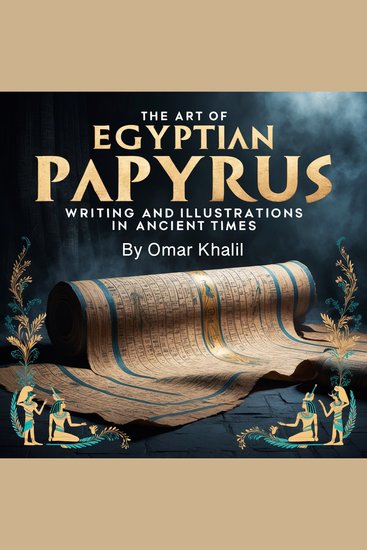
    Papyrus, one of the most important inventions of ancient Egypt, was central to the development of writing and documentation in the ancient world. The history of papyrus dates back to the early dynastic periods of Egypt, around 3000 BCE, when the first examples of papyrus usage were recorded. This plant, which grew abundantly along the Nile River, was harvested for its stalks, which were then processed into sheets that served as a writing surface. The creation of papyrus revolutionized communication in the ancient world, providing a portable, durable, and practical alternative to other materials like stone or clay tablets. 
    The origins of papyrus as a writing material can be traced to the need for a flexible and lightweight medium that could be used for documentation, record-keeping, and artistic purposes. Ancient Egyptians discovered that the inner pith of the papyrus plant could be cut into strips and laid in a crisscross pattern, pressed together, and dried to form sheets. These sheets were then smoothed and polished, making them suitable for inscribing with hieroglyphs, hieratic script, or later, the demotic script. Over time, the process of papyrus production became more refined, and its use spread to neighboring regions, influencing other ancient civilizations. 
    Early uses of papyrus were predominantly for religious and administrative purposes. Royal decrees, religious texts, and tomb inscriptions were often written on papyrus scrolls. As Egyptian society advanced, the role of papyrus expanded to include personal letters, legal documents, and works of literature, cementing its place as the primary medium for writing in the ancient world. The papyrus scroll became the preferred format for long documents, with scrolls of varying lengths used to record everything from medical texts to astronomical observations.
    Mostra libro
  • Grant at 200 - Reconsidering the Life and Legacy of Ulysses S Grant - cover

    Grant at 200 - Reconsidering the...

    Frank J. Scaturro, Chris Mackowski

    • 0
    • 0
    • 0
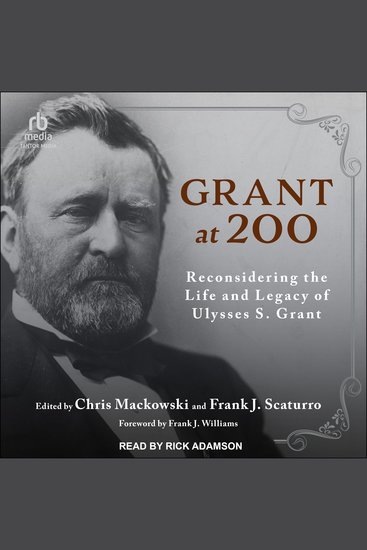
    Ulysses S. Grant stood at the center of the American Civil War maelstrom. The Ohio native answered his nation's call to service and finished the war as a lieutenant general in command of the United States Army. Four years later, he ascended to the presidency to better secure the peace he had helped win on the battlefield. Despite his major achievements in war and peace, political and sectional enemies battered his reputation. For nearly a century, his military and political career remained deeply misunderstood. 


    Since the Civil War centennial, however, Grant's reputation has blossomed into a full renaissance. His military record garners new respect and, more recently, an appreciation for his political career—particularly his strong advocacy for equal rights—is quickly catching up. 


    Throughout these decades, his personal memoirs marking him as a significant American "Man of Letters" have never gone out of print. Grant at 200: Reconsidering the Life and Legacy of Ulysses S. Grant celebrates the bicentennial of the birth of a man whose towering impact on American history has often been overshadowed and, in many cases, ignored. This collection of essays by some of today's leading Grant scholars offers fresh perspectives on Grant's military career and presidency, as well as underexplored personal topics such as his faith and family life.
    Mostra libro
  • Phoney War The: The History of the Uneasy Calm along the Western Front at the Start of World War II - cover

    Phoney War The: The History of...

    Editors Charles River

    • 0
    • 0
    • 0
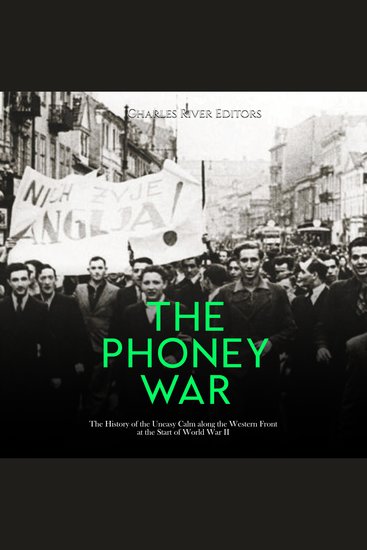
    Though the French would be decisively defeated soon after the Nazi invasion of Belgium and France in early 1940, they had not sat on their hands. As the power of Nazi Germany grew alarmingly during the 1930s, the French sought means to defend their territory against the rising menace of the Thousand Year Reich. As architects of the most punitive measures in the Treaty of Versailles following World War I, France was the most natural target for German retribution, so the Maginot Line, a series of interconnected strongpoints and fortifications running along much of France's eastern border, helped allay French fears of invasion.  
    	The popular legend of the Maginot Line portrays the frontier defenses as a useless “white elephant” project that was prompted by a gross misapprehension of warfare's new realities in the mid-20th century and quickly overwhelmed by the forceful advance of the German blitzkrieg. English idiom today invokes this vision of the Maginot Line as a metaphor for any defensive measure strongly believed in but actually useless. Indeed, usages such as “Maginot Line mentality,” describing an overly defensive, reactive mindset, perpetuate the legend. As a French author and military liaison with the British, Andre Maurois, wrote about his disillusionment with the defensive line he originally enthusiastically supported: “We know now that the Maginot line-complex was a dangerous disease of the mind; but I publish this as it was written in January, 1940.”  
    This was what brought about the stasis along the Western Front near the end of 1939, a short period of time now referred to as the Phoney War, during which the Western Allies awaited some sort of action by the Nazis. Ultimately, the Allies had not expected the Germans would be able to move armored units through the Ardennes Forests, a heavily wooded region spanning parts of Belgium, France and the Netherlands. 
    Mostra libro