Join us on a literary world trip!
Add this book to bookshelf
Grey
Write a new comment Default profile 50px
Grey
Subscribe to read the full book or read the first pages for free!
All characters reduced
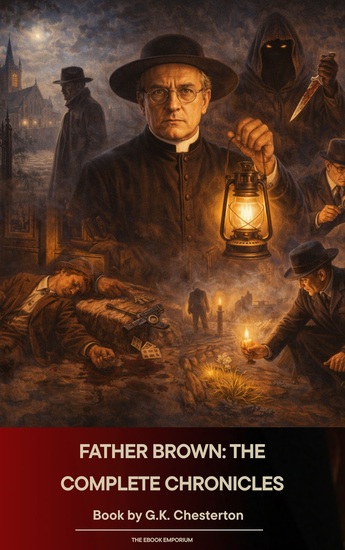
Father Brown: The Complete Chronicles - cover

Father Brown: The Complete Chronicles

G.K. Chesterton

Publisher: The Ebook Emporium

  • 0
  • 0
  • 0

Summary

What if the greatest detective solved crimes by understanding the human soul?

Father Brown: The Complete Chronicles brings together all the beloved stories featuring G. K. Chesterton's unforgettable priest-detective. Modest in appearance yet profound in insight, Father Brown solves mysteries not through force or showmanship, but through empathy, moral reasoning, and a deep understanding of human weakness.

Set in England and beyond, these classic tales blend clever puzzles with philosophical reflection and quiet humor. Each case reveals not only how a crime was committed, but why—making Father Brown's deductions as humane as they are brilliant.

These stories helped define the cozy mystery tradition while offering something rare in detective fiction: compassion without sentimentality.

Inside this eBook, you'll explore:

All Father Brown stories in one complete collection

Clever mysteries solved through insight and moral logic

Classic cases such as The Blue Cross and The Invisible Man

A cornerstone of British detective fiction

Adapted for radio and television and loved for generations, Father Brown remains one of literature's most distinctive and enduring detectives.

Discover mysteries where wisdom matters more than cleverness. Buy now and enjoy Father Brown: The Complete Chronicles.
Available since: 01/29/2026.
Print length: 1164 pages.

Other books that might interest you

  • The Tale of Timmy Tiptoes - cover

    The Tale of Timmy Tiptoes

    Beatrix Potter

    • 0
    • 0
    • 0
    The Tale of Timmy Tiptoes is written by the popular children's author Beatrix Potter. Timmy and his wife Goody are collecting nuts for winter. But Timmy falls into a hole and can't get out! Goody searches for him everywhere. The moral of the story is: concentrate on your own life and don't mind others. Recommended for age 3+.
    Show book
  • Beric the Briton: a Story of the Roman Invasion - cover

    Beric the Briton: a Story of the...

    G. A. Henty

    • 0
    • 0
    • 0
    My series of stories dealing with the wars of England would be altogether incomplete did it not include the period when the Romans were the masters of the country. The valour with which the natives of this island defended themselves was acknowledged by the Roman historians, and it was only the superior discipline of the invaders that enabled them finally to triumph over the bravery and the superior physical strength of the Britons. The Roman conquest for the time was undoubtedly of immense advantage to the people -- who had previously wasted their energies in perpetual tribal wars -- as it introduced among them the civilization of Rome. In the end, however, it proved disastrous to the islanders, who lost all their military virtues. Having been defended from the savages of the north by the soldiers of Rome, the Britons were, when the legions were recalled, unable to offer any effectual resistance to the Saxons, who, coming under the guise of friendship, speedily became their masters, imposing a yoke infinitely more burdensome than that of Rome, and erasing almost every sign of the civilization that had been engrafted upon them. How far the British population disappeared under the subsequent invasion and the still more oppressive yoke of the Danes is uncertain; but as the invaders would naturally desire to retain the people to cultivate the land for them, it is probable that the great mass of the Britons were not exterminated. It is at any rate pleasant to believe that with the Saxon, Danish, and Norman blood in our veins, there is still a large admixture of that of the warriors who fought so bravely against Caesar, and who rose under Boadicea in a desperate effort to shake off the oppressive rule of Rome.. (Introduction by G.A.Henty)
    Show book
  • Antigone - Full Cast Drama - cover

    Antigone - Full Cast Drama

    Sophocles

    • 0
    • 0
    • 0
    "Antigone" is a Greek tragedy written by Sophocles in the 5th century BCE. The play is part of a trilogy, but only "Antigone," the third installment, has survived. The narrative revolves around Antigone, the daughter of Oedipus, who defies the king's decree and buries her brother Polynices, in defiance of the law. The king, Creon, orders that Polynices' body should remain unburied as punishment for his rebellion against the city. 
     
    Antigone's act of burial is not only an expression of familial loyalty but also an assertion of divine laws over human laws. She believes in the moral duty to honor her brother, even in death and is willing to face the consequences. Creon, however, sees her actions as an affront to his authority and issues a decree that anyone attempting to bury Polynices will be put to death. 
     
    As the plot unfolds, the clash between divine and human laws intensifies. Antigone is caught and brought before Creon, where she staunchly defends her actions. Creon remains resolute in his decision to punish her, regardless of her familial ties. The play explores themes of morality, duty, and the consequences of pride and authoritarian rule. 
     
    Tragedy unfolds as Antigone is sentenced to be entombed alive. The narrative weaves the fates of various characters, including Antigone, Haemon (Creon's son and Antigone's fiancé), and Eurydice (Creon's wife). The play culminates in a series of tragic events, leading to Creon's realization of his own tragic flaw and the devastating consequences of his decisions.
    Show book
  • Death Comes for the Archbishop - cover

    Death Comes for the Archbishop

    Willa Cather

    • 0
    • 0
    • 0
    'The old man smiled. "I shall not die of a cold, my son. I shall die of having lived."'
    
    A quietly stunning meditation on endurance, cultural encounters and spiritual legacy in the American Southwest, Death Comes for the Archbishop remains one of Willa Carter's greatest works.
    
    First published in 1927, Carther's luminous novel follows the lives of two French Catholic missionaries – Father Jean Marie Latour and Father Joseph Vaillant – as they journey to New Mexico Territory to establish a diocese in the mid-nineteenth century. Through a series of episodic vignettes, Cather paints a vast and vibrant landscape of deserts and mesas while exploring themes of faith, identity and the shaping of spiritual and physical frontiers. The result is a life-affirming tale of harmony between people, cultures and the natural world. Now translated into twenty-four languages, Death Comes for the Archbishop remains one of Cather's most celebrated works.
    Willa Cather (1873 – 1947) was an American novelist and short story writer. She worked as a magazine editor and English teacher before turning her hand to writing, eventually resulting in a Pulitzer Prize in 1923 for her novel, One of Ours. Often writing from a romantic nationalist perspective, her work explores themes such exile and nostalgia.
    Show book
  • At Christmas Time - From their pens to your ears genius in every story - cover

    At Christmas Time - From their...

    Anton Chekhov

    • 0
    • 0
    • 0
    Anton Pavlovich Chekhov was born on 29th January 1860 in Taganrog, on the south coast of Russia.  
    His family life was difficult; his father was strict and over-bearing but his mother was a passionate story-teller, a subject Chekhov warmed to. As he later said; ‘our talents we got from our father, but our soul from our mother’.  
    At school Chekhov was distinctly average. At 16 his father mis-managed his finances and was declared bankrupt. His family fled to Moscow. Chekhov remained and eked out a living by various means, including writing and selling short sketches to newspapers, to finish his schooling. That completed and with a scholarship to Moscow University obtained he rejoined his family. 
    He was able to help support them by selling satirical sketches and vignettes of Russian lifestyles and gradually obtained further commissions. In 1884, he qualified as a physician and, although it earned him little, he often treated the poor for free, he was fond of saying ‘Medicine is my lawful wife, and literature is my mistress.’ 
    His own health was now an issue as he began to cough up blood, a symptom of tuberculosis.  Despite this his writing success enabled him to move the family into more comfortable accommodation.  
    Chekhov wrote over 500 short stories which included many, many classics including ‘The Kiss’ and ‘The Lady with a Dog’.  His collection ‘At Dusk’ won him the coveted Pushkin Prize when was only 26.  
    He was also a major playwright beginning with the huge success of ‘Ivanov’ in 1887.   
    In 1892 Chekhov bought a country estate north of Moscow. Here his medical skills and money helped the peasants tackle outbreaks of cholera and bouts of famine. He also built three schools, a fire station and a clinic.  It left him with less time for writing but the interactions with real people gained him detailed knowledge about the peasantry and their living conditions for his stories.  
    His most famous work, ‘The Seagull’ was received disastrously at its premiere in St Petersburg. It was later restaged in Moscow to highlight its psychological aspects and was a huge success. It led to ‘Uncle Vanya’, ‘The Three Sisters’ and ‘The Cherry Orchard’.  
    Chekhov suffered a major lung hemorrhage in 1897 while visiting Moscow. A formal diagnosis confirmed tuberculosis and the doctors ordered changes to his lifestyle.  
    Despite a dread of weddings the elusive literary bachelor quietly married the actress Olga Knipper, whom he had met at rehearsals for ‘The Seagull’, on 25th May 1901. 
    By May 1904 with his tuberculosis worsening and death imminent he set off for the German town of Badenweiler writing cheerful, witty letters to his family and assuring them his health was improving.  
    On 15th July 1904 Anton Chekhov died at Badenweiler.  He was 44.
    Show book
  • Lights - From their pens to your ears genius in every story - cover

    Lights - From their pens to your...

    Vladimir Korolenko

    • 0
    • 0
    • 0
    Vladimir Galaktionovich Korolenko was born in Zhytomyr, Ukraine, then part of the Russian Empire on 27th July 1853. 
    His father died when he was 13 and life was then often struck with bouts of poverty, which resulted in his education being somewhat erratic.   A spell in exile at 23 was followed by another as the politics of the times opposed his volatile but heart-felt passions. 
    Writing was also coming to the fore and in 1879 his debut short story telling of a young Narodnik searching for social and spiritual identity, was published. 
    In 1881, Korolenko refused to swear allegiance to the new Russian Tsar and was again exiled, this time much farther afield.  He spent the next three years doing manual work, but took time to study local customs and history.  These impressions in exile provided rich material for his writings. 
    In 1885 he was allowed to settle in Nizhny, where again he repeatedly questioned the authorities.  That same year ‘Makar's Dream’ established his literary reputation and was part of his first collection ‘Sketches and Stories’, the following year. 
    In the early 1890’s when famine struck Central Russia, he went to work on relief missions, collecting donations, supervising the delivery and distribution of food, opening 45 free canteens, all this while writing the graphic reports that would later be published as ‘In the Year of Famine’ in 1893. 
    By 1896 despite some psychological disorders, he was well regarded amongst Russian writers and was even a member of the Russian Academy of Sciences.  Throughout his writing career Korolenko was a staunch advocate of human rights, putting that sacred activity above what he called his 'part-time-writing'. 
    In the Revolutionary year of 1905, under his editorship, Russkoye Bogatstvo published the Manifest by the Petersburg Soviet of the Workers' deputies. Korolenko was now repeatedly harassed by the authorities, had his flat raided many times and materials confiscated. 
    As a lifetime opponent of Tsarism, he guardedly welcomed the Revolution of 1917.  Once the nature of Bolshevism was established, he soon started to criticize it. During the Russian Civil War that ensued, he condemned both the Red Terror and the White Terror.  
    Despite suffering from a progressive heart disorder, he collected food packages for children in famine-stricken Moscow and Petrograd as well as organised orphanages and shelters for the homeless.  
    Vladimir Korolenko died in Poltava, Ukraine, of the complications of pneumonia on 25th December 1921.  He was 68.
    Show book