Unisciti a noi in un viaggio nel mondo dei libri!
Aggiungi questo libro allo scaffale
Grey
Scrivi un nuovo commento Default profile 50px
Grey
Iscriviti per leggere l'intero libro o leggi le prime pagine gratuitamente!
All characters reduced
Dickens by Chesterton - Critical Study Biography Appreciations & Criticisms of the Works by Charles Dickens - cover

Dickens by Chesterton - Critical Study Biography Appreciations & Criticisms of the Works by Charles Dickens

G. K. Chesterton

Casa editrice: DigiCat

  • 0
  • 0
  • 0

Sinossi

In "Dickens by Chesterton," G. K. Chesterton offers a captivating and insightful exploration of Charles Dickens' literary genius. This rich analysis combines a biographical approach with a critical examination of Dickens' themes, stylistic choices, and social commentary. Chesterton's enchanting prose, imbued with his characteristic wit and philosophical musings, resonates within the broader context of early 20th-century literature, shedding light on the moral dilemmas and societal injustices Dickens confronted in his work. Through Chesterton's lens, readers gain a deeper appreciation for the interplay of humor, tragedy, and the human condition that permeates Dickens' narratives. G. K. Chesterton, a prolific writer and influential thinker, is well-regarded for his contributions to literature, philosophy, and social criticism. His own experiences and deep-seated belief in the importance of morality and faith, often juxtaposed with the harsh realities of modern life, frame his interpretation of Dickens. Chesterton admired Dickens not only for his storytelling prowess but also for his profound ability to engage with social issues, making this analysis a reflection of the values that underpinned Chesterton's own work. For readers who seek to understand the intricate layers of Dickens' characters and the societal critiques embedded within his narratives, "Dickens by Chesterton" serves as an essential companion. Chesterton's engaging style and perceptive insights will appeal to both scholars and casual readers alike, inviting them to delve into the world of Dickens with renewed passion and understanding.
Disponibile da: 27/12/2023.
Lunghezza di stampa: 377 pagine.

Altri libri che potrebbero interessarti

  • The Letters of Charlotte Brontë - Performed by IMOGEN STUBBS in a dramatised setting - cover

    The Letters of Charlotte Brontë...

    Alan Drury

    • 0
    • 0
    • 0
    Immerse yourself in the captivating world of Charlotte Brontë featuring the remarkable performance of Imogen Stubbs as the iconic author herself in “The Letters of Charlotte Brontë”. 
     
    “Imogen Stubb’s reading of her letters show us a character so fine, so sympathetic that in the end we are uplifted” Good Book Guide 
     
    “Imogen Stubbs reading is enthusiastic... and her reading of Emily’s slow death could not be faulted. 5-star rating.”  Talking Business 
     
    Step back in time to the early 19th century as we unveil the poignant and tragic life of Charlotte Brontë (1816-1855). From the desolate Haworth parsonage to the captivating landscapes of Brussels and the windswept Yorkshire moors, Charlotte's life unfolds before your ears through her heartfelt letters to her closest friend and confidante, Ellen Nussey.  
     
    Witness her triumphant creation of "Jane Eyre," only to be struck by the heart-wrenching loss of her siblings. Discover the resilience of a woman who, despite personal tragedy, continued to pen timeless novels and wander her cherished moors. 
     
    Enjoy a gripping narrative of Charlotte Brontë's remarkable life and untimely death, filled with passion, perseverance, and profound literary legacy. This is Charlotte Brontë’s world, a literary genius who left an indelible mark on literature. 
     
    Also available as part of the CLASSIC LETTERS & JOURNALS BOX SET, a sixteen hour, seven-volume edition featuring the letters and journals of Lord Nelson, Charlotte Brontë, Scott of the Antarctic, Queen Victoria, Lord Byron, Jane Austen and Dorothy Wordsworth. Performed by Charles Dance, Imogen Stubbs, Edward Fox, Virginia McKenna, Robert Powell, Fiona Shaw and Jenny Agutter. 
     
    © & ℗ 2022 Mr Punch Audiobooks Ltd
    Mostra libro
  • New Zealand Wars - Conflict and Change in the 19th Century - cover

    New Zealand Wars - Conflict and...

    Lillian Brooks

    • 0
    • 0
    • 0
    The New Zealand Wars, a series of armed conflicts in the 19th century, marked a defining period in the history of Aotearoa. These wars were fought primarily between the British colonial forces and various Māori iwi (tribes), though the conflicts were far from one-sided. They stemmed from a complex array of issues, including disputes over land, sovereignty, and the growing influence of European settlers on Māori society. The origins of these wars can be traced to the arrival of Europeans, whose presence in New Zealand brought with it not only trade but also significant cultural, political, and economic changes. 
    The initial encounters between Māori and European settlers were characterized by a mixture of curiosity, trade, and alliance-building. However, as more settlers arrived, pressure mounted on Māori land and resources. Tensions began to escalate as land was purchased, often under dubious circumstances, leading to Māori grievances over the loss of their ancestral territories. The New Zealand Company, a British settlement scheme, played a significant role in these land disputes, exacerbating tensions between Māori and the Crown. 
    In response to these threats, Māori began to organize and resist. Some iwi, such as the Waikato and Taranaki, developed strong resistance movements in defense of their land and way of life. The British, in turn, sought to assert their authority over the increasingly restless Māori population, leading to the outbreak of hostilities.
    Mostra libro
  • Nazis on the Potomac - The Top-Secret Intelligence Operation that Helped Win World War II - cover

    Nazis on the Potomac - The...

    Robert K. Sutton

    • 0
    • 0
    • 0
    “A fascinating account” of the secret Virginia facility code-named PO Box 1142, where the US gathered intelligence and interrogated German prisoners (Journal of Counterterrorism & Homeland Security International).   About fifteen miles south of Washington, DC, Fort Hunt, Virginia is a green open space enjoyed by residents. But not so long ago, it was the site of one of the highest-level clandestine operations of World War II.   Shortly after the US entered the war, the military realized it had to work on exploiting any advantages it might gain on the Axis Powers. One part of this endeavor was to establish a secret facility not too close to—but also not too far from—the Pentagon, which would interrogate and eavesdrop on the highest-level Nazi prisoners and also translate and analyze captured German war documents. That complex was established at Fort Hunt, known by the code name: PO Box 1142.   The American servicemen who did the interrogating and translating were young, bright, hardworking, and absolutely dedicated to their work. Many of them were Jews who’d escaped Nazi Germany as children—some had come to America with their parents, others had escaped alone, but their experiences, and what they’d been forced to leave behind, meant they had personal motivation to do whatever they could to defeat Nazi Germany. They were perfect for the difficult and complex job at hand. They never used corporal punishment in interrogations of German soldiers but developed and deployed dozens of tricks to gain information. The Allies won the war against Hitler for a host of reasons, discussed in hundreds of volumes. This is the first book to describe the intelligence operations at PO Box 1142 and their part in that success. It will never be known how many American lives were spared, or whether the war ended sooner with the programs at Fort Hunt, but it’s doubtless that they made a difference—and gave the young Jewish men stationed there the chance to combat the evil that had befallen them and their families.   “Fills a gap in World War II intelligence history by documenting the origins of a number of European Theater intelligence successes thanks to the work of Ft. Hunt interrogators.” —Studies in Intelligence  Includes photographs
    Mostra libro
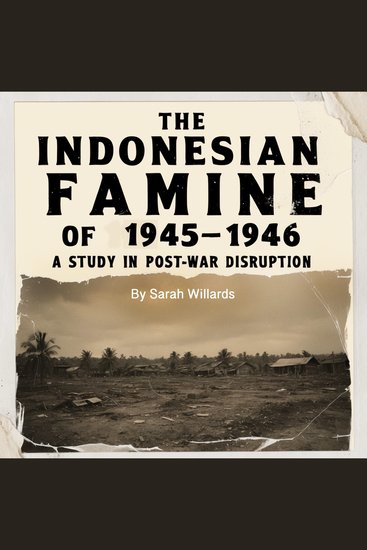
  • The Indonesian Famine of 1945-1946 - A Study in Post-War Disruption - cover

    The Indonesian Famine of...

    Sarah Willards

    • 0
    • 0
    • 0
    The conclusion of World War II marked a pivotal turning point in Indonesia’s history. As the Japanese forces surrendered in August 1945, the vacuum left behind in their wake exposed the fragility of colonial and wartime institutions. Indonesia, long under Dutch colonial rule and occupied by Japan since 1942, was suddenly thrust into a state of political and administrative chaos. The power void that followed the Japanese capitulation was quickly filled by nationalist fervor, culminating in the proclamation of Indonesian independence on August 17, 1945. However, the declaration did not result in immediate recognition or control. Instead, the country found itself caught between competing powers and clashing agendas. 
    The collapse of Japanese administrative structures left the newly proclaimed Republic of Indonesia struggling to assert its legitimacy. Republican leaders, including Sukarno and Mohammad Hatta, faced the monumental task of organizing a new government while also managing the fallout of war. Meanwhile, Dutch authorities, with Allied support, sought to re-establish their colonial presence. This led to violent confrontations and widespread instability, as various factions—including local militias, former Japanese-trained troops, and returning colonial forces—vied for control over towns, supply routes, and administrative posts. 
    The disintegration of centralized governance had far-reaching consequences. Essential services, including food distribution and public health, were severely disrupted. The chaos was further compounded by a breakdown in communication lines and transportation infrastructure, much of which had been damaged during the war or repurposed by occupying forces. With no clear authority in many regions, local leaders and grassroots organizations were left to manage crises as best they could, often with limited resources and no coordination.
    Mostra libro
  • The Art of Being Magnetic - How Small Gestures and Big Presence Win Hearts - cover

    The Art of Being Magnetic - How...

    Mason Keller

    • 0
    • 0
    • 0
    What makes some people instantly likeable, effortlessly charismatic, and unforgettable in any room they enter? The answer is not luck, looks, or wealth—it’s the art of presence, connection, and genuine attention. The Art of Being Magnetic teaches you how to cultivate that rare and powerful quality in your own life. 
    Through 27 practical, easy-to-apply strategies, this book shows you how to:Make people feel truly seen, heard, and valuedCommunicate warmth and confidence without arroganceLeave every interaction better than you found itHarness empathy, humor, and thoughtful gestures to build lasting bondsAdapt gracefully to any social setting while staying authentically yourself 
    Whether you want to strengthen personal relationships, shine in professional settings, or simply become more memorable and magnetic, this book gives you the tools to make every interaction count. Written in clear, audiobook-friendly language, it combines actionable advice with real-life examples, guiding you step by step to become someone people naturally gravitate toward. 
    Master the subtle art of connection. Transform ordinary moments into lasting impressions. Become magnetic.
    Mostra libro
  • History of Marathas EP06 - Visit to Agra - cover

    History of Marathas EP06 - Visit...

    Vikrant Pande

    • 0
    • 0
    • 0
    'I did not come here just to receive the royal honour. My son is a panch hazari Mansabdar under the Badshah. He can be made to stand wherever the Badshah wishes him to. But I am not a servant of the Badshah! I am a Raja in my own right!'
    The three of them returned, unable to convince Shivaji. They explained the situation to the Badshah when Ram Singh said, 'Alijah! It seems the hot Agra weather has not suited Raje. Please pardon him. He will present himself soon.'
    'I can understand his feelings,' said Aurangzeb.
    'Ram Singh, please sprinkle my special gulab jal on him to cool him down. Please request him to come back. We will then talk.'
    Mostra libro