Join us on a literary world trip!
Add this book to bookshelf
Grey
Write a new comment Default profile 50px
Grey
Subscribe to read the full book or read the first pages for free!
All characters reduced
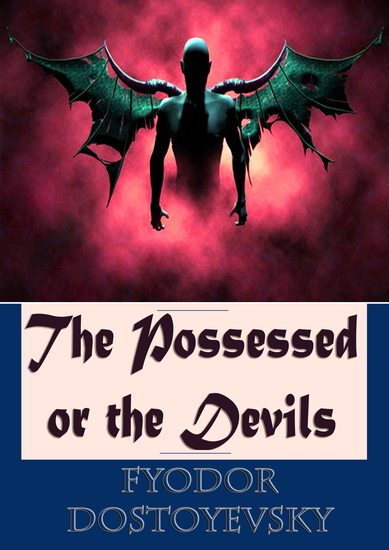
The Possessed or the Devils - cover

The Possessed or the Devils

Fyodor Dostoyevsky

Translator Constance Garnett

Publisher: E-Kitap Projesi & Cheapest Books

  • 0
  • 0
  • 0

Summary

"Strike me dead, the track has vanished,
Well, what now? We've lost the way,
Demons have bewitched our horses,
Led us in the wilds astray.
"What a number! Whither drift they?
What's the mournful dirge they sing?
Do they hail a witch's marriage
Or a goblin's burying?"

Pushkin.

"And there was one herd of many swine feeding on this mountain; and they besought him that he would suffer them to
enter into them. And he suffered them.

"Then went the devils out of the man and entered into the swine; and the herd ran violently down a steep place into
the lake and were choked.

"When they that fed them saw what was done, they fled, and went and told it in the city and in the country.

"Then they went out to see what was done; and came to Jesus
and found the man, out of whom the devils were departed,
sitting at the feet of Jesus, clothed and in his right mind;
and they were afraid."

Luke, ch. viii. 32-37.

IN UNDERTAKING to describe the recent and strange incidents in our town, till lately wrapped in uneventful obscurity, I find myself forced in absence of literary skill to begin my story rather far back, that is to say, with certain biographical details concerning that talented and highly-esteemed gentleman, Stepan Trofimovitch Verhovensky. I trust that these details may at least serve as an introduction, while my projected story itself will come later.

I will say at once that Stepan Trofimovitch had always filled a particular rôle among us, that of the progressive patriot, so to say, and he was passionately fond of playing the part—so much so that I really believe he could not have existed without it. Not that I would put him on a level with an actor at a theatre, God forbid, for I really have a respect for him. This may all have been the effect of habit, or rather, more exactly of a generous propensity he had from his earliest years for indulging in an agreeable day-dream in which he figured as a picturesque public character. He fondly loved, for instance, his position as a "persecuted" man and, so to speak, an "exile." There is a sort of traditional glamour about those two little words that fascinated him once for all and, exalting him gradually in his own opinion, raised him in the course of years to a lofty pedestal very gratifying to vanity. In an English satire of the last century, Gulliver, returning from the land of the Lilliputians where the people were only three or four inches high, had grown so accustomed to consider himself a giant among them, that as he walked along the streets of London he could not help crying out to carriages and passers-by to be careful and get out of his way for fear he should crush them, imagining that they were little and he was still a giant. He was laughed at and abused for it, and rough coachmen even lashed at the giant with their whips. But was that just? What may not be done by habit? Habit had brought Stepan Trofimovitch almost to the same position, but in a more innocent and inoffensive form, if one may use such expressions, for he was a most excellent man.
Available since: 02/02/2024.
Print length: 900 pages.

Other books that might interest you

  • The Man Who Knew Too Much - cover

    The Man Who Knew Too Much

    G.K. Chesterton

    • 0
    • 0
    • 0
    Horne Fisher is extremely well connected. The plans of prime ministers, foreign ambassadors, and chancellors are matters of table conversation - usually because these people are dining with him. And when a man so well connected is also a brilliant detective, all sinister motives and plots systematically unfold.
    
    Whether it is a case of police corruption, or a war with Sweden, Horne Fisher can always solve it. But Horne Fisher is also a philosopher, and not a policeman, and the murderer is seldom punished. G. K. Chesterton, author of the Father Brown stories, here introduces another detective outside the realm of conventional law enforcement.
    
    The Man Who Knew Too Much contains eight stories full of mystery and adventure, with a fair share of food for thought.
    Show book
  • From the Earth to the Moon - Audiobook - cover

    From the Earth to the Moon -...

    Jules Verne, Classic Audiobooks,...

    • 0
    • 0
    • 0
    With From the Earth to the Moon, Jules Verne launched not only a projectile toward space but also the modern imagination toward the stars. Written in 1865, this novel envisions an audacious experiment — the attempt to reach the Moon using the ingenuity and willpower of humankind. It is both a celebration of scientific curiosity and a satire of human ambition.Verne's protagonists, a band of American inventors and dreamers, transform post-Civil War rivalry into a race toward the heavens. With meticulous technical detail and infectious enthusiasm, Verne brings to life the excitement of discovery and the humor of innovation gone wild.A century before the Apollo missions, From the Earth to the Moon predicted space travel with uncanny accuracy. Yet its true power lies in its optimism — a belief that imagination, courage, and reason can lift humanity beyond its earthly limits.
    Show book
  • Dracula - cover

    Dracula

    Bram Stoker

    • 0
    • 0
    • 0
    A POWERFUL FULL CAST DRAMATIC MARATHON  
     
    “There is a reason why all things are as they are.” 
     
    Dracula author Bram Stoker was born on November 8, 1847 in Dublin. Stoker was bedridden with an unknown illness until he started school at the age of seven when he made a complete recovery. Of this time, Stoker wrote, "I was naturally thoughtful, and the leisure of long illness gave opportunity for many thoughts which were fruitful according to their kind in later years." He was educated in a private school run by the Reverend William Woods. 
     
    Stoker visited the English coastal town of Whitby in 1890, and that visit was said to be part of the inspiration for Dracula. He began writing novels while working as the manager for London's Lyceum Theatre, beginning with The Snake's Pass in 1890 and Dracula in 1897. Stoker was part of the literary staff of The Daily Telegraph in London, and he wrote other fiction, including the horror novels The Lady of the Shroud (1909) and The Lair of the White Worm (1911). 
     
    Dracula is an epistolary novel, written as a collection of realistic but completely fictional diary entries, telegrams, letters, ship's logs, and newspaper clippings, all of which added a level of detailed realism to the story, a skill which Stoker had developed as a newspaper writer. At the time of its publication, Dracula was considered a "straightforward horror novel" based on imaginary creations of supernatural life. "It gave form to a universal fantasy and became a part of popular culture.
    Show book
  • A Child's Garden of Verses - cover

    A Child's Garden of Verses

    ‎Robert Louis Stevenson

    • 0
    • 0
    • 0
    Here is a delightful look at childhood, written by master poet and storyteller Robert Louis Stevenson. In this collectionA Child's Garden of Verses of 64 poems, Stevenson recalls the joys of his childhood, from sailing boats down a river, to waiting for the lamplighter, to sailing off to foreign lands in his imagination. 
    Nothing has ever been written that appeals to a child's nature more than "A Child's Garden of Verses." It is written in a simple verse that a child can readily understand.
    Show book
  • Joseph Andrews - cover

    Joseph Andrews

    Henry Fielding

    • 0
    • 0
    • 0
    "Joseph Andrews ... was the first published full-length novel of the English author and magistrate Henry Fielding, and indeed among the first novels in the English language. Published in 1742 and defined by Fielding as a ‘comic romance,’ it is the story of a good-natured footman's adventures on the road home from London with his friend and mentor, the absent-minded parson Abraham Adams." (Summary by Wikipedia)
    Show book
  • The Raven - A Robin Reads Audiobook - cover

    The Raven - A Robin Reads Audiobook

    Edgar Allan Poe

    • 0
    • 0
    • 0
    Edgar Allan Poe's peerless narrative poem about a forlorn lover who is visited by a mysterious raven. 
    First published in 1845. Narrated by Robin Reads.
    Show book