Unisciti a noi in un viaggio nel mondo dei libri!
Aggiungi questo libro allo scaffale
Grey
Scrivi un nuovo commento Default profile 50px
Grey
Iscriviti per leggere l'intero libro o leggi le prime pagine gratuitamente!
All characters reduced
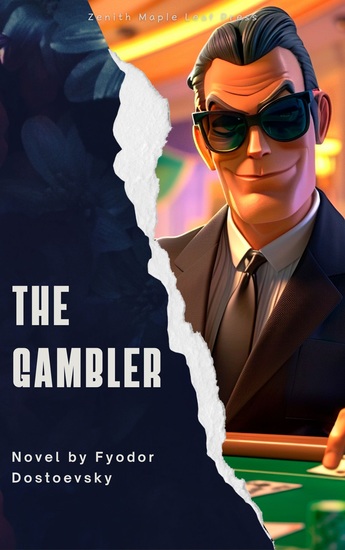
The Gambler - A Gripping Tale of Love Obsession and the Perils of Chance - cover

The Gambler - A Gripping Tale of Love Obsession and the Perils of Chance

Fyodor Dostoevsky, Zenith Maple Leaf Press

Casa editrice: Zenith Maple Leaf Press

  • 0
  • 0
  • 0

Sinossi

When the roulette wheel spins, so does his fate.
Written under the pressure of debt and a looming deadline, The Gambler is Fyodor Dostoevsky's intense exploration of addiction, desire, and human weakness. The story follows Alexei Ivanovich, a tutor working for a wealthy Russian family in a fictional European resort. Torn between his love for the enigmatic Polina and his growing obsession with the roulette table, Alexei's life becomes a desperate gamble where passion and risk collide.

First published in 1867, this semi-autobiographical novel draws on Dostoevsky's own experiences with gambling, giving the work a raw authenticity. Through vivid characters, tense drama, and deep psychological insight, The Gambler captures the intoxicating lure—and destructive power—of chance.

"A sharp, urgent novel that lays bare the psychology of obsession."
– The Guardian

"Dostoevsky writes gambling with the authority of one who has lived it."
– The New York Times

✅ Why Readers Love It:
🎲 A tense and authentic portrayal of gambling addiction

❤️ A love story entangled with ambition and risk

📚 Written with urgency and psychological depth

🎯 Click 'Buy Now' to experience Dostoevsky's electrifying tale of love, money, and the game of fate.
Disponibile da: 12/08/2025.
Lunghezza di stampa: 207 pagine.
Altri libri che potrebbero interessarti

  • Parade's End - The Complete Tetralogy - cover

    Parade's End - The Complete...

    Ford Madox

    • 0
    • 0
    • 0
    There is a hard brightness overlying the emotion and the human suffering and the human passions… Mr. Ford achieves not only what is probably his own best work but what is certainly one of the ablest of recent English novels. — The New York Times, 1924  
    There are not many English novels which deserve to be called great: Parade's End is one of them. — W. H. Auden  
    Ford Madox Ford's Parade's End tetralogy, written in the aftermath of World War I, was originally published in four parts in the 1920s: Some Do Not…; No More Parades; A Man Could Stand Up —; and Last Post. Highlighting the tension between traditional values and a rapidly changing social order in a world embroiled in war, the story details Tietjens' turmoils in both his personal life and on the warfront—and what follows when some of those struggles become one and the same.  
    Unique among other war fiction of the time, Parade's End privileges not the conflict of the Great War itself, but the impact the war had on its participants and upon society writ large. With it's publication, Ford hoped to contribute to the obviating of all future wars. 
    Parade's End is often referred to as one of the greatest 20th century novels, and one of the best depictions of war in literature. The 2012 television adaptation, written by Tom Stoppard (Shakespeare in Love), directed by Susanna White (Andor) and starring Benedict Cumberbatch and Rebecca Hall, was nominated for two Primetime Emmy Awards and seven BAFTA Television Awards.
    Mostra libro
  • Gusev - cover

    Gusev

    Anton Chekhov

    • 0
    • 0
    • 0
    "Gusev"  is an 1890 short story by Anton Chekhov.
    Several discharged soldiers return home from the Far East by ship. Confined to the hospital cabin, they are all apparently dying of consumption and seemingly indifferent to their condition. Among them are Gusev, a mild, racist, slightly dim man, and the mysterious Pavel Ivanovich, an ardent "protester" who often goes on diatribes (many of which Gusev either misunderstands or ignores) about his lifelong commitment to telling people "the truth to their faces". Ivanovich is proud of having riled every single person around him during his three years' service in the East, and thinks all the other men present are fools. He later reveals that he is the son of a priest and had to disguise himself as a peasant to buy his third-class ticket. One day, while Gusev is asleep, Pavel Ivanovich dies. One of the other soldiers, seeing that Gusev will also die shortly, helps him up to the ship's deck, where they look at the waves crashing into one another. Several days later, Gusev dies. His body is sewn into a sailcloth sack and weighted. After a short prayer, it is thrown into the ocean, where a shark bites at it. Up above, the ocean begins to reflect the colors of the sky, "...tender, joyous, passionate colours for which it is hard to find a name in human speech".
    Mostra libro
  • A Summer Novella - cover

    A Summer Novella

    Stefan Zweig

    • 0
    • 0
    • 0
    Bored in a semi-deserted Italian hotel, the narrator of this short story spends his days observing the other residents. However, his routine changes when he finally finds a companion: a mysterious elderly gentleman who is willing to share an idea for an exciting novel...
    Throughout his writing career, Stefan Zweig showed great interest in psychology and, in particular, in the work of Sigmund Freud. This fascination with human nature led Zweig to create complex portraits of his characters and, as a result, works that continue to captivate readers for generations.
    Mostra libro
  • History of Herodotus The - Book 8: Urania (Unabridged) - cover

    History of Herodotus The - Book...

    Herodotus, George Rawlinson

    • 0
    • 0
    • 0
    One of the masterpieces of classical literature, the "Histories" describes how a small and quarrelsome band of Greek city states united to repel the might of the Persian empire. But while this epic struggle forms the core of his work, Herodotus' natural curiosity frequently gives rise to colorful digressions - a description of the natural wonders of Egypt; an account of European lake-dwellers; and far-fetched accounts of dog-headed men and gold-digging ants. With its kaleidoscopic blend of fact and legend, the "Histories" offers a compelling Greek view of the world of the fifth century BC.
    BOOK 8: URANIA: The Greeks engaged in the sea-service were the following. The Athenians
    furnished a hundred and twenty-seven vessels to the fleet, which were manned in part by the Plataeans, who, though unskilled in such matters, were led by their active and daring spirit to undertake this duty.
    Mostra libro
  • Eveline (Unabridged) - cover

    Eveline (Unabridged)

    James Joyce

    • 0
    • 1
    • 0
    James Augustine Aloysius Joyce (2 February 1882 - 13 January 1941) was an Irish novelist, short story writer, poet and literary critic. He contributed to the modernist avant-garde movement and is regarded as one of the most influential and important writers of the 20th century.
    EVELINE: She sat at the window watching the evening invade the avenue. Her head was leaned against the window curtains and in her nostrils was the odour of dusty cretonne. She was tired.
    Mostra libro
  • The Curious Case of Benjamin Button - cover

    The Curious Case of Benjamin Button

    F. Scott Fitzgerald

    • 0
    • 0
    • 0
    "He was a baby of some seventy years... and he was born in a crib."
    
    In 1860 Baltimore, the prominent Button family is scandalized when their newborn son arrives not as a soft-skinned infant, but as a seventy-year-old man with a long white beard and a stooped back. So begins the extraordinary life of Benjamin Button—a man destined to grow younger as the world grows older. Fitzgerald tracks Benjamin's reverse journey through the shifting landscape of American history, from the Civil War to the glittering Jazz Age, as he navigates the complexities of love, fatherhood, and a social order that has no place for a man out of time.
    
    A Masterpiece of Social Satire: While often remembered for its fantastical premise, Benjamin Button is a sharp-witted critique of the rigidity of high society. Fitzgerald uses Benjamin's condition to expose the absurdities of social expectations, fashion, and the obsession with "appropriate" behavior. It is a story where the tragedy lies not in the supernatural, but in the human inability to accept what is different.
    
    The Heartbreak of Out of Sync Love: The emotional core of the story is Benjamin's relationship with Hildegarde Moncrief. For a brief, shining moment, their ages meet in the middle, allowing for a fleeting period of conventional happiness. But as she ages into the autumn of her life, Benjamin continues his descent into the spring of his, leading to a poignant and inevitable separation that serves as a metaphor for the universal experience of growing apart.
    
    Witness a life lived against the clock. Purchase "The Curious Case of Benjamin Button" today and experience Fitzgerald's most inventive tale.
    Mostra libro