¡Acompáñanos a viajar por el mundo de los libros!
Añadir este libro a la estantería
Grey
Escribe un nuevo comentario Default profile 50px
Grey
Suscríbete para leer el libro completo o lee las primeras páginas gratis.
All characters reduced
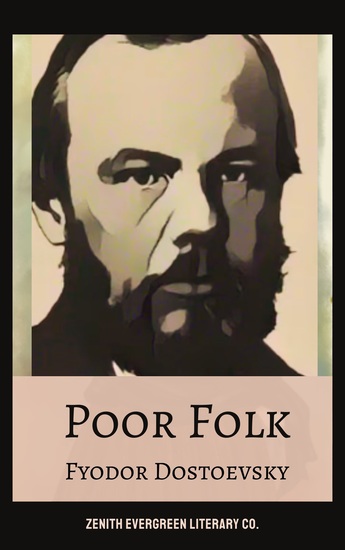
Poor Folk - Fyodor Dostoevsky's Heartfelt Tale of Poverty and Humanity - cover

Poor Folk - Fyodor Dostoevsky's Heartfelt Tale of Poverty and Humanity

Fyodor Dostoevsky, Zenith Evergreen Literary Co.

Editorial: Zenith Evergreen Literary Co.

  • 0
  • 0
  • 0

Sinopsis

📜 Step into the poignant world of Poor Folk, Fyodor Dostoevsky's debut novel that captures the struggles and resilience of the human spirit. This epistolary masterpiece explores themes of poverty, love, and the enduring bond between two souls. 🌟

📖 Follow Makar Devushkin, a humble clerk, and Varvara Dobroselova, a young woman, as they exchange heartfelt letters revealing their hardships, dreams, and unwavering support for one another. Through their correspondence, Dostoevsky paints a vivid picture of 19th-century Russian society and the challenges faced by the less fortunate. 💔

🏆 Praised as Russia's first "social novel," Poor Folk remains a cornerstone of literary realism, showcasing Dostoevsky's profound empathy and insight into the human condition. 🕯️

👉 Click "Buy Now" to experience a timeless story that will touch your heart and inspire your soul.
Disponible desde: 11/04/2025.
Longitud de impresión: 277 páginas.

Otros libros que te pueden interesar

  • Esme - From their pens to your ears genius in every story - cover

    Esme - From their pens to your...

    Saki Saki

    • 0
    • 0
    • 0
    Hector Hugh Munro, more familiarly known by his pen-name ‘Saki’ was born in what was then Akyab in British Burma on 18th December 1870. His father was an Inspector General for the Indian Imperial Police, and his mother the daughter of a Rear Admiral. 
    When he was 2 his mother died and he and his siblings were sent back to England to be raised by their grandmother and paternal maiden aunts in a strict, puritanical household near Barnstaple, Devon. Educated by governesses Saki used many of these women as character models for his later writing. 
    At 17 his father retried and returned to England and then embarked on a series of European travels with Saki and his siblings. 
    After a short stint working in Burma with the Indian Imperial Police Saki decided to move to London to make a living as a writer. Initially he wrote as a journalist for a number of newspapers and magazines before attempting an historical study, ‘The Rise of the Russian Empire’, whose real value lay in directing him to writing short stories instead, the first of which, ‘Dogged’, he published in 1899. 
    From here it was a short stab of the pen to writing political satire before in 1902 he became the foreign correspondent for The Morning Post, first in the Balkans, then Russia, Paris and back to London in 1908, where 'the agreeable life of a man of letters with a brilliant reputation awaited him.'  
    Collections of his short stories full of witty, mischievous and often macabre stories that satirized Edwardian society and two novels now appeared in the years up to the Great War.  At its’ outbreak he was 43 but managed to join as an ordinary trooper. More than once he returned to the battlefield when officially too sick or injured.  
    On 14th November 1916 Hector Hugh Munro was sheltering in crater during the Battle of the Ancre, when he was shot and killed by a German sniper. According to several sources, his last words were "Put that bloody cigarette out!"
    Ver libro
  • Les Misérables: Volume 5: Jean Valjean - Book 1: The War Between Four Walls (Unabridged) - cover

    Les Misérables: Volume 5: Jean...

    Victor Hugo

    • 0
    • 0
    • 0
    Victor-Marie Hugo (26 February 1802 - 22 May 1885) was a French poet, novelist, essayist, playwright, and dramatist of the Romantic movement. During a literary career that spanned more than sixty years, he wrote abundantly in an exceptional variety of genres: lyrics, satires, epics, philosophical poems, epigrams, novels, history, critical essays, political speeches, funeral orations, diaries, and letters public and private, as well as dramas in verse and prose.
    BOOK 1: THE WAR BETWEEN FOUR WALLS: The two most memorable barricades which the observer of social maladies can name do not belong to the period in which the action of this work is laid. These two barricades, both of them symbols, under two different aspects, of a redoubtable situation, sprang from the earth at the time of the fatal insurrection of June, 1848, the greatest war of the streets that history has ever beheld.
    Ver libro
  • The Pen and the Inkstand - cover

    The Pen and the Inkstand

    H. C. Andersen

    • 0
    • 0
    • 0
    Short story by H. Ch. Andersen, about the quarrel with respect to the input to creative work.
    Ver libro
  • Meet Mr Mulliner - cover

    Meet Mr Mulliner

    P. G. Wodehouse

    • 0
    • 0
    • 0
    In Mr Mulliner, P.G Wodehouse (1881 -1975) has created a conduit for all manner of tall tales. The amiable gentleman happily regales the drinkers in the Angler’s Rest Pub with fascinating stories, usually about his own relatives, which range from the somewhat dubious, to the downright unbelievable.  
    Welcome to this eccentric world inhabited by Curates and Bishops high on health tonic, and a lovesick chap who utilises beauty remedies to win his love. A world where a deceased author’s cottage appears to exert a sentimental influence on all who enter, and where an earthquake can lead to marriage. 
      
    Wodehouse’s most famous creations the implacable “Jeeves” and the archetypal English toff “Bertie Wooster” are only the tip of the author’s considerable output. A master of humorous prose, he published over ninety books, forty plays and two hundred short stories.  
    Head Stories presents " Meet Mr Mulliner" - narrated by Simon Hester
    Ver libro
  • Buddenbrooks - The Decline of a Family - cover

    Buddenbrooks - The Decline of a...

    Thomas Mann

    • 0
    • 0
    • 0
    Buddenbrooks is a 1901 novel by Thomas Mann, chronicling the decline of a wealthy north German merchant family over the course of four generations, incidentally portraying the manner of life and mores of the Hanseatic bourgeoisie in the years from 1835 to 1877. Mann drew deeply from the history of his own family, the Mann family of Lübeck, and their milieu.
    It was Mann's first novel, published when he was twenty-six years old. With the publication of the second edition in 1903, Buddenbrooks became a major literary success. Its English translation by Helen Tracy Lowe-Porter was published in 1924. The work led to a Nobel Prize in Literature for Mann in 1929; although the Nobel award generally recognises an author's body of work, the Swedish Academy's citation for Mann identified "his great novel Buddenbrooks" as the principal reason for his prize.
    Mann began writing the book in October 1897, when he was twenty-two years old. The novel was completed three years later, in July 1900, and published in 1901. His objective was to write a novel on the conflicts between businessman and artist's worlds, presented as a family saga, continuing in the realist tradition of such 19th-century works as Stendhal's Le Rouge et le Noir (1830; The Red and the Black). Buddenbrooks is his most enduringly popular novel, especially in Germany, where it has been cherished for its intimate portrait of 19th-century German bourgeois life.
    Before Buddenbrooks Mann had written only short stories, which had been collected under the title Der kleine Herr Friedemann (1898, Little Herr Friedemann). They portrayed spiritually challenged figures who struggle to find happiness in (or at the margins of) bourgeois society. Similar themes appear in the Buddenbrooks, but in a fully developed style that already reflects the mastery of narrative, subtle irony of tone, and rich character descriptions of Mann's mature fiction.
    The exploration of decadence in the novel reflects the influence of Schopenhauer's The World as Will and Representation (1818, 1844) on the young Mann. The Buddenbrooks of successive generations experience a gradual decline of their finances and family ideals, finding happiness increasingly elusive as values change and old hierarchies are challenged by Germany's rapid industrialisation. The characters who subordinate their personal happiness to the welfare of the family firm encounter reverses, as do those who do not.
    The city where the Buddenbrooks live shares so many street names and other details with Mann's native town of Lübeck that the identification is unmistakable, although the novel makes no mention of the name. The young author was condemned for writing a scandalous, defamatory roman à clef about (supposedly) recognisable personages. Mann defended the right of a writer to use material from his own experience.
    The years covered in the novel were marked by major political and military developments that reshaped Germany, such as the Revolutions of 1848, the Austro-Prussian War, and the establishment of the German Empire. Historic events nevertheless generally remain in the background, having no direct bearing on the lives of the characters.
    Ver libro
  • Eugenie Grandet - cover

    Eugenie Grandet

    Honoré de Balzac

    • 0
    • 0
    • 0
    The story centers on Eugénie, a kind-hearted young woman living under the oppressive rule of her miserly father, Félix Grandet, in provincial France. When her cousin Charles arrives, bringing tales of Parisian glamour and emotional turmoil, Eugénie experiences love for the first time. However, her devotion is met with betrayal as Charles succumbs to greed and societal pressures. Balzac paints a vivid portrait of family dynamics, materialism, and sacrifice, critiquing the destructive power of wealth and selfishness. With poignant detail, the novel explores themes of innocence, resilience, and the enduring impact of love amidst moral decay.
    Ver libro