Rejoignez-nous pour un voyage dans le monde des livres!
Ajouter ce livre à l'électronique
Grey
Ecrivez un nouveau commentaire Default profile 50px
Grey
Abonnez-vous pour lire le livre complet ou lisez les premières pages gratuitement!
All characters reduced
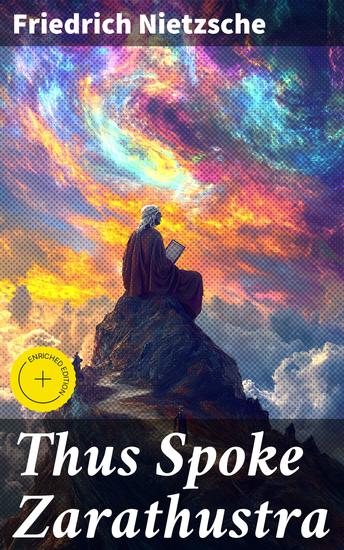
Thus Spoke Zarathustra - The Magnum Opus of the World's Most Influential Philosopher & Revolutionary Thinker - cover

Thus Spoke Zarathustra - The Magnum Opus of the World's Most Influential Philosopher & Revolutionary Thinker

Friedrich Nietzsche

Traducteur Thomas Common

Maison d'édition: Good Press

  • 0
  • 0
  • 0

Synopsis

In "Thus Spoke Zarathustra," Friedrich Nietzsche presents a profound philosophical narrative that intertwines poetry, prose, and prophetic discourse. The book follows the journey of Zarathustra, a sage who descends from the mountains to impart his wisdom on humanity. Through a series of parables and aphorisms, Nietzsche explores themes of the √úbermensch (Overman), the eternal recurrence, and the reevaluation of morality. The work is stylistically innovative, characterized by its lyrical language and rhetorical flourishes, challenging traditional philosophical conventions and reflecting the tumultuous intellectual landscape of the late 19th century. Nietzsche'Äôs text not only serves as a philosophical treatise but also as a critique of contemporary cultural and religious values, thereby establishing itself as a cornerstone of existential and modernist thought. Friedrich Nietzsche, a German philosopher known for his radical ideas and critique of religion, was deeply influenced by existential concerns and the perceived moral decay of society. His personal struggles with health and his fascination with ancient philosophical texts shaped his ideological framework. "Thus Spoke Zarathustra" emerged from Nietzsche'Äôs belief in the necessity of a new framework for understanding human existence, one that transcended conventional Christian morality and ventured into self-creation and individualism. This seminal work is highly recommended for readers interested in philosophy, literature, and the human condition. Nietzsche'Äôs eloquent prose and unsettling ideas provoke critical reflection and engage readers in a dialogue about the nature of existence and the potential for personal transformation. Its impact on 20th-century thought makes it an essential read for anyone seeking to understand contemporary existential philosophy.
Disponible depuis: 26/11/2023.
Longueur d'impression: 367 pages.

D'autres livres qui pourraient vous intéresser

  • Mastering the Art of Cult Leadership: How to Recruit Dominate and Profit - cover

    Mastering the Art of Cult...

    A.A. Castor

    • 0
    • 0
    • 0
    Mastering the Art of Cult Leadership: How to Recruit, Dominate, and Profit by A.A. Castor 
    Have you ever been intrigued by the magnetic power of cult leaders and wondered how they attract such unwavering devotion? Or perhaps you're curious about the psychological techniques that enable them to maintain control and generate substantial wealth? A.A. Castor's latest book, "Mastering the Art of Cult Leadership: How to Recruit, Dominate, and Profit," demystifies these secrets and provides a comprehensive guide to mastering the art of cult leadership. 
    In this eye-opening book, you'll explore: 
    Recruitment Strategies: Learn effective methods to attract and retain followers, including targeted outreach, personalized approaches, and creating a compelling narrative. 
    Psychological Control: Discover powerful techniques to exert influence and maintain loyalty, such as love bombing, intermittent reinforcement, and thought-stopping practices. 
    Monetization Tactics: Understand how to develop sustainable income streams through member contributions, merchandise sales, and exclusive events. 
    Real-Life Case Studies: Analyze the successes and failures of infamous cult leaders, drawing valuable lessons from their experiences. 
    Ethical Considerations: Reflect on the moral implications of cult leadership and explore alternative, ethical models of influence and community building.
    Voir livre
  • Emotional Intelligence Mastery: The Complete Guide for Improving Your EQ Relationships and Social Skills to Overcome Anxiety Depression Manipulation Narcissistic Abuse and More! - cover

    Emotional Intelligence Mastery:...

    Eva Spencer

    • 0
    • 0
    • 0
    IT’S TIME TO TAKE BACK CONTROL OF YOUR EMOTIONS! 
    Do you feel like your emotions are controlling you? 
    If so, it’s time to take control of your life and learn how to improve your emotional intelligence. 
    Emotional Intelligence is the ability to recognize and understand emotions in yourself and others. It’s a crucial skill that can have a huge impact on how successful you are at work, school, relationships, and life in general. 
    This audiobook will teach you everything there is to know about improving your EQ skills so that you can become happier and more fulfilled! 
    Learn all about what EQ is, why it matters so much for success in life (and love!), and how to develop it through practical exercises. You’ll also discover some of the most common obstacles people face when trying to improve their EQ – like anxiety, depression, narcissism – as well as proven strategies for overcoming them. 
    By the end of this audiobook, you will be fully equipped with all the tools necessary for developing better social skills! 
    It doesn’t matter if this is something new for you or if these problems have been plaguing you for years – this audiobook has all the tools necessary to help anyone who wants a happier and more fulfilling life! 
    SCROLL UP, GET THIS AUDIOBOOK, AND START LISTENING!
    Voir livre
  • Into the Dark - What darkness is and why it matters - cover

    Into the Dark - What darkness is...

    Jacqueline Yallop

    • 0
    • 0
    • 0
    Can you remember the first time you encountered true darkness? The kind that remains as black and inky whether your eyes are open or closed? Where you can't see your hand in front of your face? 
     
    Jacqueline Yallop can. It was in an unfamiliar bedroom while holidaying in Yorkshire as a child, and ever since then she has been fascinated by the dark, by our efforts to capture or avoid it, by the meanings we give to it and the way our brains process it. 
     
    Taking a journey into the dark secrets of place, body and mind, she documents a series of night-time walks, exploring both the physical realities of darkness and the psychological dark that helps shape our sense of self. Exploring our enduring love-hate relationship with states of darkness, she considers how we attempt to understand and contain the dark, and, as she comes to terms with her father's deteriorating Alzheimer's, she reflects on how our relationship to the dark can change with time and circumstance. 
     
    Darkness captivates, baffles and appals us. It's a shifty thing of many textures, many moods, a state of fascination and of horror, an absence and a presence, solace and threat, a beginning and an end. Into the Dark is the story of the many darks that fascinate and assail us. It faces the darkness full on in all its guises and mysteries, celebrating it as a thing of beauty while peering into the void.
    Voir livre
  • Franco-Prussian War - One of the Main Causes of World War I - cover

    Franco-Prussian War - One of the...

    Kelly Mass

    • 0
    • 0
    • 0
    The Franco-Prussian War, also known as the Franco-German War or, in France, the War of 1870, was a pivotal conflict between the Second French Empire and the North German Confederation, which was led by the Kingdom of Prussia. This war lasted from 19 July 1870 to 28 January 1871, and its consequences would shape European geopolitics for decades. The primary cause of the war stemmed from France's desire to reaffirm its dominance in continental Europe, which had been seriously challenged after Prussia's decisive victory over Austria in the Austro-Prussian War of 1866. This defeat shifted the balance of power in Europe, making France anxious about its standing. 
    Historians have debated the exact motivations behind the war, particularly regarding the role of Otto von Bismarck, the Prussian chancellor. Some argue that Bismarck intentionally provoked France into declaring war to unite the southern German states—Baden, Württemberg, Bavaria, and Hesse-Darmstadt—under the North German Confederation. Other historians maintain that Bismarck exploited the situation as it developed, recognizing the potential for new alliances but not necessarily seeking war. Regardless of the intent, Bismarck saw the war as an opportunity to strengthen German unity. 
    The war officially began when France mobilized its army on 15 July 1870, prompting the North German Confederation to follow suit with its own mobilization the same day. On 16 July, the French parliament declared war on Prussia, and by 2 August, France had invaded German territory. The German coalition responded swiftly and efficiently, invading northeastern France on 4 August. The Germans had several advantages: superior numbers, better training, more effective leadership, and access to advanced military technology, especially in railways and artillery.
    Voir livre
  • Canadian Citizenship Practice Test Book & Study Guide 2026 - cover

    Canadian Citizenship Practice...

    Michael O'Reilly

    • 0
    • 0
    • 0
    This is the ONLY study material you need for the current Canadian Citizenship test in 2026.  
    Maybe you’re worried about not passing your examination on the first attempt? Or maybe you have no idea where to begin preparing for the test? 
    If that’s you, then, fortunately we’re here to help you. We want to make sure that you pass your examination with confidence. 
    To give you every chance of passing this year, we have prepared the latest study material and 200 practice questions with full answers and explanations. 
    Here’s what you’ll get inside this book:  
    - Practice questions 
    - Detailed answers 
    - Study tips and techniques 
    No matter where in the world you are from, this book will help you pass your Canadian Citizenship Test in 2026 faster, and with more confidence – on your first attempt.
    Voir livre
  • The Critique of Pure Reason - cover

    The Critique of Pure Reason

    Immanuel Kant

    • 0
    • 0
    • 0
    The Critique of Pure Reason is a philosophical work written by Immanuel Kant, published in 1781. The book is divided into two main parts: the first part deals with what Kant calls "Transcendental Aesthetic," which is concerned with the nature of space and time and the way in which our minds perceive them. The second part deals with what Kant calls "Transcendental Logic," which is concerned with the nature of our understanding and how we reason about the world. 
    In the Critique of Pure Reason, Kant aims to investigate the limits and conditions of knowledge, particularly in the context of metaphysics. He argues that all knowledge must be based on experience, but that our understanding is not limited to the information that we can gain through our senses. Rather, he posits that we have certain innate concepts and categories that allow us to make sense of the world and that shape our perception and understanding of reality. 
    Kant's approach to metaphysics is known as transcendental idealism, which holds that the world as it appears to us is not necessarily the same as it is in itself. He argues that we can only know the world as it appears to us, not as it is in itself, and that our knowledge is necessarily limited by the nature of our minds and our perception. 
    Overall, the Critique of Pure Reason is a complex and influential work that has had a profound impact on philosophy, particularly in the fields of epistemology and metaphysics. It is considered a foundational text of modern philosophy and is still widely studied and debated today.
    Voir livre