Unisciti a noi in un viaggio nel mondo dei libri!
Aggiungi questo libro allo scaffale
Grey
Scrivi un nuovo commento Default profile 50px
Grey
Iscriviti per leggere l'intero libro o leggi le prime pagine gratuitamente!
All characters reduced
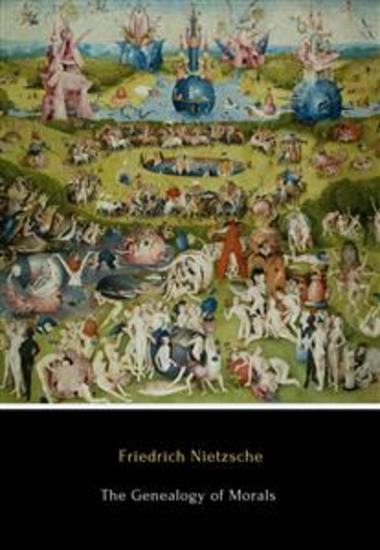
The Genealogy of Morals - cover

The Genealogy of Morals

Friedrich Nietzsche

Casa editrice: Logos

  • 0
  • 1
  • 0

Sinossi

Written in response to a book on the origins of morality by his erstwhile friend Paul Rée, the three essays comprising The Genealogy of Morals — all three advancing the critique of Christian morality set forth in Beyond Good and Evil — are among Nietzsche's most sustained and cohesive work. In the first essay — starting from a linguistic analysis of words such as "good," "bad," and "evil" — Nietzsche sets up a contrast between what he calls "master" morality and "slave" morality and shows how strength and action have often been replaced by passivity and nihilism. The next essay, looking into the origins of guilt and punishment, shows how the concept of justice was born — and how internalization of this concept led to the development of what people called "the soul." In the third essay, Nietzsche dissects the meaning of ascetic ideals. It is not Nietzsche's intention to reject ascetic ideals, "slave" morality, or internalized values out of hand; his main concern is to show that culture and morality, rather than being eternal verities, are human-made. Whether or not you agree with all of his conclusions, his writing is of such clarity and brilliance that you will find reading The Genealogy of Morals nothing short of exhilarating.
Disponibile da: 28/10/2022.


Altri libri che potrebbero interessarti

  • Ancient and Medieval Conspiracy Theories: The History of the World’s Most Persistent Conspiracy Theories - cover

    Ancient and Medieval Conspiracy...

    Editors Charles River

    • 0
    • 0
    • 0
    Perhaps it should also not be surprising that the themes found in contemporary conspiracy theories are often echoed in ancient conspiracy theories. While some people still insist that Lyndon B. Johnson was in on John F. Kennedy’s assassination, it was speculated across the ancient world that the young Macedonian king, Alexander the Great, conspired to have his own father, Philip II of Macedon, assassinated. Likewise, the New Age beliefs that Mesoamerican ruins in Mexico were somehow tied to extraterrestrials find common cause with people who believe the ancient Indus Valley site at Mohenjo-daro was destroyed by a nuclear weapon. And through it all, the lack of surviving documentary evidence about much of antiquity has allowed for all of the unknowns to become highly speculative sources of debate. For example, did Caesar’s men burn the Library of Alexandria in the 1st century B.C., or was it destroyed later, if at all? Some people even suggest that the Library of Alexandria, whose ruins have never been located, never existed at all.  
    	Few eras are easier to let the imagination run wild than the Middle Ages, which have often been coined the Dark Ages based on a perceived lack of progress and information. In some respects, that is not completely unfounded because less is known about that historical period compared to the eras that came after it. In addition, it was a period marked by a great number of deaths caused by plague epidemics, crusades, and inquisitorial persecutions. Often, researchers are not even sure how and why certain events happened, and these mysteries still occupy the attention of historians. 
    	At the same time, some historical mysteries about the era may never be solved, if only because the relevant excavated material has been lost or the archaeological site has been destroyed. Of course, the lack of answers only makes these enigmas more intriguing. 
    Mostra libro
  • Rare Recording of Joan Didion Reading Her Novel A Book of Common Prayer A - Part 2 - cover

    Rare Recording of Joan Didion...

    Joan Didion

    • 0
    • 0
    • 0
    Joan Didion (December 5, 1934 - December 23, 2021), born in Sacramento, California, was an American author, screenwriter, and journalist. Her writing during the 1960s through the late 1970s engaged audiences in the realities of the counterculture of the 1960s, the Hollywood lifestyle, and the history and culture of California. She is considered one of the pioneers of New Journalism, along with Gay Talese, Truman Capote, Norman Mailer, Hunter S. Thompson, and Tom Wolfe. In the following audio recording, Didion reads from her novel, A Book of Common Prayer.
    Mostra libro
  • The Comanche Perspective - A New Lens on the Council House Fight - cover

    The Comanche Perspective - A New...

    Davis Truman

    • 0
    • 0
    • 0
    "The Comanche Perspective" illuminates one of the most infamous events in early Texas history—the Council House Fight. Traditionally portrayed through a narrow, one-sided lens, this book challenges the conventional narrative by exploring the complex web of cultural misunderstandings and mounting tensions between the Penateka Comanche and the Texians. Drawing on diverse perspectives and in-depth research, it reveals how mutual distrust and hostility led to the tragic clash on March 19, 1840. By shedding light on the shared responsibilities and deep-seated grievances that fueled this violent encounter, "The Comanche Perspective" provides a fresh and balanced understanding of a crucial moment in the history of the American frontier.
    Mostra libro
  • In the Shadow of Our Ancestors - cover

    In the Shadow of Our Ancestors

    Wayne Arthurson

    • 0
    • 0
    • 0
    Searching through the annals of North American history uncovers the diverse and astounding contributions by the Natives of the Americas who formed the world we know today.
    		 
    In the Shadow of Our Ancestors explores the rich history of the indigenous peoples of North America and leaves us in awe of their stunning achievements and inventions:
    		 
    The Great Law of Peace — The ideals, words and symbols of the Iroquois Confederacy inspired the governments of the New World to form democracies that recognized, in their constitutions, the rights of all people.
    		 
    Potatoes — The lowly potato, a staple food of Natives for almost 15,000 years, was unknown outside the Americas until Europeans arrived; now, with almost 4000 varieties, it is the fourth most-consumed agricultural product in the world.
    		 
    Sacagawea — The settlement of western North America was inspired and influenced by the results of the Lewis and Clark expedition in the early 1800s, with the journey’s success made possible because of a Native woman named Sacagawea, whose presence paved the way for the explorers to be seen as a peaceful party.
    Mostra libro
  • The Human Calling - Three Thousand Years of Eastern and Western Philosophical History - cover

    The Human Calling - Three...

    Dao Feng He

    • 0
    • 0
    • 0
    A study of the world’s religious movements and what their history says about society today. 
     
    The Human Calling is a vigorously researched and profoundly spiritual narrative history of the world’s religious movements as they relate to society’s collective understanding of the duties they have to fellow people and looks ahead to what lessons from history can be applied as people navigate a technological age. 
     
    Focusing on the rise and fall of spiritual movements in both the East and West, The Human Calling examines what the world’s major religions have historically offered, asks what people are here for outside of pure survival, and makes the persuasive argument for Christianity as the best leader to guide individuals on the path toward better caring for one another—our human calling. The Human Calling takes readers through humanity’s three great thought movements:The first is the Axial Age, the source of the first great human reflection on public spirit and public orderThe second is the twelfth to seventeenths centuries, wrestles with the question of whether people can attain individual rationality in God’s orderThe third delves into the independent reasoning societies of the twentieth and twenty-first centuries and looks forward to what people want their third great reflection on God’s plan to be during their own period of societal flux
    Mostra libro
  • Sartor Resartus - cover

    Sartor Resartus

    Thomas Carlyle

    • 0
    • 0
    • 0
    Sartor Resartus is one of the most unusual, even quirky, British novels to emerge from the first half of the 19th century. Published in 1836, its varied heritage reflects the earlier eccentricities of Sterne and Swift, curiously mixed with influences from Goethe. 
     
    Its subject matter is strange: it concerns a book called Clothes: Their Origin and Influence by one Diogenes Teufelsdröckh, a German philosopher. And though Thomas Carlyle (1795-1881) became a household name in his lifetime, especially for his essays, and his work as an historian and philosopher, his comic novel Sartor Resartus would prove to have a lasting effect on contemporary writers. American figures in particular - Emerson, Dickinson, Melville and Twain among them - acknowledged its influence. 
     
    In addition, Jorge Luis Borges was among the 20th-century writers to salute the work, which he encountered aged 17. Borges reflects: 'I read Sartor Resartus, and I can recall many of its pages; I know them by heart.' Sartor Resartus (which means 'The Tailor Re-tailored') chronicles the struggles of an unnamed editor attempting to produce an English-language edition of a publication, which, according to the man who has sent it to him, is 'a work of philosophy which has taken all Europe by storm'. 
     
    This is the book on clothes by Teufelsdröckh, with whom the editor was briefly acquainted on his travels. However, the more vigorously the editor sets himself to his task, the more thankless and perhaps impossible it proves. In frustration, he shares fragments of the translated work with his readers, in the search for some collective insight. When a biography of the author arrives, promising to bring some context to the work, the editor finds himself even further at a loss. His trust in Teufelsdröckh begins to unravel, and he becomes suspicious that nothing about this book, not even its author, is as it appears to be. Is it a work of genius? A palimpsest with a secret hidden in its depths? Or is the editor in receipt of something completely different and wholly unexpected? Sartor Resartus may now largely exist in the shadows of On Heroes, Hero-Worship, and the Heroic in History, and his account of the French Revolution, but this early novel represents an interesting phase in Carlyle’s literary output.
    Mostra libro