Unisciti a noi in un viaggio nel mondo dei libri!
Aggiungi questo libro allo scaffale
Grey
Scrivi un nuovo commento Default profile 50px
Grey
Iscriviti per leggere l'intero libro o leggi le prime pagine gratuitamente!
All characters reduced
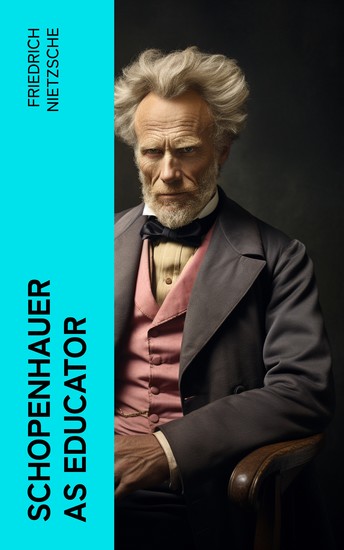
Schopenhauer as Educator - cover

Schopenhauer as Educator

Friedrich Nietzsche

Traduttore Adrian Collins

Casa editrice: e-artnow

  • 0
  • 0
  • 0

Sinossi

Friedrich Nietzsche's 'Schopenhauer as Educator,' published in 1876, is an extended but lively philosophical work that is thought-provoking. In this extended essay, Nietzsche describes education as knowing oneself--a task requiring almost herculean effort.
Disponibile da: 08/12/2023.
Lunghezza di stampa: 70 pagine.

Altri libri che potrebbero interessarti

  • Sunan Ibn Majah English Audio - cover

    Sunan Ibn Majah English Audio

    Imam Ibn Majah,...

    • 0
    • 0
    • 0
    Sunan Ibn Majah is a collection of hadith compiled by Imam Muhammad bin Yazid Ibn Majah al-Qazvini (rahimahullah). It is widely considered to be the sixth of the six canonical collection of hadith (Kutub as-Sittah) of the Sunnah of the Prophet Muhammad (ﷺ). It consists of 4341 ahadith in 37 books.
    Mostra libro
  • Unsung Hero of Gettysburg - The Story of Union General David McMurtrie Gregg - cover

    Unsung Hero of Gettysburg - The...

    Edward G. Longacre

    • 0
    • 0
    • 0
    Gen. David McMurtrie Gregg (1833–1917) was one of the ablest and most successful commanders of cavalry in any Civil War army. Pennsylvania-born, West Point–educated, and deeply experienced in cavalry operations prior to the conflict, his career personified that of the typical cavalry officer in the mid-nineteenth-century American army. Gregg achieved distinction on many battlefields, ultimately gaining the rank of brevet major general as leader of the Second Division, Cavalry Corps, Army of the Potomac. 


    The highlight of his service occurred on July 3, 1863, the climactic third day at Gettysburg, when he led his own command as well as the brigade of Brig. Gen. George Armstrong Custer in repulsing an attempt by thousands of Confederate cavalries under the legendary J. E. B. Stuart in attacking the right flank and rear of the Union Army while Pickett's charge struck its front and center. 


    Historians credit Gregg with helping preserve the security of his army at a critical point, making Union victory inevitable. Unlike glory-hunters such as Custer and Stuart, Gregg was a quietly competent veteran who never promoted himself or sought personal recognition for his service. Rarely has a military commander of such distinction been denied a biographer's tribute. Gregg's time is long overdue.
    Mostra libro
  • The 6 Types of Working Genius - A Better Way to Understand Your Gifts Your Frustrations and Your Team - cover

    The 6 Types of Working Genius -...

    Patrick M. Lencioni

    • 0
    • 0
    • 0
    New York Times best-selling author Patrick Lencioni unveils a truly groundbreaking new model that will change the way we think about work and teams forever. 
     
    The 6 Types of Working Genius is the fastest way to help people identify the type of work that brings them joy and energy—and avoid work that leads to frustration and burnout. 
     
    Beyond the personal discovery and instant relief that the Working Genius provides, the model also gives teams a remarkably simple and practical framework for tapping into one another’s natural gifts, which increases productivity and reduces unnecessary judgment. 
     
    In classic Lencioni fashion, Pat brings his model to life in a page-turning fable that is as relatable as it is compelling. He tells the story of Bull Brooks, an entrepreneur, husband, and father, who sets out to solve his own frustration at  
    work and stumbles into a new way of thinking that changes the way he sees his work, his team, and even his marriage. 
     
    What sets this book—and the model behind it—apart from other tools and assessments is the speed at which it can be understood and applied, and the relevance it has to every kind of work in life, from running a company to launching a product to managing a family.
    Mostra libro
  • Carolingian Empire - The Influence and Expansion of the Franks during the Middle Ages - cover

    Carolingian Empire - The...

    Kelly Mass

    • 0
    • 0
    • 0
    The Carolingian Empire, which existed from 800 to 888, was a dominant force in western and central Europe during the early Middle Ages. Founded by the Carolingian dynasty, this empire emerged from the Frankish kingdom, which had been ruled by this lineage since 751 and included control over the Lombards in Italy starting in 774. The empire's significance was amplified when Pope Leo III crowned Charlemagne, the Frankish king, as emperor in Rome on Christmas Day in 800, marking a pivotal moment in the attempt to reestablish a western counterpart to the Roman Empire. This event not only solidified Charlemagne's power but also laid the groundwork for what would eventually become the Holy Roman Empire. 
    At its zenith, the Carolingian Empire stretched across a vast expanse, covering approximately 1,112,000 square kilometers (429,000 square miles) and supporting a population estimated between 10 to 20 million people. Charlemagne's reign was characterized by military conquests, administrative reforms, and cultural revival, known as the Carolingian Renaissance, which fostered the preservation and promotion of learning and the arts. 
    However, the empire faced challenges after the death of Emperor Louis the Pious in 840. A civil war erupted among his heirs, leading to the Treaty of Verdun in 843, which partitioned the empire into three distinct kingdoms. Although one monarch was still recognized as emperor, his authority was significantly limited, confining his power mainly to his own realm. This division undermined the unity that Charlemagne had worked hard to establish.
    Mostra libro
  • Manipulation NLP Body Language and Dark Psychology - Master Emotional Intelligence To Deep Learning Everything About Mind Control Persuasion How To Manage Your Emotions And Influence People - cover

    Manipulation NLP Body Language...

    Younan P. Goleman

    • 0
    • 0
    • 0
    Manipulators and people who are looking to use us for their advantage, are all around us. Fortunately, there are methods to spot them and beat them at their game! 
    What you’ll learn will change your perspective of yourself and raise your confidence through the roof! The techniques and methods described here will make sure you’ll never be harmed again, and you’ll also be able to use them for your gain. 
    The time when you’ve felt like a victim can be a thing of the past! 
    Here’s what you’ll master with this book:Using body language to become a fantastic communicatorInterpreting gestures, and subtle signs to analyze othersPersuading people with easeRecognizing when someone is manipulating youDefending yourself from every type of manipulatorDealing with an abusive or manipulative partnerUsing manipulation as a means of persuasionRaising your emotional intelligence and self-awarenessKnowing exactly how to act in any type of social or work situation 
    And so much more! 
    Remember that knowledge is power, and the field of dark psychology is unfortunately still not fully explored. In other words, people are not talking about it enough, and that puts those unsavory characters in an advantage. Take control and protect yourself, and your loved ones from manipulators.
    Mostra libro
  • The Spanish Influenza Of 1918 - cover

    The Spanish Influenza Of 1918

    Mike Parson

    • 0
    • 0
    • 0
    The 1918 Influenza Pandemic moved worldwide in three waves, infecting up to 500 million people and causing over 40 million deaths. Several things tended to be present in areas that ended the pandemic with lower mortality rates than average. These include low rates of poverty, widespread access to healthcare, well-funded and general public health measures, and well-managed record keeping. Areas that ended the pandemic with high mortality rates tended to lack the above – they had high rates of poverty, limited access to healthcare, public health measures were unfunded or ineffective, and recordkeeping and communication were unreliable or unclear. It is essential to learn from the success and mistakes of nations passed so that we as a planet are better prepared for any pandemics that should arise in the future. Preparing involves high vaccination rates, fighting drug-resistant pathogens, and working to lower global poverty.
    Mostra libro