Unisciti a noi in un viaggio nel mondo dei libri!
Aggiungi questo libro allo scaffale
Grey
Scrivi un nuovo commento Default profile 50px
Grey
Iscriviti per leggere l'intero libro o leggi le prime pagine gratuitamente!
All characters reduced
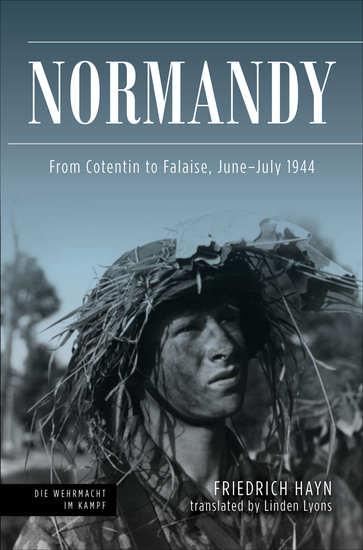
Normandy - From Cotentin to Falaise June–July 1944 - cover

Normandy - From Cotentin to Falaise June–July 1944

Friedrich Hayn

Traduttore Linden Lyons

Casa editrice: Casemate

  • 0
  • 0
  • 0

Sinossi

A German perspective of D-Day, written by an Army Corps intelligence officer in Normandy when the Allies invaded, published in English for the first time. A unique perspective on the decisive early weeks of the invasion in 1944, written by a German Army Corps Intelligence officer stationed in Normandy at the time of the Allied invasion, who during the invasion was the department head for enemy messages processing (Ic) in the staff of the LXXXIV AK. It discusses in detail the events leading up to the creation of Falaise Pocket, described by the author as a “tragic turning point of an entire front.” It discusses in detail the conditions in the American landing section and explains how the German troops based there came to be defeated.Praise for Normandy “Should be read by scholars working on the fighting between the Americans and Germans on the western side of the Normandy front.” —Journal of Military History “The interaction among German command is interesting as it scrambles to patch lines. The book covers battles over D-Day beaches, U.S. paratrooper drops, Cherbourg, hedgerows, Operations Cobra and Luttich, and Falaise Pocket formation and collapse.” —Historical Miniatures Gaming Society “[A] unique, informative, and inherently fascinating study . . . absolutely essential and core addition to personal, professional, community, college, and university library World War II history collections.” —Midwest Book Review
Disponibile da: 16/06/2022.
Lunghezza di stampa: 200 pagine.


Altri libri che potrebbero interessarti

  • The End of Antiquity - cover

    The End of Antiquity

    Nick Holmes

    • 0
    • 0
    • 0
    How did a remote desert people change the course of world history? 
     
    In the seventh century AD, the Eastern Roman Empire collapsed—defeated by the rising power of Arabia. How did this happen? And why then? 
    In this gripping new history, Nick Holmes offers a fresh view of the end of the Ancient World and the rise of Islam—it wasn't just religion and war that shaped history, but a hidden force also played a vital role—climate change. A mysterious climatic shift—the Late Antique Little Ice Age—devastated the Roman and Persian empires while Arabia thrived. 
    The End of Antiquity brings together history, science, and religion to uncover the truth behind one of the most enigmatic centuries in history. It's the fifth book in Holmes' acclaimed series on the fall of the Roman Empire—and the most surprising yet.
    Mostra libro
  • Episode 4 - Global Events - cover

    Episode 4 - Global Events

    Anjum Sharma

    • 0
    • 0
    • 0
    In 2020, the US presidential election was a major event globally. Apart from this, all eyes were on the death of George Floyd, the explosion in Beirut, the Armenia-Azerbaijan conflict, the historic peace agreement between Israel and the UAE & the Hong Kong crisis. Find out more in this episode.
    Mostra libro
  • Ancient Greece’s Most Influential Philosophers - cover

    Ancient Greece’s Most...

    Editors Charles River

    • 0
    • 0
    • 0
    In virtually all fields of human endeavor, ancient Greece was so much at the forefront of dynamism and innovation that the products of its most brilliant minds remain not only influential but entirely relevant to this day. The great philosophers of Athens, men like Aristotle, Socrates, and Plato, interrogated themselves with startling complexity about the nature of good and evil, questioned the existence of divinity, advocated intelligent design, and went so far as to argue that all life was composed of infinitesimal particles.  
    	Although the school of philosophy started by Socrates and championed by Plato and Aristotle continues to be the most famous, other schools of thought began to branch, including the Epicureans and Cynics. In the 3rd century B.C., Stoicism arose in response to and under the influence of these older schools, combining many of the best theories from each into a more cohesive whole. With a greater flexibility and more practical application to everyday life, Stoicism quickly became a very popular school of thought, a growth made exponential by its introduction to the Romans.  
    Today, very few have heard of him, but he became a major philosophical and religious figure through the publication of his thoughts, travels, and miracles by Philostratus the Elder (c. 170-247 A.D.), written about a century after Apollonius of Tyana’s death. Philostratus the Elder’s works were based on the works of other writers (Maximus of Aegae, Damis, and Moeragenes), and miracles attributed to Apollonius were often compared to those of Jesus, who lived around the same time. Apollonius’s cult was important throughout the whole of the Pagan era and even carried on into the Middle Ages. Why such an important philosopher has been so forgotten by modern historians is in itself an interesting issue, and it is just as crucial to understand what Apollonius preached and the information he provided about his contemporary world. 
    Mostra libro
  • US Constitution The - with Thunderstorms - cover

    US Constitution The - with...

    James Madison, John Jay,...

    • 0
    • 0
    • 0
    Relax and listen to a reading of the U.S. Constitution while thunderstorms play in the background. Use the built-in speakers or get the best experience with headphones. 
     
    The Constitution of the United States is the supreme law of the United States of America. The Constitution, originally comprising seven articles, delineates the national frame of government.
    Mostra libro
  • The Classical Wisdom Collection - History’s Greatest Works on Philosophy Ethics and Political Thought - cover

    The Classical Wisdom Collection...

    Marcus Aurelius, Sun Tzu,...

    • 0
    • 0
    • 0
    What if you could access the very core of moral, philosophical, and political thought—spanning centuries and cultures—all in one place? 
    This expansive collection gathers monumental texts that have shaped global civilization. From the Stoic reflections of Marcus Aurelius to Aristotle’s ethical frameworks, from Nietzsche’s radical provocations to Kierkegaard’s existential depth, each volume has been adapted for modern readers, offering timeless wisdom for navigating life’s complexities. 
    What You’ll Discover in This Essential Anthology: 
    - Meditations – Marcus Aurelius – A Stoic guide to self-discipline and resilience. 
    - The Art of War – Sun Tzu – Strategic wisdom on leadership and success. 
    - The Book of Five Rings – Miyamoto Musashi – Samurai philosophy on discipline and mastery. 
    - Letters from a Stoic – Seneca – Profound insights on ethics and personal strength. 
    - Discourses & Enchiridion – Epictetus – Practical Stoic wisdom for everyday life. 
    - Tao Te Ching – Laozi – A guide to balance and harmonious living. 
    - Nicomachean Ethics – Aristotle – Foundational teachings on virtue and happiness. 
    - Politics – Aristotle – A blueprint for governance and justice. 
    - Poetics – Aristotle – An analysis of storytelling and artistic expression. 
    - Beyond Good and Evil – Friedrich Nietzsche – A bold challenge to conventional morality. 
    - Thus Spoke Zarathustra – Friedrich Nietzsche – A poetic exploration of human potential. 
    - Fear and Trembling – Søren Kierkegaard – A deep examination of faith and existential angst. 
    Imagine possessing a library of wisdom that sharpens your intellect and expands your worldview. The Classical Wisdom Collection is a guide for self-improvement and cultural understanding. 
    Open the door to humanity’s greatest ideas. Get your copy now and immerse yourself in a legacy of unmatched intellectual heritage.
    Mostra libro
  • The History of the Peloponnesian War - cover

    The History of the Peloponnesian...

    Thucydides

    • 0
    • 0
    • 0
    Dive into the tumultuous world of ancient Greece with Thucydides' History of the Peloponnesian War, a masterpiece that stands as one of the earliest and most influential works in historical writing. Thucydides, an Athenian general turned historian, presents a riveting account of the epic conflict between the Peloponnesian League, led by Sparta, and the Delian League, led by Athens, offering unprecedented insights into the complexities of war, power, and human nature.  
    This timeless classic not only chronicles the military strategies and political machinations of ancient civilizations but also explores the deeper, enduring questions of justice, leadership, and the impact of war on society. Thucydides' meticulous approach to historiography and his commitment to neutrality and objectivity make his work a fascinating study for anyone interested in the roots of modern historical analysis. His narrative is enriched with powerful speeches, including the famous funeral oration by Pericles, and his analysis of the war’s causes and effects provides a valuable lens through which to view contemporary conflicts. 
    Whether you are a history enthusiast, a student of political science, or simply fascinated by ancient cultures, Thucydides' History of the Peloponnesian War offers a compelling and thought-provoking journey through one of history's most pivotal epochs. With its blend of rigorous scholarship and dramatic storytelling, this audiobook will transport you to the heart of ancient Greece, making it a must-have addition to your collection. Engage with the past to understand the present through the eyes of one of history's greatest observers. 
    This audiobook was narrated and produced by RAM Studios, where humans and artificial intelligence collaborate to create an excellent listening experience. (The reading is done primarily by AI)
    Mostra libro