Join us on a literary world trip!
Add this book to bookshelf
Grey
Write a new comment Default profile 50px
Grey
Subscribe to read the full book or read the first pages for free!
All characters reduced
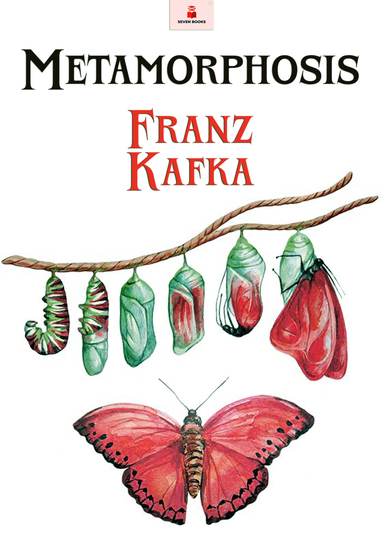
Metamorphosis - cover

Metamorphosis

Franz Kafka

Publisher: Seven Books

  • 1
  • 2
  • 0

Summary

Metamorphosis is a novella written by Franz Kafka which was first published in 1915. One of Kafka's best-known works, The Metamorphosis tells the story of salesman Gregor Samsa who wakes one morning to find himself inexplicably transformed into a huge insect, subsequently struggling to adjust to this new condition. The novella has been widely discussed among literary critics, with differing interpretations being offered.
Available since: 10/25/2024.
Print length: 200 pages.

Other books that might interest you

  • The Man of the Crowd - cover

    The Man of the Crowd

    Edgar Allan Poe

    • 0
    • 0
    • 0
    "The Man of the Crowd" is a short story by American writer Edgar Allan Poe about a nameless narrator following a man through a crowded London. It was first published in 1840.
    The story is introduced with the epigraph "Ce grand malheur, de ne pouvoir être seul" — a quote taken from The Characters of Man by Jean de La Bruyère. It translates to This great misfortune, of not being able to be alone. This same quotation is used in Poe's earliest tale, "Metzengerstein".
    Show book
  • Gulliver's Travels - cover

    Gulliver's Travels

    Jonathan Swift

    • 0
    • 0
    • 0
    Gulliver's Travels," originally titled "Travels into Several Remote Nations of the World, in Four Parts. By Lemuel Gulliver," is a satirical novel by Jonathan Swift, first published in 1726. The story follows Lemuel Gulliver as he embarks on voyages to fantastical lands, including Lilliput, where people are only six inches tall, and Brobdingnag, a land of giants. While the book is often considered a children's story due to its fantastical elements, it is also a biting satire of human nature, government, and the "traveller's tales" literary subgenre.
    Show book
  • The Stranger of the Night - A solitary walk becomes a journey of salvation - cover

    The Stranger of the Night - A...

    Edgar Wallace

    • 0
    • 0
    • 0
    Richard Horatio Edgar Wallace was born on the 1st April 1875 in Greenwich, London.  Leaving school at 12 because of truancy, by the age of fifteen he had experience; selling newspapers, as a worker in a rubber factory, as a shoe shop assistant, as a milk delivery boy and as a ship’s cook.  
     
    By 1894 he was engaged but broke it off to join the Infantry being posted to South Africa. He also changed his name to Edgar Wallace which he took from Lew Wallace, the author of Ben-Hur.  
     
    In Cape Town in 1898 he met Rudyard Kipling and was inspired to begin writing. His first collection of ballads, The Mission that Failed! was enough of a success that in 1899 he paid his way out of the armed forces in order to turn to writing full time.  
     
    By 1904 he had completed his first thriller, The Four Just Men. Since nobody would publish it he resorted to setting up his own publishing company which he called Tallis Press. 
      
    In 1911 his Congolese stories were published in a collection called Sanders of the River, which became a bestseller. He also started his own racing papers, Bibury’s and R. E. Walton’s Weekly, eventually buying his own racehorses and losing thousands gambling.  A life of exceptionally high income was also mirrored with exceptionally large spending and debts.  
     
    Wallace now began to take his career as a fiction writer more seriously, signing with Hodder and Stoughton in 1921. He was marketed as the ‘King of Thrillers’ and they gave him the trademark image of a trilby, a cigarette holder and a yellow Rolls Royce. He was truly prolific, capable not only of producing a 70,000 word novel in three days but of doing three novels in a row in such a manner. It was estimated that by 1928 one in four books being read was written by Wallace, for alongside his famous thrillers he wrote variously in other genres, including science fiction, non-fiction accounts of WWI which amounted to ten volumes and screen plays. Eventually he would reach the remarkable total of 170 novels, 18 stage plays and 957 short stories. 
     
    Wallace became chairman of the Press Club which to this day holds an annual Edgar Wallace Award, rewarding ‘excellence in writing’.  
     
    Diagnosed with diabetes his health deteriorated and he soon entered a coma and died of his condition and double pneumonia on the 7th of February 1932 in North Maple Drive, Beverly Hills. He was buried near his home in England at Chalklands, Bourne End, in Buckinghamshire.
    Show book
  • In the Fourth Dimension - From their pens to your ears genius in every story - cover

    In the Fourth Dimension - From...

    Clothilde Graves

    • 0
    • 0
    • 0
    Clotilde Augusta Inez Mary Graves was born on the 3rd June 1863 at Buttevant Castle, Co. Cork, to parents with military backgrounds. 
    At age nine, the family moved to Southsea in England for yet another military posting.  Her father’s postings gave her valuable experiences that would be put to good use in later years in some of her literary works. 
    She was educated at a Catholic convent in Lourdes before returning to London in 1884 to study art in Bloomsbury.  She worked part-time at the British Museum and the Royal Female School of Art and generated further income by drawing little pen-and-ink grotesques for the comic papers.  
    A few years later a chance meeting found her writing extra lyrics for a pantomime version of Puss in Boots.  She followed up with several financially successful plays, both in London and New York, and gained a measure of notoriety in one with the comparison of marriage and prostitution.   
    Despite her dramatic success she published her first novel in 1911 under the pseudonym of Richard Dehan which she continued to use for later works.  As well as novels and plays she published collections of short stories which glow with talent and invention. 
    She was an unusual figure in London society, wearing her hair short, taking on a masculine manner and cut of clothing, and smoking cigarettes in public when such traits were considered eccentric at best.  Add to this her admired collection of Chinese and Japanese trophies, her enthusiasm for fly-fishing and her riding of a tricycle and you have a perfect image of this fascinating writer. 
    Clotilde Graves died at the convent of Our Lady of Lourdes at Hatch End in Middlesex, on the 3rd December 1932.  She was 69.
    Show book
  • My Financial Career - From their pens to your ears genius in every story - cover

    My Financial Career - From their...

    Stephen leacock

    • 0
    • 0
    • 0
    Stephen P H Butler Leacock FRSC was born on 30th December 1869 in Swanmore, near Southampton, England.  He was the third of eleven children. 
    The family emigrated to Canada in 1876, settling on a 100-acre farm in Sutton, Ontario.  There Leacock was home-schooled until, funded by his grandfather, he was enrolled into the elite private school Upper Canada College in Toronto.  Academically he was very strong.  In 1887, at age 17, he became head boy and then proceeded on to the University of Toronto to study languages and literature.  Despite completing two years of study in only one, he was obliged to leave the university because his father, an alcoholic, had abandoned the family and finances could not be stretched to continue his attendance.  Leacock now enrolled in a three-month course at Strathroy Collegiate Institute to become a qualified high school teacher with a regular income. 
    He worked at Upper Canada College from 1889 through 1899 and later resumed his studies part-time at the University of Toronto, graduating with a B A in 1891.  It was during this period that he was first published in The Varsity, a campus newspaper.  But his passion was now economics and political theory.  In 1899 he enrolled for postgraduate studies at the University of Chicago and earned his PhD in 1903. 
    Leacock had married Beatrix Hamilton in 1900 and 15 years later the couple had their only child, Stephen.  In time father and son developed a love-hate relationship, partially caused by his son’s diminutive stature of only four feet.  
    Accepting a post at McGill University Leacock would remain there until he retired in 1936.  In 1906, he wrote ‘Elements of Political Science’, quickly adopted as a standard textbook for the next two decades and his most profitable book.  He also began public speaking and lecturing, and took a year's leave of absence in 1907 to speak throughout Canada on the subject of national unity.  
    Leacock had submitted humourous articles to the Toronto magazine Grip in 1894, and was soon published in other Canadian and US magazines.  In 1910, he printed privately a collection of these as ‘Literary Lapses’.  Acquired by the British publisher, John Lane, it was released in London and New York.   He was now a commercially successful writer.  There soon followed ‘Nonsense Novels’ (1911) and the sentimental favourite, ‘Sunshine Sketches of a Little Town’ (1912).  His ‘Arcadian Adventures with the Idle Rich’ (1914) is a darker collection that satirizes city life.  Collections of sketches continued to be published almost annually, filled with a mixture of light-hearted whimsy, parody, nonsense, and satire. 
    In later life, he wrote on the art of humour writing and published biographies on Twain and Dickens.  Together with continued speaking tours he also added to his non-fiction with many well-regarded and award-winning volumes on Canada. 
    Politically Leacock was a social conservative and a partisan Conservative.  He opposed women’s right to vote and had a varied record on non-English immigration.  He was a champion of Empire but an advocate of social welfare legislation and wealth redistribution, but he often caused friction with his racist views towards blacks and Indigenous peoples. 
    Leacock has for some time been forgotten as an economist, but it’s often quoted that in 1911 more people had heard of him than had heard of Canada.  For the decade after 1915 Leacock was the most popular humorist in the English-speaking world. 
    Stephen Leacock died on 28th March 1944 of throat cancer in Toronto, Canada.  He was 74.  He was buried in the St George the Martyr Churchyard, Sutton, Ontario.
    Show book
  • Dr Duthoit's Vision - From their pens to your ears genius in every story - cover

    Dr Duthoit's Vision - From their...

    Arthur Machen

    • 0
    • 0
    • 0
    Arthur Llewelyn Jones was born in Caerleon, Monmouthshire on the 3rd March 1863. 
    Machen came from a long line of clergymen, and when he was two, his father became vicar of a small parish about five miles north of Caerleon, and Machen was brought up at the rectory there. 
    In his early years he received an excellent classical education, but family poverty ruled out university, and he was sent to London to sit exams to attend medical school but failed the exams.  He did show literary promise with the publication of the poem ‘Eleusinia’ in 1821.  But life in London was difficult and it was only in 1884 that he published again and was taken on to translate several French works which thereafter became the standard editions for many years. 
    In 1887, his father died.  That same year he married Amelia Hogg, a maverick music teacher with a passion for the theatre.  He also began to receive legacies from Scottish relatives which allowed him to devote more time to writing. 
    After publishing in literary magazines in 1894 he published his first book ‘The Great God Pan’.  Its sexual and horrific content very much helped sales. 
    Over the next decade or so he wrote some of his best work but was unable to find a publisher mainly due to the collapse of the decadent market over Oscar Wilde’s scandalous trial. 
    In 1899, his wife died and during his long recovery he took up acting and travelled around the country as part of a travelling company.  Three years later he was publishing again and had remarried. 
    Re-publishing of earlier works helped anchor both his reputation and his income.  By the time the Great War opened Europe’s wounds he returned to the public eye with ‘The Bowmen’ helped by the publicity around the ‘Angel of Mons’ episode. 
    However, by the late 20’s new works had dried up and his back catalogue was no longer a source of regular income. 
    In 1932 he received a Civil List pension of ₤100 per annum but other work was not forthcoming.  His finances finally stabilised with a literary appeal in 1943 for his eightieth birthday and allowed him to live his remaining years in relative comfort. 
    Arthur Machen died on 15th December 1947 in Beaconsfield. He was 84.
    Show book