¡Acompáñanos a viajar por el mundo de los libros!
Añadir este libro a la estantería
Grey
Escribe un nuevo comentario Default profile 50px
Grey
Suscríbete para leer el libro completo o lee las primeras páginas gratis.
All characters reduced
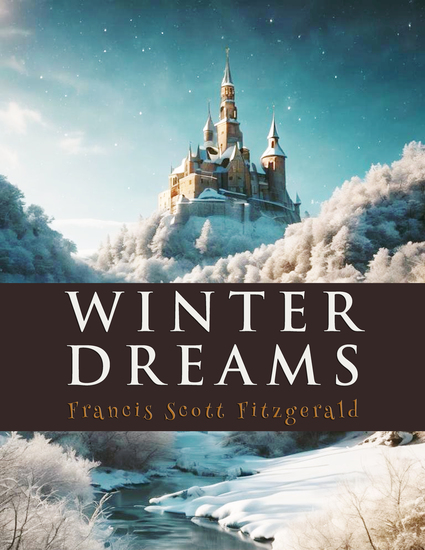
Winter Dreams - cover

Winter Dreams

Francis Scott Fitzgerald

Editorial: E-Kitap Projesi & Cheapest Books

  • 0
  • 0
  • 0

Sinopsis

SOME of the caddies were poor as sin and lived in one-room houses with a neurasthenic cow in the front yard, but Dexter Green's father owned the second best grocery-store in Black Bear—the best one was "The Hub," patronized by the wealthy people from Sherry Island—and Dexter caddied on-ly for pocket-money.

IN the fall when the days became crisp and gray, and the long Minnesota winter shut down like the white lid of a box, Dexter's skis moved over the snow that hid the fairways of the golf course. At these times the country gave him a feeling of profound melancholy—it offended him that the links should lie in enforced fallowness, haunted by ragged sparrows for the long season. It was dreary, too, that on the tees where the gay colors fluttered in summer there were now only the desolate sand-boxes knee-deep in crusted ice. When he crossed the hills the wind blew cold as misery, and if the sun was out he tramped with his eyes squinted up against the hard dimensionless glare.

IN April the winter ceased abruptly. The snow ran down into Black Bear Lake scarcely tarrying for the early golfers to brave the season with red and black balls. Without elation, without an interval of moist glory, the cold was gone.
Disponible desde: 10/02/2024.
Longitud de impresión: 75 páginas.

Otros libros que te pueden interesar

  • About Love - From their pens to your ears genius in every story - cover

    About Love - From their pens to...

    Anton Chekhov

    • 0
    • 0
    • 0
    Anton Pavlovich Chekhov was born on 29th January 1860 in Taganrog, on the south coast of Russia.  
    His family life was difficult; his father was strict and over-bearing but his mother was a passionate story-teller, a subject Chekhov warmed to. As he later said; ‘our talents we got from our father, but our soul from our mother’.  
    At school Chekhov was distinctly average. At 16 his father mis-managed his finances and was declared bankrupt. His family fled to Moscow. Chekhov remained and eked out a living by various means, including writing and selling short sketches to newspapers, to finish his schooling. That completed and with a scholarship to Moscow University obtained he rejoined his family. 
    He was able to help support them by selling satirical sketches and vignettes of Russian lifestyles and gradually obtained further commissions. In 1884, he qualified as a physician and, although it earned him little, he often treated the poor for free, he was fond of saying ‘Medicine is my lawful wife, and literature is my mistress.’ 
    His own health was now an issue as he began to cough up blood, a symptom of tuberculosis.  Despite this his writing success enabled him to move the family into more comfortable accommodation.  
    Chekhov wrote over 500 short stories which included many, many classics including ‘The Kiss’ and ‘The Lady with a Dog’.  His collection ‘At Dusk’ won him the coveted Pushkin Prize when was only 26.  
    He was also a major playwright beginning with the huge success of ‘Ivanov’ in 1887.   
    In 1892 Chekhov bought a country estate north of Moscow. Here his medical skills and money helped the peasants tackle outbreaks of cholera and bouts of famine. He also built three schools, a fire station and a clinic.  It left him with less time for writing but the interactions with real people gained him detailed knowledge about the peasantry and their living conditions for his stories.  
    His most famous work, ‘The Seagull’ was received disastrously at its premiere in St Petersburg. It was later restaged in Moscow to highlight its psychological aspects and was a huge success. It led to ‘Uncle Vanya’, ‘The Three Sisters’ and ‘The Cherry Orchard’.  
    Chekhov suffered a major lung hemorrhage in 1897 while visiting Moscow. A formal diagnosis confirmed tuberculosis and the doctors ordered changes to his lifestyle.  
    Despite a dread of weddings the elusive literary bachelor quietly married the actress Olga Knipper, whom he had met at rehearsals for ‘The Seagull’, on 25th May 1901. 
    By May 1904 with his tuberculosis worsening and death imminent he set off for the German town of Badenweiler writing cheerful, witty letters to his family and assuring them his health was improving.  
    On 15th July 1904 Anton Chekhov died at Badenweiler.  He was 44.
    Ver libro
  • The Pilgrim's Progress - cover

    The Pilgrim's Progress

    John Bunyan

    • 0
    • 0
    • 0
    The Pilgrim's Progress from This World to That Which Is to Come is a Christian allegory written by John Bunyan. First published in 1678, it is considered one of the most significant works of English literature and Protestant theology.  
    The story follows Christian, a character representing everyman, as he journeys from the City of Destruction to the Celestial City, which symbolizes Heaven. Burdened by the awareness of his sins, depicted by a physical weight on his back, Christian seeks salvation. He is guided by Evangelist, who directs him to the Wicket Gate. Along his journey, Christian encounters various allegorical characters who either assist or impede his progress. Christian, an everyman character, journeys from the City of Destruction to the Celestial City (representing Heaven). Burdened by the knowledge of his sin (represented by a physical burden on his back), Christian seeks salvation. He is guided by Evangelist, who directs him to the Wicket-gate. Along his path, Christian encounters various allegorical characters who either help or hinder his progress.
    Ver libro
  • A Midsummer Night's Dream by Shakespeare-Full Audio Drama Recorded Live by Meadow Sky Productions - cover

    A Midsummer Night's Dream by...

    William Shakespeare

    • 0
    • 0
    • 0
    "A Midsummer Night's Dream" by Shakespeare  
    Enjoy our live recorded audio version of our theatrical stage production, gently adapted and performed by Meadow Sky Productions in October 2024.  
    If you'd like to support us to create more stories and in turn empower us to elevate our performing arts community, consider supporting us monthly on Patreon, at https://www.patreon.com/c/MeadowSkyProductions  
    Read more about us on our website: ⁠https://www.meadowskyproductions.com/home 
    Instagram: @meadowskyproductions  
    Directed by David Purkey  
    Assistant Directed by Vreyah Palmantier  
    Costumes by Dora Novak  
    Costume Assistance by Lucinda Haigh  
    Cast: Donald Emmerich as Theseus and Oberon  
    Owen Cogen as Egeus and Quince  
    Samuel Soyster as Lysander  
    Isaac Fortune as Demetrius  
    Jessica Hayes as Philostrate and Puck  
    Kaz Paré-Mayer as Bottom  
    Dane Eichelberger as Flute and Cobweb  
    Sergio Carrillo as Snout, First Fairy, Peaseblossom and Attendant  
    Jason Gunder as Snug, Second Fairy, Moth, and Attendant  
    Andrea Carmack as Starveling and Mustardseed  
    Anna Purkey as Helena  
    Lucinda Haigh as Hermia  
    Leah Chole as Hippolyta and Titania  
    Finley Wittenborn as A Fairy and our Understudy of all roles  
    Special thanks to Somni Studios for recording/editing our show! 
    Ver libro
  • Æpyornis Island (Unabridged) - cover

    Æpyornis Island (Unabridged)

    H. G. Wells

    • 0
    • 0
    • 0
    "Æpyornis Island", or "Aepyornis Island", is a short story by H. G. Wells, first published in 1894 in the Pall Mall Budget.[1] It was included in The Stolen Bacillus and Other Incidents, the first collection of short stories by Wells, first published in 1895. In the story, a man looking for eggs of Aepyornis, an extinct flightless bird, passes two years alone on a small island with an Aepyornis that has hatched.
    Ver libro
  • The Gambler - cover

    The Gambler

    Fyodor Dostoevsky

    • 0
    • 0
    • 0
    "I am no longer a man. I am a gambler."
    
    Set in the fictional European spa town of Roulettenburg, The Gambler follows Alexei Ivanovich, a young tutor serving a dysfunctional aristocratic family. Alexei is consumed by two equally destructive passions: his unrequited love for the enigmatic Polina and his growing obsession with the roulette table. As the family awaits the death of their wealthy "Grandmother" to inherit her fortune, the old woman arrives in town—only to discover the thrill of the game herself. Dostoevsky provides a terrifyingly visceral look at the mechanics of addiction, where the spin of the wheel becomes the only thing that makes a man feel truly alive.
    
    The Psychology of the Spin: Dostoevsky, a lifelong gambler himself, captures the "fever" with haunting accuracy. He explores the gambler's fallacy—the irrational belief that one can master chance through sheer will. Through Alexei's eyes, we see how the casino floor levels all social distinctions, turning princes and paupers alike into slaves of the "zero."
    
    A Tragedy of Character: While the plot is a frantic "whodunit" of financial and romantic ruin, the core is a character study of a man losing his soul. Alexei begins the novel as a cynical observer of the upper class, but ends as a man who has traded his dignity, his love, and his future for one more turn of the wheel. It is a cautionary tale that remains startlingly relevant in an age of modern speculation.
    
    Place your bets on a masterpiece. Purchase "The Gambler" today and experience Dostoevsky's most fast-paced and personal work.
    Ver libro
  • Troilus and Cressida - cover

    Troilus and Cressida

    William Shakespeare

    • 0
    • 0
    • 0
    Troilus and Cressida is a tragedy by William Shakespeare, believed to have been written in 1602. It was described by Frederick S. Boas as one of Shakespeare's problem plays. The play ends on a very bleak note with the death of the noble Trojan Hector and destruction of the love between Troilus and Cressida. The work has in recent years "stimulated exceptionally lively critical debate".
    Throughout the play, the tone lurches wildly between bawdy comedy and tragic gloom, and readers and theatre-goers have frequently found it difficult to understand how one is meant to respond to the characters. Several characteristic elements of the play (the most notable being its constant questioning of intrinsic values such as hierarchy, honour and love) have often been viewed as distinctly "modern". 
    Among the most significant works William Shakespeare: Hamlet, Othello, King Lear, Macbeth, Orpheus, Romeo and Juliet, Julius Caesar, Troilus and Cressida, The Tempest, Venus and Adonis, Antony and Cleopatra, Measure for Measure, The Winter's Tale and many more.
    Ver libro