


Don’t Look Down - You Are Here
Francis Rosenfeld
Casa editrice: Francis Rosenfeld
Sinossi
Collected poetry. A solitary quest for of all the things that give life meaning.
Disponibile da: 07/03/2024.

Casa editrice: Francis Rosenfeld
Collected poetry. A solitary quest for of all the things that give life meaning.
The creator of Slinky, Dick James, was an engineer who took a mistake in his work place and saw the potential to make a mark on the world, and increase his fame and fortune. But he sacrificed and gave up his family and even his creation to chase after mere vapors of what he thought he wanted. He leaves Betty, his children, and the company in shambles with a load of debt. Betty, whose own background was lonely and left her desperate for love, rises to the occasion and pulls the family and the company out of the dark place they were left and they all find a better future. And, even notoriety. Betty even discovers love that is well beyond what she could imagine – in the people and family who surround her.Mostra libro
The Magnificent Seventeen is a musical adventure through 17 famous works of poetry and prose, with renowned Australian narrator and producer, Lindsay Radford. CONTENTS-1. Introduction2. "The Creation", from The Book Of Genesis, in The Bible.3. "The Passionate Shepherd To His Love", by Christopher Marlowe.4. "The Daffodils", by William Wordsworth.5. "Sonnet 43 (How Do I Love Thee ?)", by Elizabeth Barrett Browning.6. "The Man From Snowy River", by Andrew Barton Paterson.7. "The Village Blacksmith", by Henry Longfellow.8. "The Charge Of The Light Brigade", by Alfred, Lord Tennyson.9. "The Bixby Letter", by Abraham Lincoln.10. "She Walks In Beauty", by Lord Byron.11. "The Destruction Of Sennacherib", by Lord Byron.12. "To A Skylark", by Percy Shelley.13. "Written The Night Before His Execution", by Chidiock Tichborne.14. "Soliloquy From Romeo And Juliet", by William Shakespeare.15. "Monologue From Julius Caesar", by William Shakespeare.16. "Soliloquy From Hamlet", by William Shakespeare.17. "Sonnet 17", by William Shakespeare.18. "Sonnet 18", by William Shakespeare.Mostra libro

Unlike his more famous fellow war poets, Wilfred Owen and Rupert Brooke, Siegfried Sassoon survived the First World War.   In this collection of 64 poems, first published in 1920,  Sassoon portrays the dehumanizing horror of modern warfare with its staggering death toll, while also satiring the jingoistic fervour of politicians and armchair strategists.
Sassoon's own war service fell into two distinct periods.  The first was marked by a number of heroic actions on the battlefield which earned him the Military Cross.  However, after a period of convalescence in 1917, Sasson became a pacifist and refused to return to active duty.  This change of attitude was diagnosed as a psychological disorder and he was posted to Ireland where he trained new recruits.  By the end of the war he had been promoted to captain. For the rest of his long life he remained staunchly anti-war.
Production copyright 2024 Voices of Today
Mostra libro
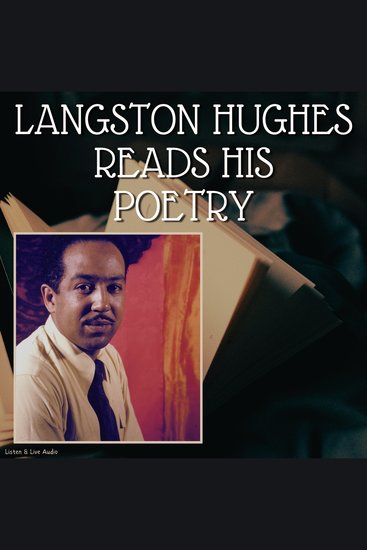
James Mercer Langston Hughes (February 1, 1901 - May 22, 1967) was an American poet, social activist, novelist, playwright, and opinion columnist from Joplin, Missouri. An early innovator of jazz poetry, Hughes is best known as a leader of the Harlem Renaissance. In the following recording, Langston Hughes reading 35 of his best-known poems, including Afro American Fragment, The Negro Speaks of Rivers, Negro, American Heartbreak, Dream Variations, Feet of Jesus, Prayer, Fire, Judgement Day, Bad Morning, Could Be, Bad Luck Card, Life Is Fine, Bound North Blues, Miss Blues'es Child, Dream Boogie, Klu Klux Klan, Roland Hayes Beaten, Silhouette, Song For A Dark Girl, One Way Ticket, Graduation, Borderline, Genius Child, Suicide’s Note, A Little Lyric of Great Importance, Motto, Flatted Fifths, Harlem, Democracy, Refugee In America, Tomorrow, No Regrets, Mother To Son, and I, Too.Mostra libro

”...a trans-mystical work of love and change...”—Ali Blythe, author of Hymnswitch

The mystics who coined the phrase ‘the way of affirmation’ understood the apocalyptic nature of the word yes, the way it can lead out of one life and into another. Moving among the languages of Christian conversion, Classical metamorphosis, seasonal transformation, and gender transition, Luke Hathaway tells the story of the love that rewired his being, asking each of us to experience the transfiguration that can follow upon saying yes—with all one’s heart, with all one’s soul, with all one’s mind, with all one’s strength ... and with all one’s body, too.
Mostra libro
We have a marvelous, almost legendary image of the circumstances in which the composition of this great poem began. Rainer Maria Rilke was staying at Duino Castle, on a rocky headland of the Adriatic Sea near Trieste.
One morning, he walked out onto the battlements and climbed down to where the cliffs dropped sharply to the sea. From out of the fierce wind, Rilke seemed to hear a voice: Wer, wenn ich schriee, horte mich denn aus der Engel Ordnungen? (If I cried out, who would hear me up there, among the angelic orders?).
He wrote these words, the opening of the first Duino Elegy, in his notebook, then went inside to continue what was to be his major opus—completely only after another ten, tormented years of effort—and one of the literary masterpieces of the century.
Duino Elegies speaks in a voice that is both intimate and majestic on the mysteries of human life and our attempt, in the words of the translator David Young, “to use our self-consciousness to some advantage: to transcend, through art and the imagination, our self-deception and our fear.”
Mostra libro





