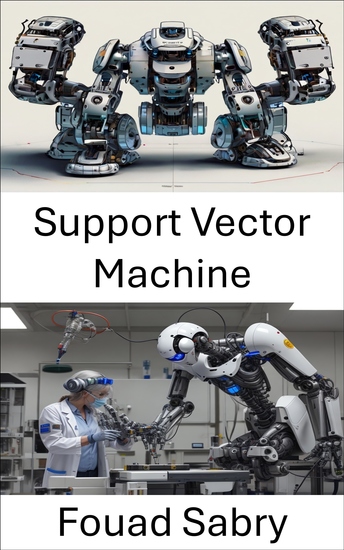
Support Vector Machine - Enhancing Machine Learning Algorithms for Intelligent Robotics
Fouad Sabry
Casa editrice: One Billion Knowledgeable
Sinossi
In the everevolving field of robotics, the application of advanced machine learning techniques is pivotal. “Support Vector Machine,” part of the Robotics Science series, explores the role of support vector machines (SVMs) in revolutionizing robotic systems. Written by Fouad Sabry, this book provides a comprehensive overview, from fundamental concepts to advanced techniques, essential for anyone keen on harnessing SVMs for robotics and automation.

Chapters Brief Overview:

1: Support vector machine: Introduction to SVMs, highlighting their importance in classification and regression tasks in robotics.

2: Linear classifier: Explains the basics of linear classifiers, foundational for understanding SVM's functionality.

3: Perceptron: Discusses the perceptron algorithm, a precursor to SVMs, useful in binary classification problems.

4: Projection (linear algebra): Focuses on the geometric concept of projection, crucial for understanding SVM's working principle.

5: Linear separability: Explores the concept of linear separability, the basis for using SVM in linearly separable datasets.

6: Kernel method: Introduces the kernel trick, enabling SVMs to operate in higherdimensional spaces for nonlinear classification.

7: Relevance vector machine: Examines relevance vector machines, a variation of SVMs with fewer support vectors for efficient computation.

8: Online machine learning: Looks at how online learning methods can be applied to SVM for realtime adaptation in robotics.

9: Sequential minimal optimization: Covers the optimization method used to train SVMs efficiently, a core concept for robotic applications.

10: Leastsquares support vector machine: Discusses this alternative SVM formulation to handle regression problems in robotic systems.

11: String kernel: Explores the string kernel, which allows SVMs to handle sequential data, such as robot sensor inputs.

12: Hinge loss: Delves into hinge loss, the function used in SVM to ensure maximum margin classification.

13: Ranking SVM: Looks at ranking SVM, particularly useful in robotics for decisionmaking and prioritization tasks.

14: Regularization perspectives on support vector machines: Explores the role of regularization in controlling overfitting, essential for building reliable robotic systems.

15: Bayesian interpretation of kernel regularization: Offers a Bayesian perspective, linking probabilistic modeling to SVM kernel regularization for more accurate robotics models.

16: Polynomial kernel: Discusses the polynomial kernel, allowing SVM to model nonlinear decision boundaries in robotic tasks.

17: Radial basis function kernel: Covers the radial basis function kernel, a powerful tool for handling complex data patterns in robotic systems.

18: Kernel perceptron: Examines the kernel perceptron method, expanding on SVMs for more advanced robotic tasks.

19: Platt scaling: Introduces Platt scaling, a technique used to convert SVM outputs into probabilistic predictions in robotics.

20: Manifold regularization: Focuses on manifold regularization, helping to generalize SVM models to highdimensional data, often encountered in robotics.

21: Weak supervision: Concludes with weak supervision techniques, essential for improving SVM models in situations with limited labeled data.

Whether you're a professional working in robotics, an undergraduate or graduate student, or an enthusiast with a keen interest in machine learning techniques, this book is invaluable. With realworld applications throughout, it delivers insights not only on theoretical concepts but also on how they can be directly applied to robotic systems.
Disponibile da: 29/12/2024.
Lunghezza di stampa: 247 pagine.