Unisciti a noi in un viaggio nel mondo dei libri!
Aggiungi questo libro allo scaffale
Grey
Scrivi un nuovo commento Default profile 50px
Grey
Iscriviti per leggere l'intero libro o leggi le prime pagine gratuitamente!
All characters reduced
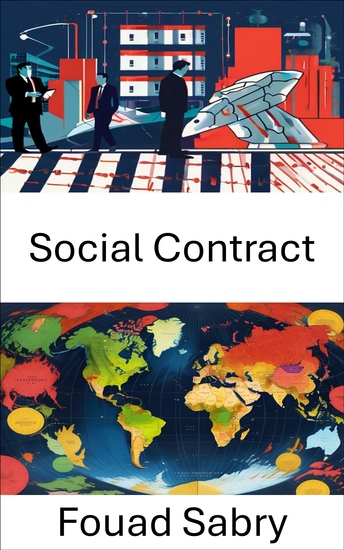
Social Contract - Democratic Foundations and Governance in Modern Societies - cover

Social Contract - Democratic Foundations and Governance in Modern Societies

Fouad Sabry

Casa editrice: One Billion Knowledgeable

  • 0
  • 0
  • 0

Sinossi

Discover Modern Governance with "Social Contract"
 
"Social Contract," a key volume in the "Political Science" series, explores the core theories of governance and societal unity. Essential for understanding political legitimacy and state power evolution, this book examines social contracts from their philosophical roots to contemporary applications.
 
Chapter Overview:
 
1. Social Contract: Introduces the concept and its impact on governance.
 
2. John Locke: Locke’s contributions on government and individual rights.
 
3. Natural Law: Principles guiding social contracts and moral standards.
 
4. Political Philosophy: Overview of key thinkers and their influence.
 
5. Sovereignty: State authority and its relation to citizens.
 
6. Original Position: Rawls’ idea for assessing social contract fairness.
 
7. State of Nature: Foundation for social contracts and political societies.
 
8. Natural Rights and Legal Rights: Their relevance and protection.
 
9. Consent of the Governed: Political legitimacy from consent.
 
10. Philosophy of Human Rights: Human rights and their role in governance.
 
11. David Gauthier: Rational choice and moral dimensions of agreements.
 
12. Will (Philosophy): Impact of will on social contracts.
 
13. Life, Liberty, and Pursuit of Happiness: Their role in democratic governance.
 
14. Positive Liberty: Acting on free will within social contracts.
 
15. Popular Sovereignty: Its significance in democratic systems.
 
16. Negative Liberty: Freedom from constraints and its role in theory.
 
17. Social Philosophy: Relevance to social contracts.
 
18. General Will: Rousseau’s concept and its impact on legitimacy.
 
19. Early Modern Philosophy: Evolution of social contract theory.
 
20. Two Treatises of Government: Locke’s influence on modern thought.
 
21. Amour de soi: Rousseau’s idea and its impact on social contracts.
 
"Social Contract" offers a thorough analysis of these topics, enriching your understanding of political theory and its application to modern issues. This detailed work is invaluable for professionals, students, and enthusiasts, providing insights that surpass the reading investment.
Disponibile da: 04/09/2024.
Lunghezza di stampa: 263 pagine.
Altri libri che potrebbero interessarti

  • The Art of the Impossible - How to start a political party (and why you probably shouldn't) - cover

    The Art of the Impossible - How...

    Andrew Reid, Simon Carr

    • 0
    • 0
    • 0
    "A revelation" – Nigel Farage
    ***
    Nothing like it had ever been done before. In January 2019, the Brexit Party was just a name. Over a matter of weeks, the party would be launched, stand candidates across seventy seats and become the largest single party in the European Parliament.
    Along the way, it fought Establishment quangos, the courts, Parliament, the Speaker and the government – hammering the Conservatives so hard it forced the resignation of their Prime Minister – to win nearly twice as many seats as its nearest rival.
    It was a success beyond anyone's dreams (or, indeed, anyone's worst nightmare). And the inside story of how it happened may serve as a manual of how to – and occasionally how not to – do it.
    This unique book details the wild ride of the brand-new Brexit Party as it heads from triumph in the European elections to disaster in the general election six months later. Packed with hilarious anecdotes about the reality of setting up a new party, it takes the reader on a journey through building the entire apparatus in an impossibly short time frame; losing key players to enemy action; and facing chaotic scenes created by a cat's cradle of legal complications – before arriving at the conclusion that politics is much more difficult than it looks.
    Mostra libro
  • Commander in Chief - Partisanship Nationalism and the Reconstruction of Congressional War Powers - cover

    Commander in Chief -...

    Casey B. K. Dominguez

    • 0
    • 0
    • 0
    The constitutional balance of war powers has shifted from Congress to the president over time. Today, presidents broadly define their constitutional authority as commander in chief. In the nineteenth century, however, Congress was the institution that claimed and defended expansive war powers authority. This discrepancy raises important questions: How, specifically, did Congress define the boundaries between presidential and congressional war powers in the early republic? Did that definition change? 


    Casey Dominguez's Commander in Chief systematically analyzes the authority that members of Congress ascribe to the president as commander in chief and the boundaries they put around that authority. 


    Dominguez shows that for more than a century members of Congress defined the commander in chief's authority narrowly. But in a wave of nationalism during the Spanish-American War, members of Congress began to argue that Congress owed deference to the commander in chief. They also tended to argue that a president of their own party should have broad war powers, while the powers of a president in the other party should be defined narrowly. Together, these two dynamics suggest that the conditions for presidentially dominated modern constitutional war powers were set at the turn of the twentieth century, far earlier than is often acknowledged.
    Mostra libro
  • Israel - What Went Wrong? - cover

    Israel - What Went Wrong?

    Omer Bartov

    • 0
    • 0
    • 0
    A leading Israeli American scholar of the Holocaust explores and explains his native country's intensifying turn toward violence and exclusion.The distinguished historian Omer Bartov was born on a kibbutz, grew up in Tel Aviv, and served in the Israel Defense Forces during the Yom Kippur War. He went on to become a leading scholar of the German army and the Holocaust, before turning his attention to his native country.In Israel: What Went Wrong?, Bartov sketches the tragic transformation of Zionism, a movement that sought to emancipate European Jewry from oppression, into a state ideology of ethno-nationalism. How is it possible, he asks, that a state founded in the immediate aftermath of the Holocaust, an event that gave legitimacy to a national home for the Jews, stands credibly accused of perpetrating large-scale war crimes? How do we come to terms with the fact that Israel’s war of destruction is being conducted with the support, laced with denial and indifference, of so many of its Jewish citizens?Tracing the roots of the violent events currently unfolding in Israel and the occupied territories, Bartov tracks his country's moral tribulations and considers the origins of Zionism, the intertwining of Israel’s independence with Palestinian displacement, the politics of the Holocaust, controversies over the term "genocide," and the uncertain future. The result is a searing and urgent critique that addresses today’s debates over Zionism and the future of Israel with rigor and depth.
    Mostra libro
  • I Never Did Like Politics - How Fiorello La Guardia Became America's Mayor and Why He Still Matters - cover

    I Never Did Like Politics - How...

    Terry Golway

    • 0
    • 0
    • 0
    Fiorello LaGuardia was one of the twentieth century's most colorful politicians—on the New York and national stage. He was also quintessentially American: the son of Italian immigrants, who rose in society through sheer will and chutzpah. Almost one hundred years later, America is once again grappling with issues that would have been familiar to the Little Flower, as he was affectionately known. It's time to bring back LaGuardia, argues historian and journalist Terry Golway, to remind us all what an effective municipal officer (as he preferred to call himself) can achieve . . .  


    Golway examines LaGuardia's extraordinary career through four essential qualities: As a patriot, a dissenter, a leader, and a statesman. He needed them all when he stood against the nativism, religious and racial bigotry, and reactionary economic policies of the 1920s, and again when he faced the realities of Depression-era New York and the rise of fascism at home and abroad in the 1930s. Just before World War II, the Roosevelt administration formally apologized to the Nazis when LaGuardia referred to Hitler as a "brown-shirted fanatic." 


    There was nobody quite like Fiorello LaGuardia. In this immensely listenable book, as entertaining as the man himself, Terry Golway captures the enduring appeal of one of America's greatest leaders.
    Mostra libro
  • Revealing Secrets: How the Fall of the Republic Shaped Our Future - "Unlock the secrets of our future! Dive into insights shaped by the Republic's fall with this powerful audiobook" - cover

    Revealing Secrets: How the Fall...

    Gideon Merrick

    • 0
    • 0
    • 0
    "Revealing Secrets: How the Fall of the Republic Shaped Our Future" 
    Are you eager to advance in your career while deepening your knowledge of the transformative events that have shaped our future? 
    Searching for a comprehensive guide that encapsulates everything needed to navigate these pivotal topics? 
    Your quest ends here! 
    This audiobook serves as your essential companion for enhancing your understanding, applying learned concepts, and engaging in practical exercises. With this resource, you’re equipped for success. 
    Updated to reflect the latest insights and structures, this guide covers profound truths about the pivotal events that have influenced our collective future. 
    Key features of this insightful guide include: 
    - In-depth insights into the significant transformations that shape our world 
    - Thorough explanations of crucial historical contexts 
    - Effective strategies for preparing and interpreting essential themes 
    Our guide stands out due to its expansive coverage, which is critical for grasping the complexities of these historical shifts. We're not just skimming the surface; we dive deep into the significant themes with accuracy. 
    Please note, this guide operates independently and is not affiliated with any official institutions. 
    Crafted with a clear structure and easy-to-understand language, our audiobook ensures fluid transitions between ideas. Say farewell to convoluted jargon and embrace clear, accurate content. 
    So, why hesitate? Click the BUY NOW button, secure your audiobook, and embark on your journey to understanding the transformative insights that shape our collective future!
    Mostra libro
  • Democracy Rules - cover

    Democracy Rules

    Jan-Werner Müller

    • 0
    • 0
    • 0
    A much-anticipated guide to saving democracy, from one of our most essential political thinkers. 


    Everyone knows that democracy is in trouble, but do we know what democracy actually is? Jan-Werner Müller, author of the widely translated and acclaimed What Is Populism?, takes us back to basics in Democracy Rules. In this short, elegant volume, he explains how democracy is founded not just on liberty and equality, but also on uncertainty. The latter will sound unattractive at a time when the pandemic has created unbearable uncertainty for so many. But it is crucial for ensuring democracy's dynamic and creative character, which remains one of its signal advantages over authoritarian alternatives that seek to render politics (and individual citizens) completely predictable. 


    Müller shows that we need to re-invigorate the intermediary institutions that have been deemed essential for democracy's success ever since the nineteenth century: political parties and free media. Contrary to conventional wisdom, these are not spent forces in a supposed age of post-party populist leadership and post-truth. Müller suggests concretely how democracy's critical infrastructure of intermediary institutions could be renovated, re-empowering citizens while also preserving a place for professionals such as journalists and judges.
    Mostra libro