Unisciti a noi in un viaggio nel mondo dei libri!
Aggiungi questo libro allo scaffale
Grey
Scrivi un nuovo commento Default profile 50px
Grey
Iscriviti per leggere l'intero libro o leggi le prime pagine gratuitamente!
All characters reduced
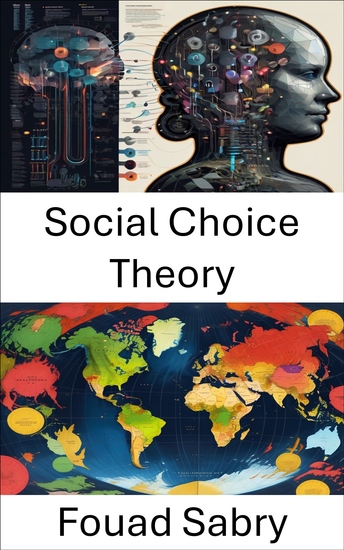
Social Choice Theory - Decisions and Democracy Unraveling the Fabric of Collective Preferences - cover

Social Choice Theory - Decisions and Democracy Unraveling the Fabric of Collective Preferences

Fouad Sabry

Casa editrice: One Billion Knowledgeable

  • 0
  • 0
  • 0

Sinossi

Explore the complexities of decision-making with "Social Choice Theory," a key volume in the "Political Science" series. This book delves into how societies make collective choices and the underlying mathematical and philosophical foundations. Essential for those interested in governance, policy, and democratic processes, it provides a thorough examination of key concepts and theories in social choice.
 
Each chapter builds on the last, covering topics such as:
 
1. Social Choice Theory: Core concepts and significance in collective decision-making.
 
2. Condorcet Paradox: The issue of intransitive collective preferences.
 
3. Pareto Efficiency: Evaluating outcomes where no one can be better off without harming others.
 
4. Kenneth Arrow: Contributions to social choice theory.
 
5. Arrow's Impossibility Theorem: Challenges in creating a fair voting system.
 
6. Social Welfare Function: Aggregating individual preferences into collective decisions.
 
7. Independence of Irrelevant Alternatives: Ensuring choices are unaffected by irrelevant alternatives.
 
8. Gibbard–Satterthwaite Theorem: Limitations of strategic voting.
 
9. Welfare Economics: Improving social welfare through resource allocation.
 
10. Expected Utility Hypothesis: Decision-making to maximize expected utility.
 
11. Liberal Paradox: Tension between individual rights and collective decision-making.
 
12. Lexicographic Preferences: Ranking and decision-making processes.
 
13. Social Choice and Individual Values: Aligning personal preferences with collective decisions.
 
14. Quasitransitive Relation: Implications for preference aggregation.
 
15. Extended Sympathy: Understanding preferences and social choice.
 
16. Economic Justice: Relevance to equitable decision-making.
 
17. Preference (Economics): Modeling preferences and their impact.
 
18. Kevin W. S. Roberts: Contributions to social choice theory.
 
19. Prasanta Pattanaik: Influence on the field.
 
20. Jury Theorem: Conditions for accurate collective decisions.
 
21. Fractional Social Choice: Incorporating partial preferences into decision-making.
 
An invaluable resource for professionals, students, and enthusiasts, this book offers deep insights into social choice theory and its applications, making it a must-have for any political science library.
Disponibile da: 07/08/2024.
Lunghezza di stampa: 240 pagine.

Altri libri che potrebbero interessarti

  • The Prince - cover

    The Prince

    Niccolò Machiavelli

    • 0
    • 0
    • 0
    "The Prince" is a political treatise by Niccolò Machiavelli, written in 1513 and published in 1532. The book is a pragmatic guide for political leaders, focused on how to maintain power and navigate the complex and often ruthless world of governance. Although the text is commonly viewed as a manual for manipulation and a justification for Machiavellian deceit and cunning, it has also been interpreted as a realistic, if cynical, analysis of power dynamics. The work is a foundational text in political theory and continues to be studied and debated today.
    Mostra libro
  • State of the Union 1983 - cover

    State of the Union 1983

    Ronald Reagan

    • 0
    • 0
    • 0
    The 1983 State of the Union address, delivered January 25, 1983, focuses on “what we can do together -- not as Republicans and Democrats, but as Americans -- to make tomorrow's America happy and prosperous at home, strong and respected abroad, and at peace in the world.” 
    Reagan praises a bipartisan proposal to save social security. He blames deficits on domestic spending and not on defense spending or tax cuts. A four-part plan is proposed to reduce the deficit: first, a federal spending freeze; second, reducing fraud and waste in programs such as food stamps; third, reductions in defense spending; and fourth, a future tax increase but only if Congress approves the spending freeze. 
    Reagan proposes the Employment Act of 1983 to provide training for the long-term unemployed. Educational reforms are proposed to promote math and science and tax credits for parents who send their children to private or religiously affiliated schools. Many other reforms relating to port modernization, women’s rights, civil rights, crime, agriculture, job training, health care, and technology are proposed.  
    In the international arena, we export over 20 percent of our industrial production and 40 percent of our farm produce. As the leader of the West, “America must be an unrelenting advocate of free trade.” While pursuing arms reduction with the Soviet Union, Reagan insists that agreements be verifiable, noting “the overwhelming evidence of Soviet violations of international treaties”. 
    Reagan asserts that “America is on the mend” and asks Congress “to make government a help, not a hindrance to our people in the challenging but promising days ahead.” 
    Audio recording courtesy of the Ronald Reagan Presidential Library. 
    AspenLeafMedia.com
    Mostra libro
  • Understanding Machiavelli’s The Prince - cover

    Understanding Machiavelli’s The...

    Denis Collin

    • 0
    • 0
    • 0
    Machiavelli has a reputation as an immoral thinker. His most famous work, The Prince, is oftemnm criticized as being a manual for political cunning and cynicism.
    On the contrary, Machiavelli invites us to face up to political and human reality. Faced with illusions and moralistic rhetoric, we must seek the truth and adopt a scientific approach to seriously reflect upon action.
    This introduction provides us with the keys to understanding The Prince, a foundational book of modern political thought, and the relevance of its teachings for our contemporary societies.
    Mostra libro
  • Two Three Words (Do Se Kalameh) - cover

    Two Three Words (Do Se Kalameh)

    Aram Hessami

    • 0
    • 0
    • 0
    Where is the driving force for change? Who envisions a better future, crafts the path to democracy, and strategizes the movement? Who fuels it with revolutionary zeal and the will to power? And where is the force that can fulfill the unfinished promise of Iran's Constitutional Revolution? In three words: The Iranian Citizenry. Thirty years before Iran's Constitutional Revolution, the treatise One Word (Yek Kalameh) ignited a movement—challenging absolute monarchy, advocating the rule of law, and empowering the people. Now, Two, Three Words (Do, Se Kalameh) draws inspiration from the courageous youth of Iran. It articulates their aspirations, forges a new discourse, and unites a narrative that could pave the way for democratic alternatives.
    Mostra libro
  • Parliamentary America - The Least Radical Means of Radically Repairing Our Broken Democracy - cover

    Parliamentary America - The...

    Maxwell L. Stearns

    • 0
    • 0
    • 0
    Americans face increasingly stark choices each presidential election and a growing sense that our government can't solve the nation's most urgent challenges.  Our eighteenth-century system is ill-suited to our twenty-first-century world. Information-age technology has undermined our capacity to face common problems together and turned our democracy upside down, with gerrymanders letting representatives choose voters rather than voters choosing them. In Parliamentary America, Maxwell L. Stearns argues that the solution to these complex problems is a parliamentary democracy. 


    Stearns considers such leading alternatives as ranked choice voting, the national popular vote, and congressional term limits, showing why these can't solve our constitutional crisis. Instead, three amendments—expanding the House of Representatives, having House party coalitions choose the president, and letting the House end a failing presidency based on no confidence—will produce a robust multiparty democracy. 


    Stearns takes listeners on a world tour—England, France, Germany, Israel, Taiwan, Brazil, and Venezuela—showing what works in government, what doesn't, and how to make the best features our own. Genuine party competition and governing coalitions, commonplace across the globe, may seem like a fantasy in the United States. But we can make them a reality.
    Mostra libro
  • Reagan's Hollywood America - How the Great Communicator Turned Movies into Propaganda for a New Nation - cover

    Reagan's Hollywood America - How...

    Davis Truman

    • 0
    • 0
    • 0
    Lights. Camera. Politics 
    Before Ronald Reagan became “the Great Communicator,” he was a Hollywood actor who mastered the art of storytelling — and he carried that skill straight into the White House. Reagan’s Hollywood America reveals how the former movie star reshaped not only the Republican Party but also the entire cultural imagination of the United States. 
    From the rise of patriotic blockbusters to the golden glow of prime-time optimism, Davis Truman traces how film and television during the 1980s became a mirror — and a weapon — for Reagan’s vision of America. Behind the scenes, entertainment and ideology merged into a powerful narrative machine that sold not just movies, but a new national myth. 
    Inside this groundbreaking book:That ’80s Show! – How pop culture and politics fused into one seamless performance.The Image President – How Reagan used cinematic language to control public perception.Hollywood’s Cold War – Movies as moral battlegrounds for American virtue versus Soviet villainy.Television Nation – The rise of nostalgia, family values, and the American Dream on screen.The Legacy Reel – How Reagan’s Hollywood still shapes today’s political storytelling. 
    Rich with cultural analysis, cinematic insight, and political commentary, Reagan’s Hollywood America is an essential listen for readers who love history, film, and the art of persuasion. 
    Whether you’re a student of politics, a lover of classic cinema, or fascinated by how image became power, this book pulls back the curtain on an era when the American Dream was scripted, directed, and broadcast worldwide. 
     
    Mostra libro