Join us on a literary world trip!
Add this book to bookshelf
Grey
Write a new comment Default profile 50px
Grey
Subscribe to read the full book or read the first pages for free!
All characters reduced
Single Member District - Decoding Representation and Electoral Integrity - cover

Single Member District - Decoding Representation and Electoral Integrity

Fouad Sabry

Publisher: One Billion Knowledgeable

  • 0
  • 0
  • 0

Summary

Single Member District-An Overview of Electoral Systems
 
Explore the vital role of single-member districts in democratic governance with this essential book from the "Political Science" series. Whether you're a professional, student, or hobbyist, this book provides crucial insights into how single-member districts shape political outcomes globally.
 
Chapter Overviews
 
1-Introduction to single-member districts and their impact on political representation.
 
2-Understanding plurality voting and its influence on electoral competition.
 
3-The effects of gerrymandering on electoral fairness.
 
4-Comparison between single-member districts and proportional representation.
 
5-The two-round system and its role in securing majority winners.
 
6-How strategic voting shapes election results.
 
7-Duverger's law and the two-party system in single-member districts.
 
8-The single non-transferable vote and its impact on representation.
 
9-First-past-the-post voting and its implications for representation.
 
10-The design and influence of electoral districts.
 
11-Multi-party systems within single-member districts.
 
12-Parallel voting systems combining districts with proportional representation.
 
13-The phenomenon of wasted votes in single-member systems.
 
14-The general ticket system and its effect on voter choice.
 
15-Issues with the single transferable vote in multi-member constituencies.
 
16-Plurality block voting and its impact on election outcomes.
 
17-Direct representation principles in single-member districts.
 
18-A comparative analysis of various electoral systems.
 
19-Majoritarian representation methods in single-member districts.
 
20-Mixed electoral systems combining districts and proportional representation.
 
21-Mixed-member majoritarian representation and its enhancement of voter representation.
 
Conclusion
 
"Single Member District" offers more than just theoretical knowledge; it is a practical guide to understanding the complexities of electoral systems and their profound impact on governance. This comprehensive resource will equip you with the insights needed to grasp the nuances of political representation.
Available since: 09/04/2024.
Print length: 326 pages.


Other books that might interest you

  • Bricks that Build Us Book 4 - CommunityFamilyBeliefsLawsConflictAndSocio-Political Remedies - cover

    Bricks that Build Us Book 4 -...

    Rob Howat

    • 0
    • 0
    • 0
    A socio-psychological look at what has formed our society and suggestions of where it is going seriously wrong. Planned development, demonstrated self-discipline, calm discussion with clear beliefs and community traditions enable stability within a growing worldwide society. Stable family and educational experiences are the key to each child's happy and successful development. Neo-liberal lax and soft society is destroying stability as well as our future. Previous guides such as politeness, manners, quality, and uncorrupted religion are just as relevant when we venture beyond neglect and doctrinal corruption.
    Show book
  • The Spy and the Devil - The untold story of the MI6 agent who penetrated Hitler’s inner circle - cover

    The Spy and the Devil - The...

    Tim Willasey-Wilsey

    • 0
    • 0
    • 0
    The forgotten tale of MI6's top spy in Nazi Germany and his bid to stop the Second World War.In the world of espionage, where the accounts of renowned spies often dominate the narrative, this is a rare gem - an untold story of a completely unknown spy. Baron William de Ropp, a Baltic German aristocrat, wasn't just any ordinary spy; he was MI6's top secret agent in Nazi Germany from 1931 to 1939, managing to escape Berlin just before war broke out. This unsung hero had direct access to Adolf Hitler and an inside track on the Nazi regime. His reports, shrouded in secrecy, had the power to shape British policy toward Germany in a pivotal period of history.The Spy and the Devil is a riveting tale of espionage, intrigue, and the untold impact of one man's secret mission on the course of history. A journey into the shadows of Nazi Germany, where a forgotten British spy worked tirelessly to avert catastrophe, and discover the secrets that history almost left behind.Bill de Ropp's story has never been published in full before, adding an extra dimension to what is, by any standard, the account of a very remarkable man. Drawing on his years of service in the Foreign Office, Tim Willasey-Wilsey offers an insider's view of this outstandingly effective but enigmatic British spy.
    Show book
  • Summary: A People's History of the United States - by Howard Zinn: Key Takeaways Summary & Analysis Included - cover

    Summary: A People's History of...

    Brooks Bryant

    • 0
    • 0
    • 0
    Disclaimer: This is not the official book, but a summary & it does not accompany the official. 
    As you delve into our concise summary of Zinn's monumental work, you will navigate through the turbulent waters of America's history, encountering narratives of resistance, activism, and the fierce struggle for justice and equality. We uncover stories seldom told, spotlighting individuals and movements that challenged the status quo and fought valiantly against oppression and inequality. 
    Our summary accentuates Zinn's commitment to a history that is a source of inspiration, not just a recounting of past events but a living document that resonates in today's society. It challenges readers to question the accepted narratives and to understand that history is not just the story of the victors, but a tapestry woven with the countless stories of everyday people. 
    Join us in exploring a vibrant and starkly different perspective on American history, where the voiceless get a voice and the unsung heroes take the center stage. It is not just a recounting of history; it is a call to consciousness, an invitation to rethink the past, and to forge a future that is inclusive, just, and fair.
    Show book
  • Utopia - cover

    Utopia

    Thomas More

    • 0
    • 0
    • 0
    Enter Thomas More's imagined society and explore enduring questions about politics, justice, wealth, work, and human nature.
    
    Thomas More's Utopia presents an imagined island society that provides the framework for a wide-ranging examination of European political and social life.
    
    Through conversations and descriptions of the fictional society, More explores government, property, labor, education, religion, law, wealth, and social organization. The work invites readers to question whether the institutions of their own society truly produce justice and happiness.
    
    Since its publication in the sixteenth century, Utopia has remained a foundational work of political philosophy and social thought.
    
    Discover Thomas More's influential vision and explore timeless questions about how societies should be organized and governed.
    Show book
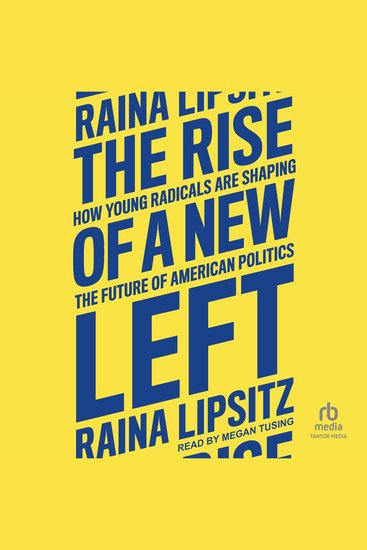
  • The Rise of a New Left - How Young Radicals Are Shaping the Future of American Politics - cover

    The Rise of a New Left - How...

    Raina Lipsitz

    • 0
    • 0
    • 0
    A new progressive generation is on the rise in the United States, reflected in the mushrooming rolls of the Democratic Socialists of America (90,000 mostly twentysomething members), Marxist explainers in Teen Vogue, and perhaps most famously of all, the youngest woman ever elected to Congress, Alexandria Ocasio-Cortez. 


    The Rise of a New American Left is the first book to look closely at this new politics. Propelled by interviews with AOC and the other key figures and organizations that have shaken up American politics, the book includes portraits of groups like Democratic Socialists of America, the Sunrise Movement, and Justice Democrats, explaining who they are, where they come from, and what they want. Investigating the panoply of strategies employed by the new movements and their relationships to politicians from Bernie Sanders to Nancy Pelosi, the book describes how the generational focus on insurgent electoral campaigns both aims to transform the Democratic Party and threatens to be captured by it. 


    Written with panache by a member of this rising generation, this book immerses the listener in a youth culture the likes of which hasn't been seen since the Sixties.
    Show book
  • Imitation Democracy - The Development of Russia's Post-Soviet Political System - cover

    Imitation Democracy - The...

    Dmitrii Furman

    • 0
    • 0
    • 0
    After the collapse of the Soviet Union, Russia under Yeltsin and Putin implemented a political system of "imitation democracy," marked by "a huge disparity between formal constitutional principles and the reality of authoritarian rule." How did this system take shape, how else might it have developed, and what are the prospects for re-envisioning it more democratically in the future? 


    These questions animate Dmitrii Furman's Imitation Democracy, a welcome antidote to books that blandly decry Putin as an omnipotent dictator, without considering his platforms, constituencies, and sources of power. With extensive public opinion polling drawn from throughout the late- and post-Soviet period, Furman offers a definitive account of the formation of the modern Russian political system, casting it into powerful relief through comparisons with other post-Soviet states. 


    Peopled with grey technocrats, warring oligarchs, patriots, and provocateurs, Furman's narrative details the struggles among partisan factions, and the waves of public sentiment, that shaped modern Russia's political landscape, culminating in Putin's third presidential term, which resolves the contradiction between the "form" and "content" of imitation democracy, "the formal dependence of power on elections and the actual dependence of elections on power."
    Show book