Unisciti a noi in un viaggio nel mondo dei libri!
Aggiungi questo libro allo scaffale
Grey
Scrivi un nuovo commento Default profile 50px
Grey
Iscriviti per leggere l'intero libro o leggi le prime pagine gratuitamente!
All characters reduced
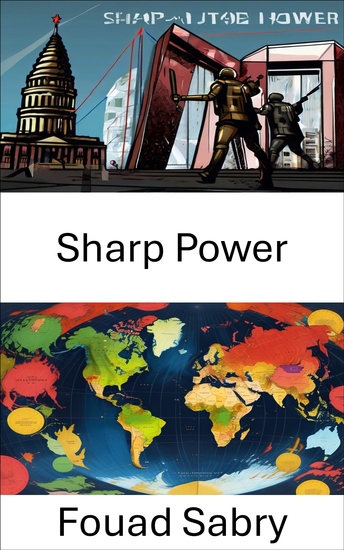
Sharp Power - Understanding Covert Influence and Strategic Manipulation in Global Politics - cover

Sharp Power - Understanding Covert Influence and Strategic Manipulation in Global Politics

Fouad Sabry

Casa editrice: One Billion Knowledgeable

  • 0
  • 0
  • 0

Sinossi

This compelling volume unravels the covert strategies employed by authoritarian regimes to manipulate democratic institutions and international perceptions through media and technology.
 
1: Sharp Power: Explore how authoritarian states use deceptive practices to sway global opinion and undermine democracy.
 
2: Soft Power: Contrast Sharp Power with Soft Power, detailing differences between covert manipulation and traditional persuasion.
 
3: National Endowment for Democracy: Understand the role of the National Endowment for Democracy in supporting democratic institutions against Sharp Power.
 
4: Illiberal Democracy: Examine illiberal democracies as hybrid governance blending democratic processes with authoritarian practices.
 
5: Larry Diamond: Delve into Larry Diamond's contributions to democracy and how his work intersects with Sharp Power.
 
6: Independent Media: Investigate the importance of independent media in resisting Sharp Power and safeguarding democratic discourse.
 
7: Chavismo: Analyze Chavismo as a case study of Sharp Power tactics in Venezuela under Hugo Chávez and successors.
 
8: Liberal Democracy: Explore liberal democracy principles and how they are challenged by the rise of Sharp Power tactics.
 
9: State Media: Assess state-controlled media as a tool for advancing Sharp Power and undermining democratic institutions.
 
10: Neoauthoritarianism (China): Examine China's neoauthoritarian model and its strategic use of Sharp Power to expand influence globally.
 
11: Foreign Policy: Explore the impact of Sharp Power on international relations and its influence on foreign policy strategies.
 
12: Political System: Understand the interplay between political systems and Sharp Power, highlighting vulnerabilities and defenses.
 
13: The Economist Democracy Index: Evaluate how the Economist Democracy Index reflects Sharp Power's impact on global democratic health.
 
14: Authoritarianism: Delve into authoritarian regimes' characteristics and their reliance on Sharp Power for control.
 
15: Democratic Republic: Explore the democratic republic concept and how Sharp Power can influence or undermine it.
 
16: Coup d'état: Analyze coups in the context of Sharp Power and their impact on political stability and democracy.
 
17: Hybrid Regime: Examine hybrid regimes and their use of Sharp Power to straddle democracy and authoritarianism.
 
18: Democracy and Economic Growth: Investigate the relationship between democracy and economic growth, and how Sharp Power affects this dynamic.
 
19: Democratic Backsliding: Understand democratic backsliding and how Sharp Power contributes to the erosion of democratic norms.
 
20: Authoritarian Capitalism: Explore the rise of authoritarian capitalism and its strategic use of Sharp Power to reshape global landscapes.
 
21: G7 Rapid Response Mechanism: Assess the G7's efforts to counter Sharp Power through rapid response mechanisms and international cooperation.
Disponibile da: 07/10/2024.
Lunghezza di stampa: 219 pagine.
Altri libri che potrebbero interessarti

  • Civil Wars - A Very Short Introduction - cover

    Civil Wars - A Very Short...

    Monica Duffy Toft

    • 0
    • 0
    • 0
    Civil wars are the most common form of large-scale political violence. In the past thirty years, the study of civil wars has been one of the largest growing segments of the international relations field. Their causes are complex, ranging from fights over access to housing, jobs, and land or other resources, to political contests over offices, rights, and representation. Groups form, collapse, coalesce, align and realign, and then fight amongst themselves. Governments themselves change through elections, coups, military defeats, or revolutions. Understanding the origins of civil wars and their trajectories therefore demands some appreciation of the economic, political, social, cultural, and geographic order of societies. If there is one factor that best predicts why a civil war erupts, it is a prior civil war. That is why knowledge of a country's history of political violence, and associated narratives about who is to blame and why, are critical to understanding where a civil war might next occur. We now have a better understanding of the conditions under which civil wars generally emerge, how the fighting evolves, and how civil wars end. However, historical understanding—the human dimensions—remain every bit as critical. This book explores current debates on civil wars and how the reasons for fighting (and the nature of belligerents themselves) are changing.
    Mostra libro
  • Buddha or Karl Marx - cover

    Buddha or Karl Marx

    Dr. B R Ambedkar

    • 0
    • 0
    • 0
    Buddha or Karl Marx - is a comparative study of the two philosophies Buddhism and Marxism. 
    It concludes by presenting in plain English that Buddhism through changing man's disposition is a superior way to achieve and most importantly maintain a society sans suffering, greed and fostering Maitri (universal love and brotherhood).
    Mostra libro
  • David Trimble: Peacemaker - cover

    David Trimble: Peacemaker

    Stephen Walker

    • 1
    • 0
    • 0
    Nobel laureate, party leader, peacemaker, first minister and statesman – David Trimble had many roles. But what is the real story behind the man who made headlines and changed lives?
    In this definitive biography of Trimble's life and death, award-winning journalist Stephen Walker vividly details how a shy Belfast academic changed the political landscape of Northern Ireland.
    Written with the cooperation of his widow, Lady Trimble, and their grown-up children, Peacemaker offers unparalleled insights into the life of the first person to be elected first minister of Northern Ireland and the most significant unionist leader since the creation of Northern Ireland in 1921. From the beginning of his political career in the dark days of the Troubles, to bringing unionism and nationalism together to end decades of division and violence and secure peace, Trimble's personal journey mirrors the story of Northern Ireland itself.
    Drawing on over 100 fresh interviews, this is a colourful and personal account of the life of a key figure in Irish history and an essential companion to Stephen Walker's bestselling biography of John Hume.
    Mostra libro
  • Two Three Words (Do Se Kalameh) - دو سه کلمه - cover

    Two Three Words (Do Se Kalameh)...

    Aram Hessami

    • 0
    • 0
    • 0
    Where is the driving force for change? Who envisions a better future, crafts the path to democracy, and strategizes the movement? Who fuels it with revolutionary zeal and the will to power? And where is the force that can fulfill the unfinished promise of Iran's Constitutional Revolution? In three words: The Iranian Citizenry. Thirty years before Iran's Constitutional Revolution, the treatise One Word (Yek Kalameh) ignited a movement, challenging absolute monarchy, advocating the rule of law, and empowering the people. Now, Two, Three Words (Do, Se Kalameh) draws inspiration from the courageous youth of Iran. It articulates their aspirations, forges a new discourse, and unites a narrative that could pave the way for democratic alternatives. 
    Aram Hessami is a professor of Political Science and Philosophy at Montgomery College in Rockville, Maryland. His research and publications focus on Democratic Transition, Discourse Theory, and Social Change. He received his BA, MA, and Doctorate in Political Science & Philosophy from The George Washington University in 1993. Dr. Hessami's specialization is in Western Political Thought and Post-modern philosophy.
    Mostra libro
  • Whose America? - Culture Wars in the Public Schools Second Edition - cover

    Whose America? - Culture Wars in...

    Jonathan Zimmerman

    • 0
    • 0
    • 0
    In this expanded edition of his 2002 book, Zimmerman surveys how battles over public education have become conflicts at the heart of American national identity. 
      
    Critical Race Theory. The 1619 Project. Mask mandates. As the headlines remind us, American public education is still wracked by culture wars. But these conflicts have shifted sharply over the past two decades, marking larger changes in the ways that Americans imagine themselves. In his 2002 book, Whose America?, Zimmerman predicted that religious differences would continue to dominate the culture wars. Twenty years after that seminal work, Zimmerman has reconsidered: arguments over what American history is, what it means, and how it is taught have exploded with special force in recent years. In this substantially expanded new edition, Zimmerman meditates on the history of the culture wars in the classroom—and on what our inability to find common ground might mean for our future.
    Mostra libro
  • FREEDOM: The Authorized Universal Capitalist ltd Economic Structure - cover

    FREEDOM: The Authorized...

    Olson Twain, Ruby Tai

    • 0
    • 0
    • 0
    The nature of money as gates and letters revealed gives light to the nations of humankind to find in troubled times a historic luxury and modern necessity in the FML FIREs: these are the first constitutional centers of foundation money law governance and the prize of digital revolution. Through the architectures in the top layer of the double blue ON/E Divide, Intel-Modernized Governance from each city center in vertical international parallel selects for the lettered gates of economic FREEDOM and systemically discriminates against and shuts down the old capitalist unlimited extremist forms lettered as DEATH. Free artists, the Rolling service, Experts, Élites, Developers, Officers and Managers are the chosen occupational categories in the foundation money law range. Each HOME Medallion bank card that is encoded to FREEDOM is recognized by our constitutional conscience in the FML FIREs as constitutionally fit to transact. Each nation is redeemed with a capitalist ltd olympic spirit infused economy. As we no longer merely pay taxes to the discretion of full grey governments, the contingent capitalist excesses fall away and the suite of necessarily capitalist ltd institutions and businesses emerge. Prior to the digital revolution, the foundation money law was ungovernable and thus irrelevant: though now from each city central FML FIRE, Intel-Modernized Governance center-checks every Medallion Bank Card in transaction. The eyes behind the FML FIRE, in three charismatic forms, see through the top layer of the double blue ON/E Divide, travelling the speed of light to protect both the three and national class ruling structure from trespass and the first freedom of every man to earn and build HOME Wealth from trespass. It is finally with our HOME Patriot Medallions’ support that the ON/E Divide vertical boundary is built between the capitalist ltd economy that lives above and the five occupational evils that die below. 
    Mostra libro