Join us on a literary world trip!
Add this book to bookshelf
Grey
Write a new comment Default profile 50px
Grey
Subscribe to read the full book or read the first pages for free!
All characters reduced
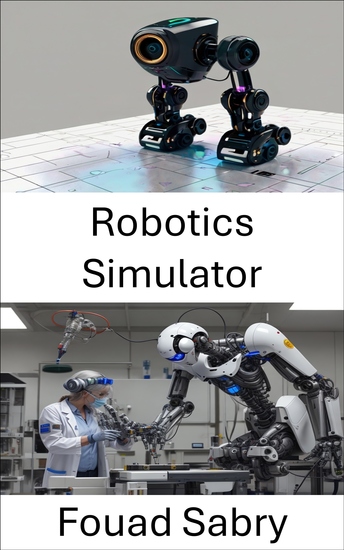
Robotics Simulator - Advancing Virtual Environments for Intelligent Machine Interaction - cover

Robotics Simulator - Advancing Virtual Environments for Intelligent Machine Interaction

Fouad Sabry

Publisher: One Billion Knowledgeable

  • 0
  • 0
  • 0

Summary

Robotics Simulator-Introduces the concept of robotics simulators, their importance in the development of robots, and how they help in creating virtual environments to test robotic systems before implementation
 
Simulation-Explores the role of simulation in robotics, covering the various types of simulations used to model, predict, and analyze robotic behaviors and systems
 
Eclipse (software)-Focuses on the Eclipse platform, a powerful opensource IDE that supports robotics software development, and its integration with robotics simulators
 
Open Dynamics Engine-Discusses the Open Dynamics Engine (ODE), a physics simulation library for modeling rigid body dynamics in robotics, particularly for realistic robot movement simulations
 
Quite Universal Circuit Simulator-Covers the use of the Quite Universal Circuit Simulator (Qucs) in simulating electronic circuits, crucial for designing and testing robotics control systems
 
Microsoft Robotics Developer Studio-Describes Microsoft’s Robotics Developer Studio, providing a platform for developing robotics applications and simulations with easytouse tools and interfaces
 
Robotics Suite-Examines the Robotics Suite, a collection of tools that support robotic simulations, including planning, vision systems, and control mechanisms for robot behavior
 
Player Project-Introduces the Player Project, an opensource software framework for robotics that supports simulation and realtime control of robotic systems, facilitating flexible experimentation
 
Coin3D-Highlights Coin3D, an opensource 3D graphics library used for simulating robot models and their environments, emphasizing its application in visualizing robot motions and interactions
 
Webots-Discusses Webots, a simulation platform widely used for creating complex robotic models, testing algorithms, and running autonomous robot simulations in realistic environments
 
Robot Operating System-Explores ROS, the opensource middleware for controlling robots, focusing on how it integrates with simulators to streamline development processes
 
SimSpark-Looks at SimSpark, a multiagent simulation platform used for simulating soccerplaying robots, highlighting its contributions to robot soccer competitions like RoboCup
 
RoboLogix-Provides an overview of RoboLogix, a robotic simulation software that allows users to design, control, and simulate robot behavior for both educational and practical purposes
 
Flight Simulation Video Game-Explores the application of flight simulation games as a tool for developing robotic systems, demonstrating their role in testing unmanned aerial vehicles (UAVs)
 
RoboCup 3D Soccer Simulation League-Focuses on RoboCup’s 3D Soccer Simulation League, a platform that advances research in autonomous systems through virtual soccer matches, offering valuable insights into multirobot coordination
 
Advanced Simulation Library-Introduces the Advanced Simulation Library (ASL), a set of tools used to model complex robotic systems in multiphysics environments for detailed performance analysis
 
RoboDK-Discusses RoboDK, a powerful simulator for industrial robots that allows users to generate offline programming for robotic arms and automate manufacturing processes
 
Gazebo (Simulator)-Describes Gazebo, a 3D robotics simulator that provides a robust platform for simulating robots in a wide range of realworld environments, enabling testing and research in robotics
 
AirSim-Explores AirSim, an opensource simulator designed for drones and autonomous vehicles, providing realistic physics simulations for aerial robotics development
 
CoppeliaSim-Introduces CoppeliaSim (formerly VREP), a versatile simulator for modeling and controlling robots, widely used for research, education, and prototyping in robotic systems
Available since: 01/22/2025.
Print length: 209 pages.

Other books that might interest you

  • Design Dissected - Is the design real? - cover

    Design Dissected - Is the design...

    David Galloway

    • 0
    • 0
    • 0
    Many people assert that all of reality, including life, has simply emerged as a result of natural law and circumstance. How credible is that assumption? How well does it fit with what we find? Exquisite features of apparent design are in evidence everywhere we look. Either something is responsible for all the molecular engineering of life or, it just happened and nothing is directly responsible. Which option offers the best explanation? 
    This book provides a clinician’s perspective on the evidence for design in living things. Specific scenarios are dissected from examples of real cases in clinical medicine and surgery, as well as descriptions of some of the amazing integrated systems that exist in human physiology. Read about the critical processes that must be successfully navigated at the time of birth for every individual to have any prospect of survival. Beyond that, think about thinking itself. This book is a powerful challenge to the belief that the universe, life, and conscious experience can result only from unguided, natural processes.  
    “Excellent ... a most enjoyable mix of personal anecdote and scientific precision.”  Prof John C Lennox  
    “Fresh and original. Beautifully written and extensively researched. Highly recommended.”  Dr Stephen C. Meyer  
    “Impressive and thought provoking”  Prof Frank Dunn  
    For further information visit:  www.davidgalloway.co.uk  
    DAVID J GALLOWAY MD DSc FRCS FRCP FACS FACP  
    David Galloway is a Scottish surgeon who trained in Glasgow, London, and New York City. He was a Consultant Surgeon in Glasgow and a Former President of the Royal College of Physicians and Surgeons of Glasgow. He is also a Fellow of numerous international medical and surgical Colleges and has held academic appointments in Glasgow, Kuala Lumpur and Hong Kong. 
    Show book
  • App Innovator's Guide - Mobile App Development for Android and iOS: Building Cross-Platform Solutions - cover

    App Innovator's Guide - Mobile...

    Lily Chang

    • 0
    • 0
    • 0
    Are you prepared to take a thrilling journey into the field of developing mobile applications? This book is your guide to navigating the fascinating world of developing your own mobile applications for iOS and Android, if you've ever wanted to do so. 
    This thorough book, "App Innovator's Guide: Mobile App Development for Android and iOS- Building Cross-Platform Solutions," takes you by the hand and provides a wealth of information and useful insights. Your door to innovation is this book, whether you're an ambitious developer, a visionary entrepreneur, or just curious about the app-making process. 
    Inside, you'll learn the techniques for developing captivating, user-friendly mobile apps that have the power to turn your concepts into real-world solutions. This book gives you the tools to realize your ideas, from setting up development environments to comprehending the fundamentals of UI/UX design, investigating programming languages, and diving into the nuances of Android and iOS development.
    Show book
  • Generative AI on AWS - Building Context-Aware Multimodal Reasoning Applications - cover

    Generative AI on AWS - Building...

    Shelbee Eigenbrode, Chris...

    • 0
    • 0
    • 0
    Companies today are moving rapidly to integrate generative AI into their products and services. But there's a great deal of hype (and misunderstanding) about the impact and promise of this technology. With this book, Chris Fregly, Antje Barth, and Shelbee Eigenbrode from AWS help CTOs, ML practitioners, application developers, business analysts, data engineers, and data scientists find practical ways to use this exciting new technology. 


    You'll learn the generative AI project life cycle including use case definition, model selection, model fine-tuning, retrieval-augmented generation, reinforcement learning from human feedback, and model quantization, optimization, and deployment. And you'll explore different types of models including large language models (LLMs) and multimodal models such as Stable Diffusion for generating images and Flamingo/IDEFICS for answering questions about images. 


    You'll also discover how to apply generative AI to your business use cases; determine which generative AI models are best suited to your task; perform prompt engineering and in-context learning; fine-tune generative AI models on your datasets with low-rank adaptation (LoRA); align generative AI models to human values with reinforcement learning from human feedback (RLHF); augment your model with retrieval-augmented generation (RAG); explore libraries such as LangChain and ReAct to develop agents and actions; and build generative AI applications with Amazon Bedrock.
    Show book
  • Punching Above Your Weight - How to Use AI Without Losing Your Mind - cover

    Punching Above Your Weight - How...

    Ryan J. Smith

    • 0
    • 0
    • 0
    Punching Above Your Weight: How to Use AI Without Losing Your Mind 
    Written and narrated by Ryan J. Smith 
    What if AI isn’t the end of your job, but the start of your edge? 
    Written in one week and recorded with grit, Punching Above Your Weight is part memoir, part manifesto - a crash course in using AI to scale your clarity, courage, and impact. 
    Ryan J. Smith - AI product leader by day, musician by night - opens with the moment his father flatlined for 15 minutes and came back. That brush with death sparked a fire: life is short, and fear can’t keep us from what matters. 
    This audiobook cuts through the hype with honest strategy, sharp tools, and stories of underdogs who refused to fold. Whether you're a solo act or leading a team, this is your cornerman in the AI fight. 
    Perfect for listeners who are:Outmatched but not out of optionsCurious about AI, but allergic to tech bro nonsenseReady to fight smarter - not harder
    Show book
  • Modern Web Development with Go - cover

    Modern Web Development with Go

    Anonymous

    • 0
    • 0
    • 0
    Build fast, scalable web server applications by harnessing the power of solution-driven programming with Go. 
    
    KEY FEATURES 
    - Understanding the core concepts of the Go programming language.
    - Designing and development of modern Web Server applications.
    - Dealing with different kinds of database management solutions.
    - Deploying applications with cutting edge technologies.
    - Monitoring and maintenance of applications with popular tools.
    
    DESCRIPTION
    In this book, we are going to learn how to design, develop and deploy Web Server Applications using the Go programming language. In recent years, Go has become the industrial standard for these kinds of applications; so by learning this, a lot of good opportunities can be opened in the market. All subjects will be covered through various practical examples.
    This book will cover the state-of-the-art technology for the development of Web Applications and follow all industrial standards. At the beginning we will do the preparation for development. Here, we will learn the basics of the Go programming language, the basics of Web Servers, how to set up a project with Go, and how to design software solutions.
    Later, we will concentrate more on development. We will learn how to develop the application designed in the previous chapters, how to use different types of databases, how to test our application, and how to make it secure. At the end of the book, we will show how to deploy the application and monitor it after deployment.
    After reading this book, the readers can independently develop Web Server Applications or include themselves in already-started projects.
    
    WHAT WILL YOU LEARN 
    - Solve common problems with the Go programming language.
    - Be familiar with the terms related to server applications.
    - Understand the phases in the software development process.
    - Be able to independently design software solutions and use some best practices.
    - Be familiar with multiple different database management solutions (relational and NoSQL) and be able to predict which best suits their needs.
    - Learn how to deploy applications.
    - Understand and know how to apply monitoring and alerting concepts.
    
    WHO THIS BOOK IS FOR
    The book is for beginners and experienced developers who want to learn and have a thorough introduction to web development using the Go programming language. With a lot of practical examples and guidelines on how to install and configure specific tools, beginners will easily understand and follow the content covered in this book. On the other hand, more experienced developers will certainly find some useful tips and tricks. 
    TABLE OF CONTENTS 
    1. Basic Concepts of Go programming language
    2. Advanced Concepts of Go programming language
    3. Web Servers
    4. Setting up a project with Go programming language
    5. Design of Web Applications
    6. Application layers
    7. Relational databases and Repository layer
    8. NoSQL databases and Repository layer
    9. Testing
    10. Security
    11. Deploying Web Application
    12. Monitoring and Alerting
    Show book
  • Nuclear and Particle Physics - A Comprehensive Introduction to Subatomic Physics - cover

    Nuclear and Particle Physics - A...

    Mark Hedges

    • 0
    • 0
    • 0
    Subatomic physics is the branch of physics that studies the fundamental particles and forces that constitute the universe at the smallest scales. It explores the nature of matter and energy at the level of atomic nuclei and beyond, delving into the complex interactions that govern the behavior of elementary particles. The study of subatomic physics emerged from the broader field of nuclear physics, which initially focused on the structure and properties of atomic nuclei. Over time, discoveries of new particles and interactions led to the expansion of the field into what is now known as particle physics. 
    The foundation of subatomic physics was laid with the discovery of the electron by J.J. Thomson in 1897, which provided the first evidence that atoms were composed of smaller constituent particles. This was followed by the discovery of the proton by Ernest Rutherford in 1917 and the neutron by James Chadwick in 1932, establishing the basic structure of the atomic nucleus. The development of quantum mechanics in the early 20th century provided a theoretical framework for understanding the behavior of these particles, revealing that their properties could only be accurately described through probabilistic wave functions and discrete energy levels. 
    In the mid-20th century, the discovery of a wide variety of new particles, including mesons, baryons, and leptons, suggested that protons and neutrons themselves were composed of more fundamental constituents. This led to the development of the quark model by Murray Gell-Mann and George Zweig in 1964, which proposed that protons and neutrons are made up of combinations of quarks held together by the strong nuclear force, mediated by gluons. The quark model became a central component of the Standard Model of particle physics, which describes the known elementary particles and the fundamental forces—excluding gravity—that govern their interactions.
    Show book