Join us on a literary world trip!
Add this book to bookshelf
Grey
Write a new comment Default profile 50px
Grey
Subscribe to read the full book or read the first pages for free!
All characters reduced
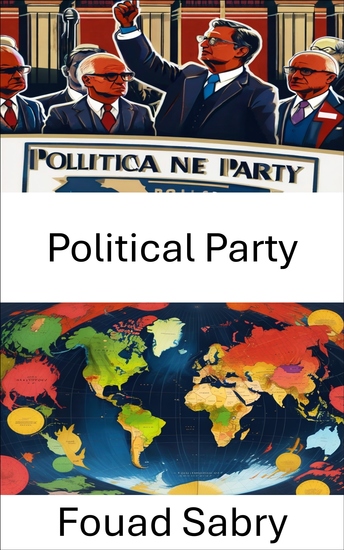
Political Party - Dynamic Strategies in Modern Governance - cover

Political Party - Dynamic Strategies in Modern Governance

Fouad Sabry

Publisher: One Billion Knowledgeable

  • 0
  • 0
  • 0

Summary

Political Party provides a comprehensive analysis of political parties, highlighting their crucial roles in shaping democracies, ideologies, and electoral processes across the globe. This book is essential for professionals, students, and enthusiasts seeking to understand the profound impact of political parties on modern governance.
 
Chapters Overviews:
 
1: Defines what a political party is and its role in policy shaping across political systems.
 
2: Explores how political parties contribute to democracy by fostering electoral competition and civic participation.
 
3: Examines how political parties ensure transparency and accountability in government.
 
4: Analyzes the influence of populist movements within political parties and their impact on governance.
 
5: Explores centrist ideologies in political parties, focusing on the Third Way approach.
 
6: Discusses political polarization and its effects on governance and societal unity.
 
7: Investigates illiberal trends within democratic parties and their challenges to liberal norms.
 
8: Offers insights into China's political party dynamics within its authoritarian framework.
 
9: Explores polyarchy as a democratic model with competing political parties.
 
10: Analyzes Cuba's electoral processes under socialism, contrasting with democratic systems.
 
11: Focuses on liberal democratic parties and their promotion of individual rights and rule of law.
 
12: Surveys political ideologies within U.S. political parties, examining their historical and modern significance.
 
13: Examines global efforts to promote democracy through political parties and governments.
 
14: Investigates how authoritarian political parties maintain power, contrasting with democratic principles.
 
15: Analyzes the instability of anocratic systems that mix democracy and authoritarianism.
 
16: Examines hybrid regimes blending democratic and authoritarian elements within political parties.
 
17: Focuses on center-left political parties and their role in modern governance.
 
18: Explores anti-political movements challenging traditional parties and their effects on democratic engagement.
 
19: Investigates democratic backsliding caused by political parties that erode democratic norms.
 
20: Analyzes how techno-populism is reshaping political parties' strategies and governance models.
 
21: Provides an in-depth analysis of political polarization in the U.S., examining its causes and implications.
 
This well-researched volume gives readers a thorough understanding of the complex dynamics of political parties, offering critical insights into how they shape global governance. For anyone invested in the modern political landscape, Political Party is a vital resource that transcends basic knowledge, offering an in-depth exploration necessary for navigating today’s political environment.
Available since: 10/02/2024.
Print length: 263 pages.

Other books that might interest you

  • Corporations Are Not People - Reclaiming Democracy from Big Money and Global Corporations (2nd Edition) - cover

    Corporations Are Not People -...

    Jeffrey D. Clements, Bill Myers

    • 0
    • 0
    • 0
    A revised and updated edition of the definitive guide to overturning Citizens United. 


    Since the Supreme Court's Citizens United ruling that the rights of things—money and corporations—matter more than the rights of people, America has faced a crisis of democracy. In this timely and thoroughly updated second edition, Jeff Clements describes the strange history of this bizarre ruling, its ongoing destructive effects, and the growing movement to reverse it. 


    He includes a new chapter, "Do Something!," showing how—state by state and community by community—Americans are using creative strategies and tools to renew democracy and curb unbalanced corporate power. Since the first edition, sixteen states, one-hundred-sixty members of Congress, and five hundred cities and towns have called for a constitutional amendment to overturn Citizens United, and the list is growing. This is a fight we can win! 


    "More relevant than ever, this updated edition of Corporations Are Not People chronicles the remarkably vibrant, nationwide grassroots movement to 'get money out and voters in.' " —Katrina vanden Heuvel, Editor and Publisher, The Nation
    Show book
  • Korea - A New History of South and North - cover

    Korea - A New History of South...

    Victor Cha, Ramon Pacheco Pardo

    • 0
    • 0
    • 0
    A major new history of North and South Korea, from the late nineteenth century to the present day 


    Korea has a long, riveting history—it is also a divided nation. South Korea is a vibrant democracy, the tenth largest economy, and is home to a world-renowned culture. North Korea is ruled by the most authoritarian regime in the world, a poor country in a rich region, and is best known for the cult of personality surrounding the ruling Kim family. But both Koreas share a unique common history. 


    Victor Cha and Ramon Pacheco Pardo draw on decades of research to explore the history of modern Korea, from the late nineteenth century, Japanese occupation, and Cold War division to the present day. A small country caught amongst the world's largest powers—including China, Japan, Russia, and the United States—Korea's fate has been closely connected to its geography and the strength of its leadership and society. This comprehensive history sheds light on the evolving identities of the two Koreas, explaining the sharp differences between North and South, and prospects for unification.
    Show book
  • There Will be No Palestinian State - A Diary of a Negotiator in Palestine - cover

    There Will be No Palestinian...

    Ziyad Clot

    • 0
    • 0
    • 0
    "I bought an El Al ticket. Destination Ben Gourion airport. Tel Aviv. Israel. 60 years ago, my mother was born a few dozen kilometers away. In Haifa, Palestine.
    So begins the story of the "return" of Ziyad Clot, grandson of Palestinian exiles. In Ramallah, he accepted a position as legal advisor to the Palestine Liberation Organization (PLO) and became a negotiator, taking part in the talks that were to lead to the creation of the Palestinian state by the end of 2008. But he soon came to terms with the obvious: "The peace process is a spectacle, a farce, played out at the expense of Palestinian reconciliation, at the cost of bloodshed in Gaza. And despite myself, I'm becoming one of the actors in this drama.”
    The author plunges us into the heart of the peace process, revealing the pretenses, behind-the-scenes maneuvers of the parties and the internal and international rivalries that help fuel the fantasy of a two-state solution. This edifying account, steeped in personal history, shows how and why negotiations to create a Palestinian state came to nothing. For the former negotiator, a peaceful solution to the conflict can only be found through a single state in which Palestinians and Israelis will have to live together. This hybrid country, "Israeltine," is already here.
    Show book
  • Common Sense - cover

    Common Sense

    Thomas Paine

    • 0
    • 0
    • 0
    The explosive essay that sparked a revolution.
    
    When Common Sense hit the streets in 1776, it ignited the American colonies like never before. With bold, plain-spoken language, Thomas Paine challenged the authority of the British monarchy and made the urgent case for American independence. More than just a political argument, this short but powerful work gave everyday people the words to demand freedom—and the courage to fight for it.
    
    Radical, rebellious, and razor-sharp, Common Sense remains a landmark of political writing. Its message still resonates today: real change begins when ordinary people dare to speak truth to power.
    Show book
  • The Hidden Face of Pope Francis - cover

    The Hidden Face of Pope Francis

    Paul Ariès

    • 0
    • 0
    • 0
    Why did Pope Francis canonize a priest responsible for the genocide of the Indians?
    Why does he wish to beatify the anti-Semitic French priest, Leon Dehon?  
    What are the unmentionable reasons for his papal election? 
    Pope Francis is presented as progressive and sensitive to the interests of the people, but underneath his smiles and his good words hides an authoritarian and dogmatic pope. This pope relies on very conservative movements such as Communion and Liberation or the Order of the Knights of Columbus, which are close to Opus Dei. 
    The good Pope Francis is beginning to drop his mask when he declares that Europe is undergoing a new Arab invasion (sic), when he calls on "Catholics with a sense of identity" to take to the streets, when he fights against republican secularism and demonizes atheists.
    After an overview of the financial, political and sexual scandals, Paul Ariès proceeds to a very detailed and documented analysis of the "Church of Francis," particularly in the areas of ecology and sexuality. This clear book offers a surprising insight into the best communicator the Church has known in a long time.
    Show book
  • Repeat - A Warning from History - cover

    Repeat - A Warning from History

    Dennis Glover

    • 0
    • 0
    • 0
    Are we seeing history repeat itself?
    An urgent, surprising and altogether persuasive read, Repeat: A Warning from History will open your eyes.
    We live in an age that seems eerily familiar. A time of dictators, populists, organised lying, European wars, grabs for territory, ideological extremism and antisemitism. A time when things are falling apart and the centre is struggling to hold. The insurrection on the Capitol in January 2021 evoked chilling memories of the calamity of Hitler in the 1920s and 30s. The world needs to learn the lessons of these decades, and fast. Dennis Glover retells the story of the interwar years in a series of lessons drawn from unfolding events and the unheeded omens of those who spoke out but were ignored.
    Show book