Unisciti a noi in un viaggio nel mondo dei libri!
Aggiungi questo libro allo scaffale
Grey
Scrivi un nuovo commento Default profile 50px
Grey
Iscriviti per leggere l'intero libro o leggi le prime pagine gratuitamente!
All characters reduced
Patrimonialism - How Elite Power Shapes Governance and Society - cover

Patrimonialism - How Elite Power Shapes Governance and Society

Fouad Sabry

Casa editrice: One Billion Knowledgeable

  • 0
  • 0
  • 0

Sinossi

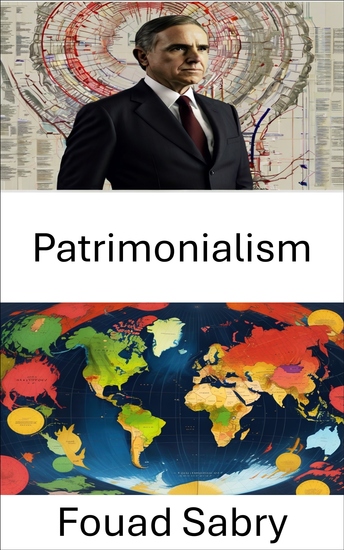
Dive into Patrimonialism, a deep dive into patrimonial governance in political science. This book reveals how personal loyalty and family ties shape power and governance, impacting political systems and state structures. A vital resource for professionals, students, and enthusiasts, it offers a thorough understanding of political authority and its many variations.
 
Chapters Brief Overviews:
 
1: Patrimonialism: Explores how political power is tied to personal loyalties and family connections.
 
2: Neopatrimonialism: Examines how modern states blend traditional patrimonial elements.
 
3: Tripartite Classification of Authority: Details authority types and their influence on political structures.
 
4: Traditional Authority: Discusses the role of traditional authority in sustaining patrimonialism.
 
5: Politics (Aristotle): Connects Aristotle’s political theories to patrimonial governance.
 
6: First Brazilian Republic: Analyzes the influence of patrimonialism in the First Brazilian Republic.
 
7: Kleptocracy: Explores how kleptocracy and patrimonialism reinforce each other.
 
8: Sultanism: Examines Sultanism’s characteristics within patrimonial governance.
 
9: Tsarist Autocracy: Discusses Tsarist autocracy as a model of patrimonialism.
 
10: Despotism: Explores how despotism reflects patrimonial principles.
 
11: Government: Provides an overview of government structures interacting with patrimonialism.
 
12: Monarchy: Explores the intersection between monarchy and patrimonialism.
 
13: Oligarchy: Examines how oligarchies align with patrimonial governance.
 
14: Republic: Analyzes the relationship between republics and patrimonial practices.
 
15: Aristocracy: Discusses the reflection of patrimonial values in aristocratic systems.
 
16: Autocracy: Explores how autocratic rule embodies patrimonial governance.
 
17: Political System: Analyzes how different political systems interact with patrimonialism.
 
18: List of Forms of Government: Reviews forms of government that display patrimonial traits.
 
19: Diarchy: Discusses dual leadership systems with patrimonial elements.
 
20: Emperor of Russia: Examines how the Russian Emperor exemplified patrimonial rule.
 
21: Conservatism in Russia: Explores the link between conservatism and patrimonial governance in Russia.
 
Patrimonialism offers crucial insights into the relationship between personal loyalty and political power. Through case studies and analysis, it sheds light on the mechanisms of governance, making it an indispensable resource.
Disponibile da: 30/09/2024.
Lunghezza di stampa: 229 pagine.

Altri libri che potrebbero interessarti

  • Today Hong Kong Tomorrow the World - What China's Crackdown Reveals About Its Plans to End Freedom Everywhere - cover

    Today Hong Kong Tomorrow the...

    Mark L. Clifford

    • 0
    • 0
    • 0
    For 150 years as a British colony, Hong Kong was a beacon of prosperity where people, money, and technology flowed freely, and residents enjoyed many civil liberties. In preparation for handing the territory over to China in 1997, Deng Xiaoping promised that it would remain highly autonomous for fifty years. An international treaty established a Special Administrative Region (SAR) with a far freer political system than that of Communist China. 


    But as the halfway mark of the SAR's lifespan approaches in 2022, it is clear that China has not kept its word. Universal suffrage and free elections have not been instituted, harassment and brutality have become normalized, and activists are being jailed en masse. This tragic backslide has dire worldwide implications. 


    Today Hong Kong, Tomorrow the World tells the complete story of how a city once famed for protests so peaceful that toddlers joined grandparents became a place where police have fired tear gas, rubber bullets and even live ammunition at their neighbors, while pro-government hooligans attack demonstrators. A Hong Kong resident from 1992 to 2021, author Mark L. Clifford has witnessed this transformation firsthand. A powerful and dramatic mix of history and on-the-ground reporting, this book is the definitive account of one of the most important geopolitical standoffs of our time.
    Mostra libro
  • The Golden Verses of Pythagoras - cover

    The Golden Verses of Pythagoras

    Florence Firth

    • 0
    • 0
    • 0
    In this small volume an attempt has been made to gather together the best and most reliable of the sets of Ethical Verses attributed to the Pythagoreans.Both Hall's translation from the Greek (1657), and Rowe's translation from the French of André Dacier (1707), have been used in reproducing the Golden Verses of Pythagoras, but Dacier's version has been almost exclusively followed, being clearer and more intelligible.The Golden Sentences of Democrates, the Similitudes of Demophilus, and Pythagorean Symbols are from Bridgman's translation, and are to be found in his little book, Translations from the Greek, published in 1804. The Pythagorean Sentences of Demophilus, translated by Taylor, are contained in that volume also.The remaining sets of verses, translated by Taylor, are appended by him to his Iamblichus' Life of Pythagoras, published in 1818.
    Mostra libro
  • Life on the Frontlines: Summary & analysis - cover

    Life on the Frontlines: Summary...

    Alexander Pike

    • 0
    • 0
    • 0
    This content is an independent and unofficial summary created for informational and educational purposes only. It is not affiliated with, authorized, approved, licensed, or endorsed by the original author or publisher. All rights to the original work belong to its respective copyright holders. This summary is not intended to substitute the original book, but to offer a concise overview and interpretation of its main ideas. 
     
    Life on the Frontlines plunges listeners into the heart of conflict, where chaos meets courage and survival becomes a daily act of defiance. Through vivid storytelling and raw, firsthand perspectives, this audiobook captures the brutal realities and quiet heroics of those who live—and fight—where the world is most fragile. 
    More than a chronicle of war, it’s a portrait of humanity under pressure: the brotherhood forged in battle, the moments of grace amid devastation, and the resilience that rises when everything else falls away. Each chapter is a powerful testament to endurance, duty, and the unspoken cost of holding the line. 
    Intense, intimate, and unforgettable, Life on the Frontlines is perfect for listeners drawn to stories of sacrifice, strength, and the unyielding will to persevere.
    Mostra libro
  • Robert E Lee’s Greatest Victories - cover

    Robert E Lee’s Greatest Victories

    Editors Charles River

    • 0
    • 0
    • 0
    After Lee succeeded the wounded Johnston, he pushed McClellan’s Army of the Potomac away from Richmond and back up the Peninsula in late June, only to then swing his army north to face a second Union army, John Pope’s Army of Virginia. Needing to strike out before the Army of the Potomac successfully sailed back to Washington and linked up with Pope’s army, Lee daringly split his army to threaten Pope’s supply lines, forcing Pope to fall back to Manassas to protect his flank and maintain his lines of communication. At the same time, it left half of Lee’s army (under Stonewall Jackson) potentially exposed against the larger Union army until the other wing (under James Longstreet) linked back up. Thus, in late August 1862, the Army of Northern Virginia and the Army of Virginia found themselves fighting over nearly the exact same land the South and North fought over in the First Battle of Bull Run 13 months earlier.  
    Of all the Civil War battles fought, and of all the victories achieved by Robert E. Lee at the command of the Confederate Army of Northern Virginia, the Battle of Chancellorsville is considered the most tactically complex and ultimately the most brilliant Confederate victory of the war. In early May 1863, the Army of the Potomac was at the height of its power as it bore down on Robert E. Lee’s Army of Northern Virginia near Fredericksburg, where the Confederates had defeated them the previous December. The Union behemoth had spent most of the winter season being reorganized and drilled by “Fighting Joe” Hooker, an aggressive commander who had fought hard at places like Antietam. With an army nearing 130,000 men, Hooker’s Army of the Potomac was twice the size of the Army of Northern Virginia. Lee’s heavily outnumbered army went on to win the most stunning victory of the war, but it cost them nearly 25% of their men and Stonewall Jackson.
    Mostra libro
  • Private Government - How Employers Rule Our Lives (and Why We Don't Talk about It) - cover

    Private Government - How...

    Elizabeth Anderson

    • 0
    • 0
    • 0
    Why our workplaces are authoritarian private governments—and why we can't see it 


    One in four American workers says their workplace is a "dictatorship." Yet that number almost certainly would be higher if we recognized employers for what they are—private governments with sweeping authoritarian power over our lives. Many employers minutely regulate workers' speech, clothing, and manners on the job, and employers often extend their authority to the off-duty lives of workers, who can be fired for their political speech, recreational activities, diet, and almost anything else employers care to govern. In this compelling book, Elizabeth Anderson examines why, despite all this, we continue to talk as if free markets make workers free, and she proposes a better way to think about the workplace, opening up space for discovering how workers can enjoy real freedom.
    Mostra libro
  • The Golden Age Returned - cover

    The Golden Age Returned

    Robert D. Jones, Arthur Edward...

    • 0
    • 0
    • 0
    The Golden Age Restored is a stunning piece of alchemical work that is vivid in its descriptions and a Jungian utopia for dream analysis and analogy of the individuation process.Originally written in 1622 by a German physician and alchemist under the pseudonym Henry Madathanas, The Golden Age Restored was published publically in the Musaeum Hermeticum (1625) and later translated into English by Arthur Edward Waite in his work The Hermetic Museum, Vol. I (1893). Waite's version of the text has been diligently edited by Jones so that it can be easily digested by modern readers.Jones has also included a foreword introducing the text and diligently footnoted the work to give meaning and context to the original writing.
    Mostra libro