Join us on a literary world trip!
Add this book to bookshelf
Grey
Write a new comment Default profile 50px
Grey
Subscribe to read the full book or read the first pages for free!
All characters reduced
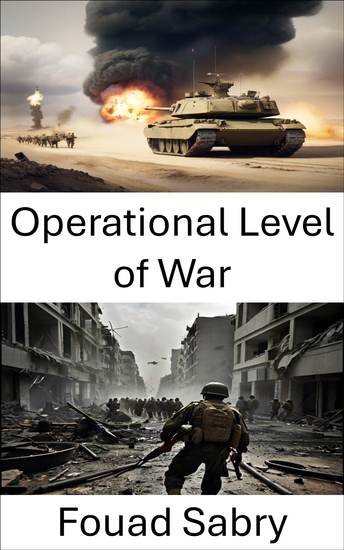
Operational Level of War - Strategic Chess Navigating the Battlefield from A to Z - cover

Operational Level of War - Strategic Chess Navigating the Battlefield from A to Z

Fouad Sabry

Publisher: One Billion Knowledgeable

  • 0
  • 0
  • 0

Summary

What is Operational Level of War
 
In the field of military theory, the operational level of war represents the level of command that connects the details of tactics with the goals of strategy.
 
How you will benefit
 
(I) Insights, and validations about the following topics:
 
Chapter 1: Operational level of war
 
Chapter 2: Blitzkrieg
 
Chapter 3: On War
 
Chapter 4: Military science
 
Chapter 5: Military strategy
 
Chapter 6: Military
 
Chapter 7: Military doctrine
 
Chapter 8: Military operation
 
Chapter 9: AirLand Battle
 
Chapter 10: Maneuver warfare
 
(II) Answering the public top questions about operational level of war.
 
Who this book is for
 
Professionals, undergraduate and graduate students, enthusiasts, hobbyists, and those who want to go beyond basic knowledge or information for any kind of Operational Level of War.
Available since: 05/31/2024.
Print length: 142 pages.

Other books that might interest you

  • Claudius - The Successful Roman Emperor Who Had Cerebral Palsy - cover

    Claudius - The Successful Roman...

    Kelly Mass

    • 0
    • 0
    • 0
    Tiberius Claudius Caesar Augustus Germanicus, better known as Emperor Claudius, ruled the Roman Empire from 41 to 54 AD. Born in Lugdunum (modern-day Lyon, France), in 10 BC, Claudius was the son of Drusus and Antonia Minor, both prominent figures in the Roman elite. His birthplace marked a significant departure from previous emperors, as he was the first Roman Emperor born outside Italy. Though Claudius’ family was rooted in the ancient Sabine people, his upbringing would not follow the traditional path of an elite Roman, largely due to his physical infirmities. He suffered from a limp and mild deafness, conditions that led his family to deem him unfit for public life and dismiss him from military and political endeavors. 
    Growing up in the shadows of more capable and ambitious relatives, Claudius was largely ignored by the Roman aristocracy. His health issues, though perhaps a result of childhood illness, kept him out of sight and out of mind during the brutal purges of Tiberius and Caligula. This absence from political life proved advantageous, as it spared him the many assassination attempts that claimed the lives of his more prominent family members. In a twist of fate, following the assassination of Caligula in 41 AD, the Praetorian Guard, upon finding him hiding in fear, declared Claudius the new emperor. As the only remaining adult male in his family, Claudius ascended to the throne, despite his perceived weakness. 
    Despite initial doubts about his ability to rule, Claudius quickly proved to be a capable and intelligent administrator. He worked tirelessly to stabilize the Roman Empire, which had suffered under the excesses of Caligula’s reign. One of his first actions was to restore the empire’s finances, expanding the imperial bureaucracy to include freedmen, and re-establishing order in the imperial administration.
    Show book
  • Dhoya - From their pens to your ears genius in every story - cover

    Dhoya - From their pens to your...

    W B Yeats

    • 0
    • 0
    • 0
    William Butler Yeats was born in Sandymount in County Dublin, Ireland on 13th June 1865. 
    His early years moved between Ireland and England. By his mid-teens he was writing but those works were described as ‘entirely Un-Irish’.  With Ernest Rhys he founded the Rhymers Club. Based at Ye Olde Cheshire Cheese in Fleet Street it’s best described as a drinking club for performing poets.  Yeats later cited them as ‘The Tragic Generation’.  By now Yeats was writing and publishing poetry and stories that were profoundly based in Irish folklore.   
    Yeats is perhaps best described as Ireland’s national poet in addition to being one of the major twentieth-century literary figures of the English tongue. He represents the ‘Romantic poet of modernism,’ with an extraordinary style created from the outward emphasis on the expression of emotions and the extensive use of symbolism, imagery and allusions.  
    In 1923 his fame was brought to an even wider audience when he received the Nobel Prize in Literature.  
    His personal life was driven by his many relationships in love and by his great interest in oriental mysticism and occultism.  Yeats also wrote prose and drama and, as an ardent Nationalist, established himself as a spokesman of the Irish cause and served as an Irish senator for two terms.  
    W B Yeats died at the Hôtel Idéal Séjour, in Menton, France, on 28th January 1939.  He was 73.
    Show book
  • KNOW ABOUT "Adi Shankaracharya" - A Great Indian Philosopher Theologian & Reformer - cover

    KNOW ABOUT "Adi Shankaracharya"...

    Saurabh Singh Chauhan

    • 0
    • 0
    • 0
    This is small part of the introduction of the book: Welcome to the extraordinary journey through the life and legacy of one of India's greatest philosophers, theologians, and reformers - Adi Shankaracharya. In this book, we will explore the remarkable story of a man who, more than a millennium ago, left an indelible mark on Indian philosophy, spirituality, and culture. 
    Adi Shankaracharya, often referred to simply as Shankara, was a luminary of the 8th century CE. His teachings and profound insights into the nature of reality continue to influence countless minds, transcending the boundaries of time and geography. But who was Adi Shankaracharya, and why does his legacy endure? To answer these questions, we'll embark on a journey that takes us from his humble beginnings in the village of Kaladi to the far reaches of India and even to the sacred heights of Kailash. 
    We'll delve into the key events of his life, from his early education in the Vedic scriptures to his decision to renounce worldly life and become a monk. We'll follow him on his travels across the length and breadth of India as he spread his teachings, engaged in philosophical debates, and founded monastic institutions.
    Show book
  • Pickleball For All - Everything but the ""Kitchen"" Sink - cover

    Pickleball For All - Everything...

    Rachel Simon

    • 0
    • 0
    • 0
    An entertaining and comprehensive look at the America’s fastest growing sport, Pickleball for All is the ultimate primer for any level of player interested in the wacky history, unique rules, and exciting future of pickleball.  
    Bainbridge Island, Washington State. On a sleepy summer vacation, three dads with bored kids started a game with handmade equipment and rules that were even more hastily constructed. Pickleball—an accessible and engaging combination of sports like ping-pong and tennis—was born, and a rich history began to take shape. Fifty years later, as the COVID-19 pandemic forced the world to quarantine and hunt for new activities, Americans of all ages and athletic ability discovered pickleball, turning to the rapidly growing phenomenon as a way to stay active, safe, and entertained. With its unique rules, wacky terminology, and inclusive gameplay, pickleball caught the attention of the likes of the Kardashians, Bill and Melinda Gates, and Leonardo DiCaprio, and quickly became the world’s fastest growing sport with Olympic games potential.Few have followed pickleball’s ascent in American life as closely as New York Times writer and pickleball enthusiast Rachel Simon. Now Simon shares her fascination with the world in this lively, energetic primer for anyone wondering what in the world a dink is or why their neighbors have had a net up in their driveway since May 2020. From the history of the game to the basic rules (hint: you do not want to be caught in the “kitchen” during a volley), Simon offers a complete overview for casual and expert players alike. With easy-to-follow steps and expert advice, readers will learn everything they need to know, including information like: Where and how to set up a courtScoring, gameplay, and equipmentStrategies to win at any skill levelThe difference between a dink, a drive, and a drop shot 
    In addition, Simon weaves in inspiring stories from the world’s top players during their most exciting pickleball moments. An immersive look at a global phenomenon that’s only gaining momentum, Pickleball for All paints a vivid portrait of a new American pastime.  
    Supplemental enhancement PDF accompanies the audiobook.
    Show book
  • Summary of Jonathan Karl’s Betrayal - cover

    Summary of Jonathan Karl’s Betrayal

    Falcon Press

    • 0
    • 0
    • 0
    Buy now to get the main key ideas from Jonathan Karl’s Betrayal 
      
    Donald Trump, the forty-fifth president of the United States, is regarded as one of the most influential but chaotic presidents in history. What was his downfall really like? 
    Political journalist Jonathan Karl wrote Betrayal as a documentation of Trump’s final days as president. He knew Trump better than any other reporter in the White House, and had a front-row seat to the final showdown of his presidency. Karl details the events leading up to the 2020 election and subsequent attack on the US Capitol by angry Trump supporters on January 6, 2021. From crazy loyal personnel to alleged treachery, Karl explores it all. 
     
    Show book
  • A Painful case - From their pens to your ears genius in every story - cover

    A Painful case - From their pens...

    James Joyce

    • 0
    • 0
    • 0
    James Augustine Aloysius Joyce was born on the 2nd February 1882 in Dublin into a middle-class family, and the eldest of ten surviving siblings 
    Admired as a brilliant student he briefly attended the Christian Brothers-run O'Connell School before excelling at the Jesuit schools of Clongowes and Belvedere.  From there he went on to attend University College Dublin from 1898, studying English, French and Italian 
    In 1902, Joyce was now in his early twenties, and went to Paris to study Medicine but soon abandoned his teachings.  Back in Dublin to attend to his dying Mother he met Nora Barnacle. They bonded immediately into a life-long match. Together they decided to emigrate to Europe.  The couple lived in Trieste, Rome, Paris, and finally Zürich where Joyce pursued a variety of jobs and ventures to supplement his literary pursuits but none of these paid off.  
    After publishing a poetry volume, ‘Chamber Music’, in 1907, his short story collection ‘The Dubliners’, in 1914, helped establish his talent in the rapidly changing world.  
    Although far from home Joyce’s literary heart and works were set in his recollections of Dublin.  Characters are close resemblances of family and friends and indeed enemies.  His landmark work ‘Ulysses’, published in 1922, is set in the streets and alleyways of the city as it parallels Homer’s Odyssey in a variety of styles including its famed stream of consciousness. 
    His pen continued to produce classics of the order of ‘A Portrait of the Artist as A Young Man’ and ‘Finnegan’s Wake’ together with several volumes of poetry and a play ‘The Exiles, in 1918.   
    On the 11th January 1941, Joyce underwent surgery in Zürich for a perforated duodenal ulcer. The next day he fell into a coma. On the 13th after a brief period of lucidity in which he called for his wife and son he passed.  He was 58.
    Show book