Unisciti a noi in un viaggio nel mondo dei libri!
Aggiungi questo libro allo scaffale
Grey
Scrivi un nuovo commento Default profile 50px
Grey
Iscriviti per leggere l'intero libro o leggi le prime pagine gratuitamente!
All characters reduced
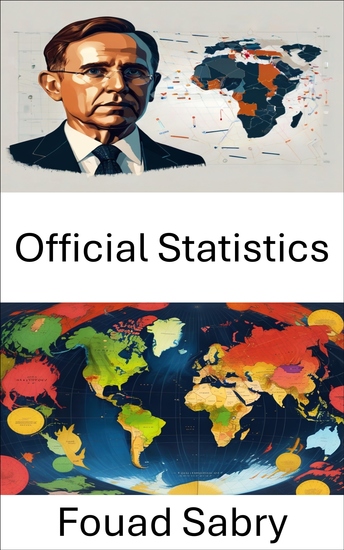
Official Statistics - Analyzing Data Trends for Informed Governance - cover

Official Statistics - Analyzing Data Trends for Informed Governance

Fouad Sabry

Casa editrice: One Billion Knowledgeable

  • 0
  • 0
  • 0

Sinossi

"Official Statistics" is a must-read for anyone in political science and governance, offering a deep dive into how official statistical methods influence policy-making, governance, and public perception. Through exploring data collection and dissemination, the book highlights the pivotal role of statistics in shaping political dynamics and guiding critical decisions.
 
Chapters Overview:
 
1. Official Statistics: Introduction to key concepts and methodologies in official statistics and their importance in political science.
 
2. Census: Examines the role of national censuses in shaping policy decisions and public services.
 
3. United Nations Economic Commission for Europe: Discusses the UN's efforts in harmonizing statistical practices across Europe to improve data quality and comparability.
 
4. Statistics Canada: Explores how Canadian statistics support evidence-based policy.
 
5. Hellenic Statistical Authority: Highlights Greece’s contributions to national and European data systems.
 
6. Economic Data: Discusses how economic data informs fiscal and monetary policies.
 
7. Economic Statistics: Covers key economic indicators like GDP and inflation rates and their role in policy-making.
 
8. Statistics Belgium: Insight into Belgium’s statistical practices in a federal system.
 
9. Statistics New Zealand: Explores how New Zealand uses statistics to drive policy in a diverse context.
 
10. American Community Survey: Discusses its role in providing detailed demographic data for U.S. policy.
 
11. National Institute of Statistics and Census of Argentina: Highlights challenges in Argentina’s data collection and analysis.
 
12. Philippine Statistics Authority: Discusses innovations and challenges in the Philippines’ statistical system.
 
13. Statistics Denmark: Examines Denmark’s use of data in public policy.
 
14. Pollutant Release and Transfer Register: Focuses on environmental statistics and their role in policy.
 
15. Ministry of Statistics and Programme Implementation (India): Details how statistics support development in India.
 
16. Census and Statistics Department (Hong Kong): Explores Hong Kong’s unique statistical practices.
 
17. Statistics Botswana: Discusses Botswana’s use of data in national development.
 
18. Data Dissemination: Examines the importance of accessible data for transparency.
 
19. Statistical Disclosure Control: Covers techniques for balancing data confidentiality and utility.
 
20. Indian Statistical Service: Discusses the role of the Indian Statistical Service in government functions.
 
21. Five Safes: Introduces a framework for managing and sharing data securely.
 
This book offers essential insights and practical examples for understanding the impact of statistics on political science, making it a vital resource for professionals, students, and enthusiasts in the field.
Disponibile da: 08/08/2024.
Lunghezza di stampa: 218 pagine.
Altri libri che potrebbero interessarti

  • The Encyclopedia of Out of Place Artifacts - cover

    The Encyclopedia of Out of Place...

    Martin Ettington

    • 0
    • 0
    • 0
    Out of Place Artifacts is a fascinating subject. There are too many of these unusual objects for them to be fakes. I’ve already written several books on this subject including “Strange Objects Which Should Not Exist”, “More Out of Place Objects”, and “A 300 Million Year Old Civilization Existed on Earth”.In this book I’ve compiled everything I could find out about these unusual finds from my prior three books and additional research. 54 artifacts are covered in detail.I’ve included all of this information except that specifically related to Aliens and UFOs since that information is in my books on those topics.The information here is presented in five parts:Part A: Artifacts Found in Historical TimesPart B: Very Ancient Objects to Millions of Years OldPart C: A Civilization 300 Million Years AgoPart D:  Human Footprints in RockPart E: Artifacts of Undetermined AgesI hope you find all of this information as interesting as I do since it changes our understanding of the history of our planet in incredible ways.
    Mostra libro
  • Byline - How Local Journalists Can Improve the Global News Industry and Change the World - cover

    Byline - How Local Journalists...

    Cristi Hegranes

    • 0
    • 0
    • 0
    International journalism needs a new paradigm, and this is the moment to forge one. In the wake of the pandemic and ongoing racial and environmental justice movements, news consumers are demanding better stories. International coverage prioritizes disasters and victim-centered narratives, ignores huge chunks of the world, and relies on outdated stereotypes. This kind of news reinforces the distrust people feel for the news.The solution, as Cristi Hegranes details throughout this book, lies with local journalists who live in the communities at the center of the stories. They can tell the accurate, precise, compelling stories readers across the world are desperate to read.By changing the mindset around who covers the news and how people in that coverage are depicted, Hegranes charts a path the entire industry can follow back to build trust, authority, and great er success.
    Mostra libro
  • The Fathers of the Soviet Union - cover

    The Fathers of the Soviet Union

    Editors Charles River

    • 0
    • 0
    • 0
    Among the leaders of the 20th century, arguably none shaped the course of history as much as Vladimir Lenin (1870-1942), the Communist revolutionary and political theorist who led the Bolshevik Revolution that established the Soviet Union. In addition to shaping the Marxist-Leninist political thought that steered Soviet ideology, he was the first Soviet premier until his death and set the Soviet Union on its way to becoming one of the world’s two superpowers for most of the century, in addition to being the West’s Cold War adversary. 
    As it turned out, the creation of the Soviet Union came near the end of Lenin’s life, as he worked so hard that he had burned himself out by his 50s, dying in 1924 after a series of strokes had completely debilitated him. In the initial aftermath of Lenin’s death, Trotsky had been his ally’s heir apparent, and for those inclined to believe the Soviet experiment had started promisingly but gone astray, Trotsky became the embodiment of the betrayed promise of the early Bolshevik revolution. There were certain ironies in this widespread sympathetic interpretation of Trotsky’s legacy, because Trotsky had overseen and spearheaded campaigns of persecution against Russians suspected of “counterrevolutionary” leanings, and he had written a long tract defending these “terroristic” measures as necessary safeguards of the revolution. 
    Near the end of his life, Lenin expressly stated that the regime's power should not be put in the hands of the current General Secretary of the Communist Party, Joseph Stalin. Of course, Stalin managed to do just that, modernizing the Soviet Union at a breakneck pace on the backs of millions of poor laborers and prisoners. If Adolf Hitler had not inflicted the devastation of World War II upon Europe, it’s quite likely that the West would consider Stalin (1878-1953) the 20th century’s greatest tyrant.
    Mostra libro
  • This is Europe - The Way We Live Now - cover

    This is Europe - The Way We Live...

    Ben Judah

    • 0
    • 0
    • 0
    A Times, Financial Times and Telegraph Book of the Year 2023'Illuminates some of the great trends of our time' - Gideon Rachman, Financial Times'Vivid, urgent and unsettling' - Tom Holland, author of Dominion_____What does it now mean to call yourself European? Who makes up this population of some 750 million, sprawled from Ireland to Ukraine, from Sweden to Turkey? Who has always called it home, and who has newly arrived from elsewhere? Who are the people who drive our long-distance lorries, steward our criss-crossing planes, lovingly craft our legacy wines, fish our depleted waters, and risk life itself in search of safety and a new start?In a series of vivid but always empathetic portraits of other people’s lives, journalist Ben Judah invites us to meet them. Drawn from hours of painstaking interviews, these vital stories reveal a vibrant continent which has been transformed by diversity, migration, the internet, climate change, Covid, war and the quest for freedom.Laid dramatically bare, it may not always be a Europe we recognize – but this is Europe._____'An astonishing achievement' - Evening Standard'Brilliantly told . . . highly readable' - The Times
    Mostra libro
  • How Media Ownership Matters - cover

    How Media Ownership Matters

    Rodney Benson, Julie Sedel,...

    • 0
    • 0
    • 0
    Does it matter who owns and funds the media? As journalists and management consultants set off in search of new business models, there's a pressing need to understand anew the economic underpinnings of journalism and its role in democratic societies. 


    How Media Ownership Matters provides a fresh approach to understanding news media power, moving beyond the typical emphasis on market concentration or media moguls. Through a comparative analysis of the US, Sweden, and France, as well as interviews of news executives and editors and an original collection of industry data, this book maps and analyzes four ownership models: market, private, civil society, and public. Highlighting the effects of organizational logics, funding, and target audiences on the content of news, the authors identify both the strengths and weaknesses various forms of ownership have in facilitating journalism that meets the democratic ideals of reasoned, critical, and inclusive public debate. Ultimately, How Media Ownership Matters provides a roadmap to understanding how variable forms of ownership are shaping the future of journalism and democracy.
    Mostra libro
  • Hygiene in World History - cover

    Hygiene in World History

    Peter N. Stearns

    • 0
    • 0
    • 0
    This book features a global, historical analysis of the changes and continuities in one of society's basic functions: seeking to protect itself from disease. 
     
    Hygiene offers an important lens for major aspects of world and comparative history. The volume explores the ways different regions and major religions approached hygiene both before modern times and through the present with the more recent uses of germ theory. Topics in "premodern" hygiene include toilet practices, remarkably varied views about bathing, and different levels of commitment to investments in hygiene infrastructure. The "sanitary revolution" of the nineteenth and twentieth centuries forms a major dividing line in the book, including the variations introduced by developments like colonialism or communism and various forms of resistance to "modern" hygiene. The book links current, often bitter, debates about hygiene, around practices such as masking, both to the larger history and to recent issues like COVID-19. 
     
    Hygiene in World History is an accessible overview aimed at undergraduate and non-specialist listeners interested in world history, public health, and the history of health and disease.
    Mostra libro